Tag: gold investment

  • Stop Selling, Start Guiding: Why the Smartest Advisors Now Act More Like Therapists

    Money is emotional.
    We hate admitting it but it is.

    No one checks their portfolio and says, “Hmm, this fund’s alpha looks weak.”
    They say, “Why is everything falling again?”

    And that’s the real problem with how financial advice still works today.

    The Old Way: Sell First, Talk Later

    Most advisors still think their job is to recommend products the “right” mutual fund, the “best” ULIP, or that “exclusive” PMS.
    But here’s the truth: people rarely lose money because they picked the wrong product.
    They lose money because they reacted wrong.

    When markets fall, fear kicks in.
    When everyone else is making money, greed follows.

    That’s not a finance problem.
    That’s a psychological problem.

    And yet, the industry keeps rewarding the ones who sell more, not the ones who guide better.

    Investors Don’t Need a Distributor ,They Need a Decoding Partner

    The most successful advisors today aren’t the loudest sellers.
    They’re the ones who understand how people think, feel, and panic about money.

    They don’t throw ten product brochures at you.
    They ask, “What makes you anxious about your finances?”

    Because, whether we like it or not, money touches everything relationships, confidence, even sleep.
    So what’s the point of chasing returns if your client can’t sleep at night?

    The Numbers Back It Up

    Vanguard did a massive study to understand what actually drives investor outcomes and it wasn’t product selection.
    It was behaviour.
    Their Advisor’s Alpha research found that behavioural coaching alone adds up to 1.5%–2% in extra annual returns just by keeping clients calm, consistent, and invested when markets get messy.

    That’s nearly the same as the difference between an “average” and a “top-performing” fund.

    Go one step further, and the full advisor framework (behavioural coaching, rebalancing, cost management) adds around 3% in net returns per year pure alpha created by good guidance, not product picking.

    So yeah, empathy literally pays.

    Advisors as Financial Therapists

    Think about what a great therapist does:
    They listen. They help you understand your triggers. They stop you from making choices that hurt you long term.

    Now swap the word emotion with investment decision and that’s exactly what a great financial advisor should do.

    Instead of saying, “Let’s invest in this because it’s performing well,”
    they say, “Let’s talk about why you panic every time markets fall.”

    That’s not being soft.
    That’s being smart.

    Because when you manage behaviour, you automatically manage money better.

    Empathy Has an ROI

    Here’s what’s wild empathy isn’t just good for clients. It’s great for business.

    Advisors who focus on guiding rather than selling keep clients almost 50% longer, according to industry research.
    And retention pays increasing client retention by just 5% can boost profits by 25% to 95%.
    That’s because loyal clients invest more, stay longer, and refer more.

    It’s not about flashy returns it’s about emotional trust.

    And once you’ve built that, you’re no longer “one of many advisors.”
    You become the person they call before making any major financial decision.

    So What Needs to Change?

    If you’re an advisor, start here:

    • Listen more than you speak. People want to be heard before being advised.
    • Ask better questions. Not Where do you want to invest? But Why do you want to invest?
    • Redefine success. The best metric isn’t AUM growth it’s how calmly your clients sleep at night.

    And for investors?
    Stop looking for someone who promises the highest returns.
    Find someone who helps you stay sane when the markets don’t.

    The Future of Financial Advice Is Deeply Human

    AI and robo-advisors can already pick funds and rebalance portfolios faster than any human.
    But what they’ll never replace is trust.

    In fact, when Vanguard compared clients of robo-advisors vs. human advisors, people with human guidance believed their advisor added nearly 33% of their returns — compared to just 12% for robo platforms.

    That’s not about math. That’s about connection.

    AI can’t hear fear in your voice or calm you down after a bad quarter.
    That’s the human moat.

    Tomorrow’s top advisors won’t be product experts they’ll be behavioural translators.
    People who help you understand your relationship with money.
    People who stop you from making panic-driven mistakes that cost far more than any fee ever could.

    Final Thought

    Your advisor shouldn’t just be someone who sells you investments.
    They should be the person who helps you stay rational when your emotions want to take over.

    Because great advice isn’t about beating the market.
    It’s about understanding the person facing it.


  • 5 Life Lessons Every Software Engineer Learns the Hard Way (But You Don’t Have To)

    Intro: Code, Coffee, and the Curveballs

    You started with curiosity. A passion for building. Maybe you were the “tech guy” in your circle, or the quiet one who could fix anything.

    Fast forward to now: deadlines, burnout, Slack pings at 10pm, and a feeling that you’re not “growing fast enough.”

    Sound familiar?

    You’re not alone. Engineering is a high-growth, high-burn game. And with experience comes a few truths that nobody teaches in tutorials.

    Here are 5 life lessons most software engineers only learn after years in the trenches—with real examples, data, and emotional honesty.

    Lesson 1: Tech Changes Fast. But Fundamentals Stay.

    In 2010, PHP was everywhere. By 2016, React ruled. Now, it’s AI frameworks, Svelte, Astro, and edge computing.

    The cycle never stops.

    But what stays: problem-solving ability, clean architecture, and core CS concepts.

    Real Data:

    • A Stack Overflow 2023 Developer Survey found that engineers with strong CS fundamentals reported 22% higher salaries than peers who jumped tools without depth.

    Tip:

    • Learn one backend language deeply (Python, Go, etc.)
    • Master SQL. Understand system design.
    • Don’t just write code—understand why it works.

    Lesson 2: Burnout Is Not a Badge of Honor

    Late nights. Hero fixes. Weekend deployments.

    Sure, it feels good to be the go-to problem solver. Until you’re fried. Disconnected. Questioning everything.

    Real Talk:

    • A GitHub 2023 survey found 48% of devs reported burnout, with top reasons being unclear requirements, overwork, and lack of impact.

    Relatable Example:

    • Priya, a 30-year-old full-stack developer, quit her ₹35L job in Bengaluru to take a 6-month sabbatical after a mental breakdown. She later joined a startup with fewer hours, less pay—but a much happier life.

    What Works:

    • Use your leaves.
    • Push back on unreasonable timelines.
    • Therapy is normal. Meditation helps. Hobbies are essential.

    Lesson 3: Communication Beats Cleverness

    You wrote a brilliant piece of code. But if nobody can read it, maintain it, or understand why it exists—it’s not brilliant.

    Truth: The best engineers are teachers. They unblock teammates, document well, and align with product goals.

    Data Point:

    • Google’s internal study “Project Aristotle” showed that psychological safety and communication matter more than sheer IQ for high-performing teams.

    Tips:

    • Start writing better PR descriptions.
    • Talk to the QA team early.
    • Don’t be the silent genius. Be the helpful peer.

    Lesson 4: You Are Not Your Job Title

    Staff engineer. Principal developer. Lead architect.

    Sounds great. But titles shift. Startups fail. Teams reorg. One day you’re “senior,” next day you’re laid off.

    2023 Reality:

    • Amazon, Meta, Google all laid off senior engineers. Many of them had no backup plan.

    Mindset Shift:

    • Build your personal brand.
    • Grow your network on LinkedIn or Twitter.
    • Stay humble. Stay curious.

    Your value is more than your org chart.

    Lesson 5: Money Works When You Sleep (If You Let It)

    Most engineers start earning well young. But many never build wealth.

    Example:

    • Ankur, 26, started a ₹15K/month SIP in index funds in 2019. By 2024, he has ₹13.2L in investments. Meanwhile, his friend Rahul kept money in savings—₹9.1L.

    Difference: ₹4L+, and that’s just the beginning.

    Mini-Checklist:

    • Emergency fund (3-6 months of expenses)
    • Term life insurance
    • SIP in index or hybrid funds
    • Optional: ESOP strategy, RSUs, or real estate

    Build optionality. Buy time. That’s real freedom.

    Closing: From Coding to Crafting a Life

    Your engineering career isn’t just about writing better code.

    It’s about building a better life that includes growth, peace, clarity, and choice.

    Learn the lessons now, so you don’t have to learn them the hard way later.

    Keep building. Just don’t forget who you’re building it for.

  • 10-Year Investment Growth Analysis: Gold, Silver, and Nifty 50 (2014–2024)

    If you had invested  in Gold, Silver, or the Nifty 50 a decade ago, where would your money stand today? This question isn’t just academic—it’s one that thousands of Indian investors have lived through in real-time. From demonetization to COVID-19, and from global inflation to tech booms, the last ten years have been transformative. As market sentiment and investor awareness grew, so did the popularity of different asset classes. But the real question remains: Which one grew your money the most—and why?

    This blog dives deep into three popular investment avenues in India—Gold, Silver, and the Nifty 50—offering a simple yet thorough analysis of how each performed between 2014 and 2024. We’ll look at historical data, returns, tax impacts, risk factors, and even what recent surveys say about investor preferences. This data-driven breakdown, in plain English, is designed to help you make more informed investment decisions in the future.

    Asset Overview (In Simple Terms)

    Gold

    Gold has always been considered safe during uncertain times. In India, it holds not just financial value but cultural significance too. People often buy gold during weddings and festivals, but it’s also seen as a hedge against inflation.

    Silver

    Silver is more volatile than gold. It’s not just used for jewelry but also in industries like electronics and solar power. This dual nature makes it unpredictable, but it has huge potential when industrial demand surges.

    Nifty 50

    The Nifty 50 is a stock market index that includes 50 of the top companies in India. It’s like a snapshot of how well the Indian economy is doing. If the Nifty 50 goes up, it usually means companies are earning more, which benefits investors.

    Historical Price Performance (2014 to 2024)

    Here’s a look at how much these assets have grown in Indian Rupees over the past decade:

    Gold

    • Price in 2014: ₹26,703 per 10 grams
    • Price in 2024: ₹78,245 per 10 grams
    • Absolute Return: 193%
    • Compound Annual Growth Rate (CAGR): ~11.3%

    Silver

    • Price in 2014: ₹43,070 per kilogram
    • Price in 2024: ₹95,700 per kilogram
    • Absolute Return: 122%
    • CAGR: ~8.3%

    Nifty 50

    • Index in 2014: 6,700 points
    • Index in 2024: 22,500 points
    • Absolute Return: 236%
    • CAGR: ~13.0%

    What ₹1,00,000 Became in 10 Years

    Asset 2024 Value Total Gain
    Gold ₹2,93,000 ₹1,93,000
    Silver ₹2,22,000 ₹1,22,000
    Nifty 50 ₹3,36,000 ₹2,36,000

    Takeaway: If you had put ₹1,00,000 in Nifty 50 stocks, it would have become ₹3,36,000 in 10 years. That’s ₹1,43,000 more than gold and over ₹1 lakh more than silver.

    Risk and Volatility (How Safe Are These Investments?)

    Asset Average Volatility Biggest Loss Year Risk Level
    Gold ~12% -8% in 2015 Low to Moderate
    Silver ~21% -19% in 2015 High
    Nifty 50 ~15% -24% in 2020 Moderate

    Explanation: Silver is the most unpredictable. Nifty 50 had a sharp dip during COVID in 2020 but bounced back quickly. Gold remained the most stable.

    Why Prices Moved (The Bigger Picture)

    Gold

    • The rupee weakened from ₹60 to ₹83 per US dollar—this boosted gold prices.
    • Global inflation and events like the pandemic made people rush to gold.

    Silver

    • The demand for solar panels, electric vehicles, and tech gadgets increased.
    • Production got affected due to lockdowns in mining countries.

    Nifty 50

    • India’s economy grew steadily with an average GDP growth of 6.5–8%.
    • Government reforms (like GST) and high earnings in IT and banking sectors lifted the market.
    • Global investors poured money into Indian stocks—an average of ₹1.2 lakh crore per year came in.

    Taxes: What You Actually Keep

    Asset How Long To Be Tax-Free? Long-Term Capital Gains Tax
    Gold More than 3 years 20% with indexation benefit
    Silver More than 3 years 20% with indexation benefit
    Nifty 50 More than 1 year 10% (only if gains exceed ₹1 lakh/year)

    Tip: Nifty 50 investments become tax-efficient faster and have lower tax rates than gold and silver.

    How Easy Are These to Buy or Sell?

    • Gold: Easily available in shops, banks, and online. You can also invest via Digital Gold, Gold ETFs, or Sovereign Gold Bonds (SGBs).
    • Silver: Mostly physical, but silver ETFs are catching on.
    • Nifty 50: Super easy—just open a Demat account and invest via mutual funds, ETFs, or directly in shares.

    Survey Says…

    According to a 2023 Groww investor survey:

    • 67% of Indian investors chose equity-based mutual funds or stocks for long-term goals.
    • 22% kept 10–15% of their money in gold.
    • 6% considered silver a viable long-term asset.
    • 5% used a mix of all three to diversify and manage risk.

    Real-Life Example

    Let’s say two friends, Arjun and Priya, each had ₹1,00,000 in 2014.

    • A invested in Nifty 50 – now he has ₹3,36,000.
    • B bought gold – she has ₹2,93,000.

    Even though both saw growth, Arjun’s investment gave a better return with dividends and tax benefits. But Priya’s gold investment gave her peace of mind during rough patches like COVID and inflation.

    Final Takeaways

    • Best Wealth Builder: Nifty 50, with the highest return (236%) and solid CAGR (13%).
    • Safe & Steady: Gold, with good stability and decent CAGR (11.3%).
    • High Risk, Moderate Return: Silver gave decent returns but was unpredictable.

    Conclusion

    If your goal is to build long-term wealth, Nifty 50-based investments are clearly in the lead. However, putting all your money in one asset class isn’t wise. Instead, a smart investor balances risk and reward. Here’s a possible mix:

    • 60% in Equity (like Nifty 50) for high growth
    • 30% in Gold for safety and stability
    • 10% in Silver for future tech-related gains

    Investing is like cricket—you need a good mix of batsmen, bowlers, and all-rounders. Similarly, your portfolio needs growth, safety, and opportunity.

    Note: The above analysis is based on historical data and should not be construed as investment advice. Investors should conduct their own research or consult financial advisors before making investment decisions.

  • Why is Gold important in India?

    Why is Gold important in India?

    Introduction

    Gold has a special place in every Indian household. For ages, people have considered this precious metal a symbol of value and have held it in high respect.

    Besides being a part of the precious metals industry, the concept of gold is deeply woven into the fabric of Indian society. 

    Have you ever wondered why gold is as precious as it is considered? 

    In this blog, we’ll explore the origin of gold in India, its popularity, its role as both an instrument and an investment. 

    Origin of Gold in India

    The concept of gold in India can be jotted back to ancient times. Archeological evidence suggests that gold was mined and used in the Indian subcontinent. This was as early as the Bronze Age (circa 2500 BCE). 

    The metal found its way into various aspects of Indian society, from religious ceremonies and royal insignia to intricate jewelry and coins. In Hinduism, gold holds divine significance and is associated with the goddess Lakshmi, the symbol of wealth and prosperity. 

    It was in the Indus Valley Civilization, the first urban civilization of the world that the use of gold became more popular. In this era, people began using gold for crafting ornaments and religious artifacts.

    Over the centuries, gold continued to play a significant role in the various dynasties. Various rules would adorn themselves with large quantities of gold. People saw gold jewelry as a symbol of wealth and power.

    Why is Gold so popular?

    The popularity of gold in India is deeply rooted in cultural and religious beliefs. In Indian mythology and ancient scriptures, gold is associated with various deities and is believed to have a divine significance. 

    Over the centuries, this precious metal became an intrinsic part of Indian weddings and festivals. Gifting gold jewelry, on auspicious occasions became a way of expressing love and blessings. 

    Gold also has a strong emotional value in Indian families. It is often passed down through generations as heirlooms, holding sentimental significance and connecting the present to the past. 

    The fascination with gold extended beyond being used just as jewelry. Temples and shrines were adorned with gold, showcasing the metal’s connection to spirituality and the divine. The most famous example of this is the Golden Temple in Amritsar, Punjab, covered with a gold layer. 

    Not just that, gold is also an important part of the economy. The Federal Reserve holds a substantial amount of gold reserves as part of its monetary policy and to support the stability of the economy.

    Common Reasons Why Indians Love Gold

    Liquidity and Security

    One of the key reasons why Indians love gold is its liquidity and security. In times of financial emergencies or economic instability, gold can be easily converted into cash, providing a reliable safety net for families.

    Unlike other investments that might take time to sell or may have market fluctuations, gold’s value remains relatively stable over time, making it a trusted asset for preserving wealth and protecting against inflation.

    Symbol of Status

    In India, is linked with wealth and prosperity. Owning it is considered a status symbol. The amount of gold a family possesses often reflects their social standing and financial success. 

    During weddings and special occasions, the bride is adorned with gold jewelry as a symbol of her family’s affluence.

    Sound Investment

    Gold has consistently increased in value. This makes it a safe investment choice.

    Gold is a hedge against economic uncertainty and currency fluctuations. It is a tangible asset that can be physically possessed, providing a sense of security in uncertain financial times. 

    Gift of Preciousness

    Gold is not only cherished for its monetary value but also for its emotional significance. People across cultures and generations perceive gold as a precious and worthy gift item. It is often exchanged during weddings, festivals, and other special occasions.

    Religious Significance

    Gold holds significant religious importance. According to Hindu mythology, gold represents Goddess Lakshmi.  Gold is often used in religious ceremonies and offerings to seek divine blessings and good fortune.

    This is why it is also considered highly auspicious. Festivals like Dhanteras and Akshaya Tritiya witness a lot of people buying gold. You surely must have seen ads about hallmarked gold jewellery during these festive occasions.

    Beautiful Ornamentation

    Gold ornaments have been adorning women of all ages throughout history. From traditional wedding rings to contemporary designs, gold remains an eternal fashion statement.

    From traditional and detailed designs to modern styles, people consider gold jewelry a work of art. Women of all ages wear gold ornaments to show beauty, and grace, and uphold tradition.

    Value as an Heirloom

    Gold jewelry serves as cherished heirlooms. One generation passes them down to another, symbolizing a sense of continuity.

    It represents continuity, tradition, and the preservation of family values. The sentimental attachment to family gold makes it highly treasured and cherished among Indian households.

    Why Gold is Not Just an Instrument

    In modern times, gold has evolved beyond its traditional use as jewelry and currency. It has now also become a sought-after investment asset. It plays a crucial role in the country’s foreign exchange reserves. In fact, even the World Bank holds a significant portion of its assets in gold reserves. It helps maintain stability and support global financial initiatives.

    Historically, during economic uncertainties or times of inflation, people have regarded gold as a safe-haven asset.

    People often invest in gold bars as well. The gold bars work as an investment and are also a nice way to diversify your portfolio. 

    Let’s look at points to better understand why gold is a precious investment.

    Why Gold is a Precious Investment

    Safe-Haven Asset

    Throughout history, gold has proven to be a reliable safe-haven asset during times of economic uncertainty and geopolitical turmoil. 

    When traditional markets experience volatility or inflation looms, investors often turn to gold as a store of value.

    Gold doesn’t lose its value due to inflation and tends to maintain its worth. This makes it a hedge against economic downturns. 

    Diversification Benefits

    Gold’s low correlation with other financial assets, such as stocks and bonds, makes it an effective diversification tool. It is one of the alternative investment options to diversify your portfolio. You can also talk to financial expert at Vittae, to check your investments and help diversify your portfolio. 

    Including gold in an investment portfolio can help reduce overall risk. This is because it tends to move differently from traditional investments. 

    When equities struggle, gold may rise in value, providing a cushion for investors against losses in other asset classes.

    Inflation Hedge

    One of the primary reasons investors turn to gold is its ability to preserve purchasing power over the long term.

    In times of inflation, the value of fiat currency erodes, but gold typically retains its worth. As a result, holding gold can help protect against the eroding effects of inflation and safeguard wealth.

    Tangible Asset

    Unlike many other investments, such as stocks and bonds, gold is a tangible asset.

    Investors can physically possess the metal in the form of coins, providing a sense of security and ownership. This tangibility adds a layer of comfort, especially during times of financial uncertainty.

    Gold Loan

    Though not as popular as regular loans, gold loans are helpful in times of financial need. All the gold purchases come in handy for a loan. They provide quick access to funds without the need for extensive documentation.

    A gold loan is also flexible. It allows borrowers to repay the loan and retrieve their gold assets once the loan is fully repaid.

    Gold as an Investment

    Gold isn’t just a precious metal bought on festivals like Akshaya Tritiya, it is also a strong investment. The Indian government and financial institutions have recognized the importance of gold as an investment tool. They have introduced various schemes and products to encourage the public to invest in metal. 

    The government increased the import duty on gold to curb the rising demand and stabilize the trade deficit.

    Some of these include Gold ETFs (Exchange-Traded Funds), Sovereign Gold Bonds, and Gold Monetization Schemes. 

    Gold ETFs (Exchange-Traded Funds)

    Gold ETFs offer investors a convenient and cost-effective way to gain exposure to the price movements of gold without physically owning the metal. 

    These investment vehicles are traded on stock exchanges, like stocks, making them easily accessible to a wide range of investors. Here’s how Gold ETFs work:

    Each Gold ETF share represents a specific amount of gold, typically 1/10th of an ounce.

    The ETF provider holds the physical gold in a secured vault.

    Investors can buy and sell ETF shares throughout the trading day, providing liquidity and flexibility.

    Advantages of Gold ETFs

    • Lower expenses compared to purchasing physical gold.
    • No need for storage or security arrangements.
    • Easy to buy and sell, offering liquidity.

    Sovereign Gold Bonds

    Sovereign Gold Bonds (SGBs) are government-issued securities denominated in grams of gold. 

    These bonds aim to reduce the demand for physical gold and shift a part of domestic savings into financial savings. SGBs offer the following features:

    Fixed Tenure

    SGBs have a tenure of 8 years, with an exit option after the fifth year.

    Periodic Interest

    Investors receive fixed interest semi-annually at a rate specified by the government.

    Capital Gains Tax Exemption

    If held till maturity, the capital gains tax on SGBs is exempted.

    Tradable

    SGBs can be traded on stock exchanges if required liquidity before maturity.

    Advantages of Sovereign Gold Bonds

    • No risk of theft or storage costs as they are held in dematerialized form.
    • Fixed-interest payments provide additional income on top of any capital appreciation.
    • Capital gains tax exemption if held until maturity.

    Conclusion

    In conclusion, gold’s significance in India goes far beyond its material worth. It is an integral part of the country’s culture, traditions, and social fabric.

    The emotional attachment and cultural symbolism associated with gold make it an inseparable element of Indian ceremonies, celebrations, and religious practices. 

    Furthermore, its role as a safe-haven investment avenue has solidified its importance. 

    While the market value of gold will continue to fluctuate, its historical importance and timeless allure in India are unlikely to fade away. 

    As Indians continue to cherish their heritage and embrace the future, gold will remain a symbol of the nation’s prosperity, tradition, and unity.

    Whether as a cherished heirloom, an exquisite piece of jewelry, or a wise investment choice, gold will forever be a precious asset for the people of India.


  • Why is SGB the best option to invest in Gold?

    Why is SGB the best option to invest in Gold?

    Alongside China, India is by far the world’s largest importer and consumer of gold. Gold is one of the most preferred investments in India. With over 95% of Gold being imported, the yellow metal turns adverse to India’s forex reserve. To address this problem, Government of India launched Sovereign Gold Bonds (SGBs) in 2015 under the ambit of the Gold Monetisation Scheme.

    The objective of the scheme was to cut down the demand for physical gold and shift a part of the domestic savings (used for the purchase of gold) into financial savings. 

    SGBs are government backed securities, issued by the Reserve Bank of India (RBI) on behalf of the Indian government. Investors have to pay the issue price and the bonds will be redeemed upon maturity.

    How to buy Gold Bonds? 

    SGBs can be ordered through the Net-banking option of banks, from designated Post Offices, Stock Holding Corporation of India Ltd. (SHCIL) or even through authorized stock exchanges. Investors can also download the application from RBI’s website or through bank sites.

    Sovereign Gold Bond
    Sovereign Gold Bond

    Who can invest through SGBs?

    “Residents” in India as defined under Foreign Exchange Management Act, 1999 are eligible to invest in SGBs. Eligible investors include individuals, HUFs, trusts, universities and charitable institutions. Joint holding is allowed in SGBs. For minors, the application has to be made by his/her guardian(s).

    Can NRIs invest in SGBs?

    Only residents of India are eligible to invest in SGBs. Individual investors with subsequent change in residential status from resident to non-resident may continue to hold SGBs until early redemption/maturity.

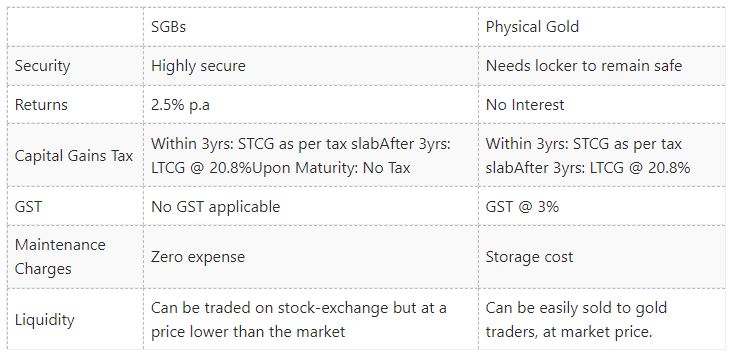
    SGBs vs Physical gold


    SGB vs Gold
    • SGBs offer a superior alternative to holding gold in physical form since the risks & costs of storage are eliminated. SGBs are free from issues such as making charges and purity in the case of gold held in the form of jewelry. 
    • The flip side of SGBs is their fixed lock-in period. SGBs are issued for a fixed term of eight years with an option to redeem them from the fifth year onwards at the RBI buyback window.
    • Also, if gold bonds are sold prematurely on the stock exchange before three years, then they will attract short-term capital gains tax (STCG) as per the investor’s slab rate. But if they are sold after three years, then long-term capital gains tax (LTCG) of 20 per cent will be applicable, and the investor will also get indexation benefits. And, if one were to hold the bonds until maturity, or until the RBI buyback window, then capital gains tax will not be applied. 

    Price of Sovereign gold bond

    The Reserve Bank of India (RBI) fixes the issue price per gram for each tranche by calculating the simple average of the closing prices of 999 purity gold as disclosed by Indian Bullion and Jewellers Association (IBJA) on the last three working days before the week marked for the subscription.

    Our Take

    Buying gold jewelry isn’t an investment. But if the idea is to remain invested in Gold, then SGB is the best option in the market. Along with capital gains, investors are paid interest rate. NO GST during purchase and NO Capital gains tax on sale. And also, India need not shell out dollars from its reserve. It’s a win-win situation.

  • What are GOLD ETFs? When should you buy them?

    What are GOLD ETFs? When should you buy them?

    For centuries gold has proven to be a safe investment bet. Indians, when compared to people in the rest of the world, have felt great comfort when investing in this yellow metal. Often, this investment is in the form of jewelry and not other digital forms like Gold ETFs or Bonds. Although, investment in physical gold has created other challenges for us. As India does not produce gold in significant quantities, we have begun to rely on imports.

    People began to accumulate Gold for safety purposes as their Long-term investment strategy. Some professionals today say that Gold is a great tool to hedge against inflation. Large scale gold imports, especially for investment created a higher Trade Deficit (this happens when imports far exceed exports). When this happens the rupee comes under pressure and tends to weaken. This sets off many more problems for the Indian economy.

    To avoid this situation and push people to look beyond investing in just Physical Gold, the Government of India came out with Gold Exchange Traded Funds (ETFs) apart from Sovereign Gold Bonds (SGB).

    Now….What is a Gold ETF?

    A Gold ETF is an exchange-traded fund that aims to track the domestic price of physical gold. In other words, Gold ETFs are units representing physical gold either on paper or in dematerialised forms. Typically, one Gold ETF is equal to 1 gram of gold. Meaning, 1 unit of Gold ETF is backed by an equivalent quantity of physical gold. Gold ETFs give you a combined benefit of investing in Stocks as well as Gold.

    They are listed and traded on the National Stock Exchange of India (NSE) and Bombay Stock Exchange Ltd. (BSE). And just like the stock of any company that can be bought & sold continuously at market prices, Gold ETFs can be treated the same way.

    However, when you actually sell your Gold ETF, you don’t get physical gold, but receive the cash equivalent of the market price.

    How are Gold ETFs Beneficial to you?

    • Transparency – The biggest benefit is the transparency in pricing as it is directly linked to the price of gold. 
    • Cost – ETFs incur far lower expenses compared to physical gold where one ends up paying wastage charges, making charges, safe storage cost etc. 
    • Safety – Unlike physical gold the investor need not worry about the investment’s safety. ETFs not only fetch the same return as physical gold but are also a lot safer than its physical form as there is no fear of theft or depreciation.
    • Loan – Gold ETFs can be placed as a collateral to secure loan from any financial institution.

    Where can you purchase Gold ETFs?

    Gold ETFs can be purchased through a stock broker like Zerodha, Sharekhan and other investment apps. You will have to pay a small brokerage or fund management charges while buying or selling Gold ETFs. As  mentioned earlier the overall cost is much lower than what an investor incurs in buying physical gold and there is NO better time to invest in Gold than today.

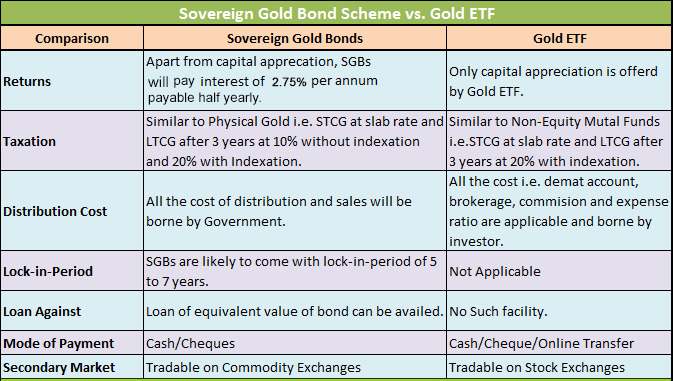
    Gold ETFs Vs. SGB

    Many of you might have a pondering question on how Gold ETFs are different from SGBs. Well here’s our take of the same. 

    gold etfs

    The advantage that ETFs have over SGB is that they are more liquid. They can be sold at any given time like stocks. An investor need not hold onto their investment for a fixed period. Although ETFs are taxable.

    If you prioritize your investments based on safety and liquidity, then Gold ETFs are your safe haven.

  • Is It The Right Time To Start Gold Investment?

    Is It The Right Time To Start Gold Investment?

    Gold Investment is considered to be an all weather investment. More than an investment, Gold is treated as an insurance for all the other investments. It is a hedge against inflation.

    During an economic downturn while asset classes such as stocks, mutual funds and real estate may tumble, Gold would still sustain and outperform them. This is the reason why portfolio managers always insist on having a fair share of your investments in gold.

    Gold_Investment

    Today, we see the stock markets across the globe have become more volatile due to geo-political tensions with Russia- Ukraine conflict and stringent covid-lockdown in China. Fears of economic recession and increase in Fed rates has created the perfect situation for gold to skyrocket again.

    Is this the right time to invest in gold? Ideally, yes. Stock markets are down, cryptos have crashed and real estate is yet to recover. Gold at its present value looks attractive. Experts believe people will shift their focus to gold if stock don’t recover soon.

    Gold’s performance in the last 20 years

    The annualized return from march 2000 to march 2020, Nasdaq 100 had a return of 2.5 percent, S&P 500 gave a return of 4 percent whereas gold gave a return of almost 9 percent. 

    In 2020, gold delivered an annual average return of 24.6 percent. Over the last 40 years gold provided an average annual return of 9.6 percent and negative returns only at 8 instances. 

    Stock Vs Gold performance during the economic crisis

    During the 2008 global financial crisis, while the stock market fell as much as 60 percent, gold remained unaffected and in fact it grew by 6 percent. The same would be visible with multiple other crisis situations like the East-Asian crisis. 

    This clearly indicates that gold is a safe bet when it comes to economic downturns. 

    How to start gold investment? 

    There are multiple options to invest in Gold like buying physical gold, Gold ETFs or Sovereign Gold Bonds (SGBs). 

    • Physical Gold can be purchased in the form of coins or bars. Buying jewelry isn’t an investment.
    • A gold ETF is a type of ETF that can be purchased or sold on a stock exchange like any regular stock. The option eliminates storage costs & security risks of holding physical gold but comes with an expense ratio and Capital gains tax.
    • SGBs are substitutes for holding physical gold. SGBs are less risky as they are guaranteed by the government. But there is more to add, these bonds offer 2.5% interest and NIL Capital Gains tax if they are redeemed by completing the term(8years).

    Options like SGBs and Gold ETFs are termed as Paper-Gold which obviates the need to buy physical gold and store them while assuring the same return.

    If the World Bank & IMF are to be believed, the global economy is slowing down significantly due to covid and geo-political tensions. Global trade has shrunk. And stocks, mutual funds, cryptos, real estate will see a major correction. Smart investors looking for better investment options would definitely find gold as their best bet. So it’s time for you to become smart by starting to invest in gold.