Tag: Finance

  • The Remarkable Journey of Apple Inc.

    The Remarkable Journey of Apple Inc.

    In the heart of Silicon Valley, amidst the hustle and bustle of tech giants and startups alike, there’s a company that stands tall. It casts its long shadow over the world of technology and innovation. 

    This is the incredible journey of Apple Inc., a company that started in a garage and went on to revolutionize the world.

    The Humble Beginnings (1976-1985)

    Long ago in 1976, two young and creative guys named Steve Jobs and Steve Wozniak started a company called Apple. They began their journey in Steve Jobs’ parents’ garage, dreaming of making computers that regular people could use.

    Their very first creation was called the Apple I, which was a super important step in the world of computers. It was made by Wozniak and was like a tiny computer on a single board. They sold it in a local computer shop after investing $1,300 to get started.

    Then, in 1980, Apple became a big deal when it went public, which means they started selling shares of the company to people. They raised a huge amount of money, $100 million, which was a record back then. It made Apple one of the fastest-growing companies in the United States. They got there thanks to their Apple II series of computers, which were known for their cool graphics and easy-to-use interface.


    The Macintosh Revolution (1984-1990)

    In the 1980s, Apple introduced more products, but the Macintosh computer stood out as a game-changer in the personal computer world. In 1984, Apple ran a groundbreaking ad during the Super Bowl, presenting the Macintosh as a computer “for everyone.” What made the Macintosh special was its easy-to-use graphical interface and a mouse for navigation, which made it simple and approachable.

    Despite its promising start, the Macintosh didn’t immediately become as popular as expected. It didn’t sell well, and there were conflicts within the company that led to Steve Jobs leaving in 1985. However, even after he left, Steve Jobs’ vision continued to shape Apple’s direction.

    The Dark Ages (1991-1996)

    The early ’90s were a tough time for Apple Inc. The company faced stiff competition from Microsoft’s Windows operating system, and its product lineup was fragmented. The Macintosh line, once a symbol of innovation, seemed to be losing its shine.

    In 1996, Apple found itself on the brink of disaster. The company was bleeding money, and its market share had dwindled. It was in this dire situation that Apple made a critical decision – it brought Steve Jobs back into the fold.

    The Resurrection (1997-2001)

    When Steve Jobs came back to Apple, things started getting much better. He made the product lineup simpler and encouraged innovation. In 1998, they released the iMac, which looked cool and brought USB ports to regular people’s computers.

    But the big moment came in 2001 with the iPod. It was a small device that could play music, and it completely changed how we listen to music. It also set the stage for Apple Inc. to become huge in consumer electronics. When they connected the iPod to iTunes, it became super easy to use and hard to resist.

    The Era of the iPhone (2007-Present)

    June 29, 2007, marked a historic day when Apple unveiled the iPhone. This sleek, touchscreen device combined a phone, an iPod, and an internet communicator into one. It was an instant hit, and lines formed outside Apple stores as people eagerly waited for their chance to own one.

    The iPhone’s popularity turned Apple Inc. into the big tech company it is now. It also brought us the App Store, which was a game-changer for both app creators and users. As time went on, each new version of the iPhone got faster, stronger, and more creative.

    Besides the iPhone, Apple released other revolutionary gadgets, like the iPad in 2010 and the Apple Watch in 2015. These products made sure that Apple stayed at the top of the tech industry.

    The Legacy (2020-Present)

    The company continued to innovate, focusing on areas like augmented reality, services (Apple TV+, Apple Music, Apple Arcade), and sustainability. Apple’s commitment to reducing its environmental footprint was evident in its efforts to make its entire supply chain carbon-neutral.

    The COVID-19 pandemic posed challenges, but Apple adapted swiftly, emphasizing remote work and enhancing its online retail experience. The release of the M1 chip, Apple’s first ARM-based processor for Macs, showcased the company’s ongoing commitment to designing its own hardware.

    What Lies Ahead (2023 and Beyond)

    In the fast-paced world of technology, it’s challenging to predict Apple’s future. However, we’ve considered a few key trends and possibilities:

    Continued Innovation

    Apple’s dedication to innovation is unlikely to wane. Expect more groundbreaking products and technologies in the coming years, possibly in the fields of augmented reality, electric vehicles, and healthcare.

    Sustainability

    Apple’s push for sustainability is likely to intensify. The company aims to be entirely carbon-neutral by 2030, and this commitment will drive changes in its products and supply chain.

    Services Growth

    Apple’s services segment, including Apple Music, Apple TV+, and Apple Arcade, is also expected to grow. The company will likely expand its service offerings, potentially entering new markets.

    Privacy and Security

    As privacy concerns continue to mount, Apple’s focus on user data protection expected to remain a priority. This could lead to further developments in privacy features and regulations.

    Market Challenges 

    Apple faces ongoing scrutiny from regulators regarding its market dominance and App Store policies. How the company navigates these challenges will shape its future.

    In conclusion, the journey of Apple Inc. is a captivating tale of innovation, resilience, and vision. 

    From its humble beginnings in a garage to its current status as one of the world’s most valuable companies, Apple has consistently pushed the boundaries of what technology can achieve. 

    As we look ahead, one thing is certain: Apple’s journey is far from over. The next chapters promise to be just as exciting and transformative. Apple has repeatedly proven that it can shape the future, and we eagerly anticipate what it will bring to the world next.


  • Understanding Your Payslip

    Understanding Your Payslip

    Introduction

    Opening your payslip can be quite a puzzling experience. We all eagerly search for that bottom-line figure – our take-home pay. But more often than not, it goes a little like this:

    “Great, payday! Wait, that’s not what I expected. How much are they taking for taxes? And what’s that other deduction? Can’t be right… ?”

    Does this sound familiar to you? 

    In this blog, we’ll help you understand your payslip, to help you make better financial decisions. We hope this comprehensive guide empower you with information to decode your payslip. 

    What is a Payslip?

    Let’s start by defining a payslip. At its core, a payslip is a document that your employer issues, typically on a monthly basis, detailing your earnings and deductions for a specific pay period. 

    This tangible record of your salary serves as a financial compass, helping you navigate the intricacies of your income, taxes, and other financial aspects related to your employment.

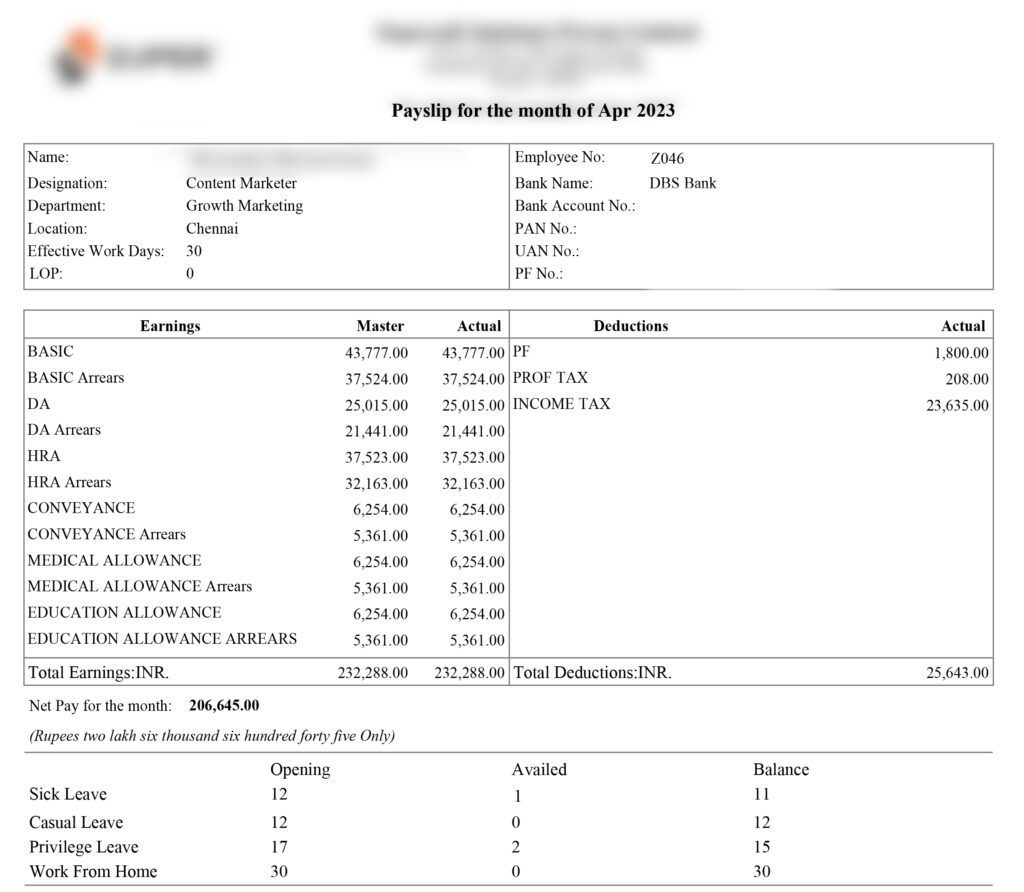
    Sample of a payslip
    Sample of a Payslip

    Inclusions Listed in a Payslip

    The above image is a sample payslip that will help us understand each component. Let’s look at the various components you’ll typically find on your payslip, through this sample.

    Understanding the components of a payslip is essential for employees to manage finances effectively. 

    1. Personal Information

    Your journey through the payslip begins with a brief introduction—a segment containing your personal details. As you can see in the top section of the image, that mentions the details of the employee. It includes your name, employee ID or code, address, and other identifiers. These details ensure that your hard-earned money reaches the right destination.

    2. Earnings

    Earnings constitute the backbone of your payslip. This section shows the diverse sources contributing to your total income for the pay period:

    Basic Salary

    The bedrock of your earnings, your basic salary forms the core of your compensation. It’s typically a fixed amount you receive consistently. In the sample, the basic salary is ₹43,777. It does not include any additional allowances or bonuses.

    Additionally, basic salary forms the basis for calculating various other components of an employee’s salary, such as provident fund contributions and gratuity.

    3. Allowances

    Your payslip may list various allowances, such as House Rent Allowance (HRA), Dearness Allowance (DA), Travel Allowance (TA), or Special Allowances. Furthermore, these add-ons enhance your overall income and can vary based on your employment terms.

    House Rent Allowance (HRA)

    HRA is an allowance provided to employees to help them cover the cost of renting accommodation or paying for their housing expenses. In the sample mentioned, the HRA is ₹ 37,523.

    HRA addresses the housing needs of employees. It is calculated as a percentage of the employee’s basic salary. It is partially or fully exempt from income tax, depending on the city and the actual rent paid by the employee.

    Dearness Allowance (DA)

    DA is an allowance provided to employees to counter the effects of inflation. It aims to ensure that employees can maintain their purchasing power. The DA in the payslip sample is ₹ 25,015.

    DA is typically applicable to government employees and some public sector workers. It is usually periodically revised to keep pace with the cost of living changes.

    Medical Allowance (MA)

    MA is an allowance provided to cover medical expenses incurred by the employee and their family members. As mentioned above in the sample, the MA is ₹6,254. Evidently, MA helps employees meet medical costs, such as doctor’s fees, medicines, and hospitalization expenses. The amount may vary depending on the employer’s policy.

    Conveyance Allowance (CA)

    CA is an allowance provided to cover commuting expenses incurred by the employee when traveling to and from work. As mentioned above in the sample, Conveyance Allowance is also ₹6,254.

    CA helps employees offset the cost of daily transportation to work. It is often a fixed amount or based on the actual distance traveled.

    Special Allowance (SA)

    SA is an allowance that employers provide to employees for specific purposes or as a flexible component that can be used for various purposes.

    SA is more flexible compared to other allowances, and employees can use it for different needs. It is often paid as a part of the salary to account for any miscellaneous expenses.

    4. Bonuses

    Ah, the pleasant surprises! Bonuses represent additional payments, often linked to performance, company policies, or special occasions. They inject an element of unpredictability into your payslip.

    5. Overtime

    If you’ve dedicated extra hours to your work during the pay period, your overtime earnings are mentioned here. It’s a tangible reward for your additional effort.

    6. Incentives

    If your job includes targets or performance-based rewards, these incentives are listed in this section.

    7. Other Benefits

    This category encompasses a wide array of perks and benefits. Such as food coupons, medical allowances, mobile phone reimbursements, or any other supplementary payments that enhance your overall earnings.

    8. In-hand Salary

    In-hand salary is the amount that an employee receives after deductions. It is the amount that remains after subtracting taxes and other deductions from the gross salary.

    In-hand salary is what an employee takes home and can spend or save. It reflects the actual cash that an employee receives in their bank account.

    In the sample mentioned, in-hand salary is mentioned as the “net pay for the month” and amounts to a total of ₹ 2,06,645.

    9. Cost to Company (CTC)

    CTC represents the total compensation an employer is willing to spend on an employee annually, including all components of the salary, benefits, and bonuses.

    CTC is gives employees an understanding of the overall value of their compensation package. It doesn’t include just the basic salary and allowances. It also included other benefits like provident fund contributions, bonuses, and any other perks.

    Understanding the components of a payslip is essential for employees to manage their finances effectively and make informed decisions about their compensation. It also helps employers maintain transparency and ensure that employees receive a fair and competitive salary package.

    10. Deductions: The Necessary Subtractions

    Regrettably, not all your earnings are yours to keep. Deductions form the subtractive side of your payslip, accounting for various financial obligations. Common deductions include:

    Income Tax

    The formidable force of taxation makes an appearance here. It’s the portion of your income that the government claims, and the amount deducted is typically based on your income level and tax-saving investments. It is generally the highest of the deductions. As mentioned in the sample, it amounts to ₹23,635.

    Employee Provident Fund (EPF)

    The EPF deduction is a compulsory contribution to your retirement savings. Both you and your employer make contributions, and the deducted amount accumulates over time, securing your financial future. Under the regulations of EPF, 12 percent of your earnings are required to be contributed towards your provident fund. As mentioned in the sample as PF, it amounts to ₹1800.

    Professional Tax

    In certain states, professional tax is levied on salaried individuals. This state-specific deduction helps fund local governance. The amount as you can see in the sample is ₹208.

    Insurance Premiums

    Payments towards insurance policies, including health insurance, life insurance, or any other coverage that your employer provides, are accounted for here.

    Loan Repayments

    If you have any outstanding loans, such as car loans, home loans, or personal loan, the EMI deductions are mentioned here. This ensures transparent tracking of your debt repayments.

    Other Deduction

    This catch-all category includes various other miscellaneous deductions, such as contributions to social or charitable causes, union fees, or any unique financial obligations specific to your employment

    Why Is It Important to Understand Your Payslip?

    Knowing what’s on your payslip is not just about curiosity; it’s a practical and essential skill for several important reasons:

    1. Financial Awareness: Understanding your payslip gives you a clearer picture of how much you earn and how much the employer is deducting. This helps you make smarter financial choices.
    2. Better Budgeting: When you know your income and deductions, you can further plan your spending more effectively. This means you can budget for your future needs and avoid spending too much.
    3. Smart Tax Planning: Your payslip has info about how much tax you pay. When you understand it, while filing taxes you can find ways to pay less tax legally and save more money.
    4. Savings and Retirement: Part of your salary might go into a retirement fund. Knowing how this works helps you plan for a secure financial future.
    5. Managing Loans: If you’re paying off a loan, your payslip serves as a reminder of how much you deduct each time. This helps you keep track of what you owe and manage repayments well.
    6. Negotiating Salaries: When you understand your payslip, you’re better equipped to discuss your salary when looking for a raise or a new job. You’ll know exactly what you’re worth.
    7. Spotting Mistakes: Sometimes, payslips have errors. When you understand yours, you can quickly spot and fix these mistakes to make sure you’re paid correctly and get the benefits you deserve.

    In Conclusion

    Your payslip, often overlooked in the busy work routine, holds the key to your financial health. 

    It’s not just a piece of paper; it’s a reflection of your efforts and commitment. By examining and understanding the information on your payslip, you can make better financial decisions and take control of your finances. 

    So, when you receive your payslip next time, don’t just glance at it – take the time to understand the numbers, look at the deductions, and empower yourself with financial knowledge.

  • 5 ways to increase your credit score

    5 ways to increase your credit score

    In today’s world, credit has become a vital part of how we manage our finances. Whether we want to buy a car, own a home, or apply for a credit card, lenders use a special number called a credit score to decide if we are trustworthy borrowers. 

    Credit scores play a major role in determining whether we can get a loan and what interest rate we’ll be charged. 

    In this blog, we’ll explore what credit scores are, how they are calculated, and how you can develop sound credit to ensure a strong financial future.

    So, what exactly is a credit score? Think of it as a financial report card. It’s a number that shows how well you handle money and repay debts. 

    Lenders, like banks and credit card companies, use this score to understand if you’re likely to pay back what you borrow on time. 

    The higher your credit score, the more confident they feel about lending you money at better terms, like at lower interest rates.

    On the other hand, a lower credit score might make it harder to get loans or credit cards, and if you do get them, you might be charged higher interest.

    How is Credit Score Calculated?

    Calculating a credit score involves carefully looking at a person’s credit history and how they handle money. A credit rating agency usually collates this information. In India, credit bureaus such as CIBIL, Experian, Equifax, and CRIF High Mark use advanced methods to assess different factors and create credit scores.

    While the exact way they calculate scores may vary slightly, the main principles are similar. A cibil credit score might be different from a CRIF credit score.

    Here are the important factors that determine a credit score:

    Payment History (35% weightage)

    This is the most crucial factor. It checks if you’ve been paying bills and loans on time. Late payments or defaults can harm your score, but making payments on schedule boosts it. Considering this is the maximum weightage, remember to spend credit sensibly.

    Credit Utilization (30% weightage)

    It looks at how much of your credit limit you use. Keeping your credit utilization rate low, ideally below 30%, is better for your score. High use may be seen as a risk by lenders. This contributes to the utilization score.

    Credit History Length (15% weightage)

    Having a longer credit history is better, as it shows how you’ve managed credit over time. Keeping old and well-handled accounts open is beneficial to your current score.

    Credit Mix (10% weightage)

    Having different types of credit, like credit cards and loans, can positively impact your score. Make sure to handle all credit responsibly.

    New Credit Applications (10% weightage)

    When you apply for new credit, it leads to a “hard inquiry” on your report. Multiple inquiries in a short time may lower your score slightly. So, apply for credit only when you really need it.

    Negative marks, such as defaults or bankruptcy, severely impact your credit score and take time to recover from.

    Credit bureaus gather information from various sources to create a detailed credit report for each person. Then, they use their special methods to analyze the data and create a credit score.

    The scores typically range from 300 to 900. Higher scores mean lower risk and better creditworthiness, while lower scores might lead to higher interest rates or credit denials.

    Remember that different credit bureaus may have slightly different scoring models, which can result in slight variations in credit scores between them.

    Credit Score in India

    In India, there are credit bureaus like CIBIL, Equifax, Experian, and CRIF High Mark that keep track of people’s credit information from banks and lenders. They use this data to create credit reports and scores for individuals.

    As of 2021, the average credit score in India was about 750. According to Mint, In the financial year 2021-22, the average credit score was 715. (report by OneScore, a platform that monitors credit scores). This score is essential because it shows how well people manage their finances and how trustworthy they are as borrowers.

    5 ways to improve credit score 

    Pay Bills on Time

    Sound too obvious, doesn’t it? Making sure to pay your credit card bills and loan payments on time is super important. That means, you make your Emi payments on time as well. When you pay your bills promptly, it shows that you’re responsible with your money, and it helps to boost your credit score.

    On the other hand, if you keep missing payments or paying late, it can bring down your score.

    Example: Imagine you have a credit card with a due date of the 10th of every month. To maintain a good credit score, make sure you pay the full amount or at least the minimum payment on or before the 10th of each month.

    Keep Credit Card Usage Low

    It’s best not to use too much of your credit card limit. If you have a credit card with a ₹50,000 limit, try not to spend more than ₹15,000 to ₹20,000 on it. Keeping your credit card balance low is better for your credit score because it shows you’re not overly reliant on credit.

    Example: Let’s say your credit card has a ₹50,000 limit, and you’ve used ₹30,000 of it. Try to pay off some of the balance before your statement date. This way, when the credit bureau checks, it shows a lower utilization rate.

    Avoid Applying for Too Much Credit

    Every time you apply for a loan or a new credit card, the lender checks your credit history, and this is called a “credit inquiry.”

    Having too many inquiries in a short period can make lenders think you’re desperate for credit, which can lower your credit score. So, only apply for credit when you genuinely need it. Don’t open multiple credit card accounts.

    Example: If you’ve been shopping around for loans or credit cards, try to do it within a short time frame. Multiple credit inquiries in a short period are often considered rate shopping and may not have a big impact on your credit score.

    Have Different Types of Credit

    Having a mix of different types of credit can be good for your credit score. This means having both revolving credit (like credit cards) and installment credit (like loans). It shows that you can handle different types of credit responsibly.

    Example: If you already have a credit card, you can also consider taking a small personal loan. By paying it back on time, you can show that you can manage both credit card debt and installment loan payments.


    Check Your Credit Reports Regularly

    Get your credit reports from time to time and go through them carefully. Look for any mistakes or errors in the report. If you find any, report them to the credit bureau so that they can be corrected.

    Errors on your credit report can negatively impact your credit score, so it’s essential to keep an eye on it.

    Example: You can request a free credit report once a year from each of the credit bureaus. Use can also online platforms that offer credit monitoring services to keep track of your credit report regularly. Keep a check on your credit score regularly too.

    By following these simple tips and being responsible with credit, you can improve and maintain a healthy credit score, which will open better financial opportunities for you in the future.

    Why Should You Maintain a Good Credit Score?

    Though the above-mentioned points are surely easy to execute, here’s a little more motivation for you why you should keep going. 

    Loan Approvals

    Maintaining a good credit score is essential because it increases the likelihood of getting approved for loans. Lenders like banks and financial institutions use your credit score to determine how reliable you are as a borrower.

    With a higher credit score, you stand a better chance of having your loan applications approved. This means you can access the funds you need for various purposes, such as buying a home, getting a car, or financing your education.

    Lower Interest Rates

    A good credit score helps you get approved for loans and comes with another significant advantage – lower interest rates. When you have a good credit score, lenders see you as less risky.

    As a result, they are more willing to offer you loans at lower interest rates. This means you’ll end up paying less interest over time, saving you money in the long run. On the other hand, if your score is low, lenders may see you as a higher risk and charge you higher interest rates, making your loans more expensive.

    Credit Card Benefits

    With a good credit score, you can qualify for premium credit cards that come with attractive rewards, cashback offers, travel benefits, and other perks.

    These premium credit cards often offer better deals and privileges that can enhance your lifestyle and save you money on everyday expenses. So, a good score can open the door to exclusive credit card options and valuable benefits that may not be available with lower scores.

    A lot of people, also wonder which is better, Credit Card or BNPL apps (Buy Now Pay Later)? That depends on each person’s spending habits.

    In Summary

    By understanding how credit scores are calculated and adopting responsible financial habits, you can maintain a healthy score. 

    You can’t improve your credit score overnight. Regularly monitoring your credit score and taking proactive steps to improve it can lead you toward a secure and prosperous financial future. 

    Remember, building a good credit score is a journey, and with patience and perseverance, you can achieve financial success. Download Vittae and build your money story today!

    FAQs:

    a. How to Increase Credit Score Fast?

    Increasing your score quickly requires consistent efforts, such as paying off outstanding debts, reducing credit card balances, and maintaining a flawless payment record.

    b. How Often Should I Check My Credit Score?

    It’s recommended to check your score and report at least once a year to ensure accuracy and detect any issues promptly.

    c. How Long Does It Take to Improve a Credit Score?

    The time to improve a score varies depending on individual financial circumstances. However, with responsible credit behavior, you can see noticeable improvements within six to twelve months.

  • 5 Investing Mistakes to Avoid

    5 Investing Mistakes to Avoid

    Investing can be a daunting task, especially for beginners who are just starting out. With so many options out there, it’s easy to get overwhelmed and make investing mistakes that can cost you money. 

    But fear not, dear reader! In this blog, we’ll be discussing the five most common investing mistakes that beginners should avoid. 

    By learning from the experiences of others, you can avoid these pitfalls and start your investing journey on the right foot.

    Back to Basics – What is Investing? 

    Investing is essentially putting your money to work to make more money. When you invest, you’re buying something with the hope that it will increase in value over time. 

    This can include stocks, bonds, mutual funds, real estate, and many other things.

    We understand that investing can be confusing for beginners. There are so many options available, and each investment comes with its own risks and potential rewards. 

    We’ve seen that many beginner investors are not familiar with terms like asset allocation, diversification, or risk tolerance. This often leaves them feeling overwhelmed. But, don’t let that stop you from starting your investment journey.

    To make investing simple, it’s important to start with the basics and take things one step at a time.

    Begin by understanding your investment goals and risk tolerance. Risk tolerance is how much of a loss you are willing to handle when making an investment decision. Then, research different investment options that align with those goals.

    It’s also important to consider diversification and asset allocation, which means spreading your investments across different types of assets to reduce risk.

    Another way to simplify investing is to simply take help from Financial Expert. At Vittae, we’ll help you choose investments that align with your goals and risk appetite.

    This can take some of the guesswork out of investing and help you make more informed decisions.

    Remember, Investing doesn’t have to be overly complicated. By starting with the basics, taking things one step at a time, and seeking guidance when needed, you can navigate the world of investing. This was you can avoid making investing mistakes, and make your money work for you.

    So, let’s dive in and explore the world of investing, one mistake at a time.

    5 Investing Mistakes to Avoid

    Warren Buffett said, “After 25 years of buying and supervising a great variety of businesses, Charlie Munger and I have not learned how to solve difficult business problems. What we have learned is to avoid them.”.

    As advised by Warren Buffett, it’s always wise to start a journey by seeing which mistakes you can avoid. Let’s take a look at which investing mistakes you should avoid, on your investment journey.

    Failing to Develop a Plan

    One of the biggest mistakes that beginner investors make is failing to develop a plan. Many people jump into investing without thinking through their goals, risk tolerance, or investment strategies.

    This can lead to impulsive decisions that can be costly in the long run. Before you start investing, take some time to develop a plan.

    Consider your investment goals, your risk tolerance, and your investment time horizon. This will help you make more informed decisions about which investments to choose and how to manage your portfolio.

    For example,

    Rajendra is an investor who wants to save for retirement but doesn’t have a clear investment plan. Without a plan, he invests in a few stocks that he’s heard are performing well.

    This is a common investment mistake, as he didn’t consider the investment’s long-term potential or his risk profile. Without a clear plan, he is more likely to make decisions based on emotions or short-term market trends, rather than a long-term investment strategy.

    He may panic and sell his investments during a market downturn, or chase hot stocks without considering the risks.

    In contrast, let’s say Ramya, is an investor with a clear investment plan.

    She is more likely to make informed decisions that align with her long-term goals. She may have a diversified portfolio (that includes a mix of stocks, bonds, and other investments). Not only that, she can also regularly review and adjust her investments based on market conditions.

    By developing a clear investment plan, investors can avoid the mistake of making impulsive decisions and improve their chances of achieving their long-term investment goals.

    Not Diversifying Your Portfolio

    Another common mistake that beginner investors make is not diversifying their portfolios. This mistake occurs when an investor puts all or most of their money, into a single investment or asset class.

    Diversification is the practice of spreading your investments across different asset classes, industries, and geographies.

    This helps to reduce your overall risk by ensuring that your portfolio is not overly exposed to any one investment or market.

    By diversifying your portfolio, you can increase your chances of achieving your investment goals while minimizing your risk.

    For example,

    Rajendra, a beginner investor has heard about the potential earnings from the technology sector. He decides to invest all his money in a single technology stock. He does this with the belief that the stock will continue to perform well in the future.

    Let’s say the stock or the technology sector as a whole, takes a downturn. How would this affect Rajendra? Well, because he invested a major chunk of his money only in one sector, he has to face the losses.

    If he had diversified his money, into other assets, his loss would have been relatively less. This balances the overall returns from other investments.

    By not diversifying their portfolio, beginner investors are exposing themselves to unnecessary investing mistakes.

    Diversification can help to protect the portfolio against market fluctuations and unexpected events, improving the chances of achieving long-term investment goals.

    Focusing on Short-Term Gains

    Many beginner investors focus solely on short-term gains, rather than taking a long-term view.

    This common investment mistake leads to impulsive decision-making and a failure to consider the long-term prospects of an investment.

    In many cases, investors who prioritize short-term gains end up sacrificing long-term profitability, as they think they’re earning quickly in the short term.

    The stock market can be volatile in the short term, but over the long term, it tends to produce positive returns.

    By focusing on long-term growth rather than short-term gains, you can avoid the temptation to make impulsive decisions based on market fluctuations.

    For example,

    Rajendra purchases a stock solely because it has experienced a sudden surge in value over the past few days.

    He hopes to cash in on the current trend and make a quick profit. The mistake he is making is that he hasn’t carefully researched the company’s fundamentals and long-term prospects.

    This might lead to him losing money when the stock’s value eventually falls back to normal levels.

    It’s important to monitor your investments and make adjustments as needed. It’s also important to remember that investing is a long-term game.

    You need to take a long-term view of your investments and focus on companies with strong fundamentals and growth potential.

    This approach can help you achieve sustainable returns over time, rather than simply chasing short-term gains.

    Trying to Time the Market

    Timing the market is a beginner investment mistake because it involves trying to predict the future movements of the stock market to buy or sell investments at the most advantageous times.

    .This can be a difficult and risky strategy, even for experienced investors. Markets are unpredictable and there are a range of factors that can impact how the market performs.

    For example,

    Rajendra, a beginner investor decides to do stock investing and purchases shares in XYZ company that he believes will perform well.

    However, shortly after buying the shares, he begins to see news reports about a potential economic downturn and market correction.

    Fearing that his investments will lose value, Rajendra decides to sell his shares quickly to avoid losses.

    Unfortunately, what a beginner may not realize is that the market is highly unpredictable, and it can be difficult to accurately predict how it will perform in the short term.

    In this case, he may have sold his shares prematurely and missed out on future gains, if the market ultimately recovered and the company’s shares increased in value.

    By trying to time the market, Rajendra made a mistake that many beginners make.

    Instead of trying to predict the unpredictable, it’s often better to develop a long-term investment strategy based on your financial goals and risk appetite.

    This can help you make more informed investment decisions that are less influenced by short-term market fluctuations.

    Making Emotional Decisions

    Finally, one of the biggest mistakes that beginner investors make is decisions influenced by their emotions.

    The stock market can be unpredictable, and it’s easy to get caught up in the hype and panic of market fluctuations.

    However, making decisions based on fear or greed can lead to poor investment choices and missed opportunities. These emotions can cloud your judgment and lead to making decisions that are not practical.

    For example,

    Rajendra, a beginner investor, hears about a new company that is rumored to be on the verge of a breakthrough.

    He becomes excited about the company’s potential and decides to invest a huge amount of money without doing proper research or analysis.

    This emotional decision is a mistake, that makes him overlook potential risks. He fails to consider the company’s long-term prospects and ultimately has to deal with a loss.

    Similarly, Ramya is another investor who becomes fearful during a market downturn and may panic and sell all investments at a loss. What she should have done is hold on and wait for the market to recover.

    These two examples clearly show how emotional decisions can result in missed opportunities for long-term gains.

    As investors, it is important for you to remain calm and rational when making investment decisions. Make it a habit to base your choices on research rather than emotional reactions.

    By taking a disciplined and analytical approach to investing, you can avoid the pitfalls of emotional decision-making and increase your chances of achieving long-term success.

    How to Avoid These Mistakes?

    Here are some tips to avoid beginner investing mistakes.

    Do your research

    Before investing in a company, make sure you understand its business model, financials, and long-term prospects. This will help you make informed decisions and avoid stock investing in companies that may be risky or have limited growth potential.

    Diversify your portfolio

    Don’t put all your eggs in one basket. Instead, spread your investments across different asset classes, such as stocks, bonds, and real estate. Diversification can help minimize risk and maximize potential returns.

    Invest for the long-term

    Avoid the temptation to focus on short-term gains and instead take a long-term view of your investments. This can help you ride out market fluctuations and take advantage of compounding returns over time.

    Avoid emotional decisions

    Don’t let fear, greed, or excitement drive your investment decisions. Remain calm and rational, and base your choices on research and analysis.

    Start small

    If you’re new to investing, start small and gradually build up your portfolio over time. This can help you gain experience and minimize the risk of significant losses.

    The Bottom Line

    Whenever you start something new, it’s common to make mistakes.

    But, when you start your investment journey, remember to avoid these common investing mistakes.

    Investing is a great way to build wealth and achieve financial freedom, but it’s important to approach it with caution. The first step to this is to avoid common beginner investing mistakes.

    You can reach your financial goal over the long term by educating yourself on investing, ensuring to create a diverse portfolio, and avoiding emotional decision-making. Be it mutual funds, equity, or bonds, remember these pointers when you start investing.

    Staying disciplined in your investment strategy increases your chances of success.

    Stay focused on your goals and don’t let short-term market fluctuations derail your plan. With the right mindset and approach, anyone can become a successful investor.

    Remember, investing is a journey, not a destination, and it takes time, patience, and discipline to succeed.


  • What is an Emergency Fund?

    What is an Emergency Fund?

    Have you ever heard the saying, “expect the unexpected”? Well, an emergency fund is like a superhero cape for your wallet. 

    It’s a special stash of money that you keep tucked away for those unexpected emergencies that life throws your way.

    Think about it like this: imagine you’re walking down the street and suddenly, a giant piano falls from the sky and squashes your car. Yikes! That’s definitely not something you were expecting, but with an emergency fund, you’ll be ready to handle it without breaking a sweat.

    An emergency fund is like a safety net that catches you when you fall. It’s there to help you cover unexpected expenses, such as a broken phone, a medical bill, or even a surprise trip to the vet for your furry friend.

    By having an emergency fund, you can avoid going into debt or having to borrow money. Borrowing money either from a bank or a friend, can often be stressful and embarrassing.

    Understanding an Emergency Fund

    When you set out to manage your personal finances, there are few things more important than having an emergency fund. 

    Expenses such as medical bills or a job loss, don’t come with a notice. Emergency fund is that preplanned fund that can protect you and your family from unexpected expenses.

    Yet, despite its importance, many people don’t have an emergency fund or don’t have enough saved up.

    An emergency fund is not the same as a regular savings account, which is typically used for long-term goals like a down payment on a house or a vacation. Instead, the purpose of an emergency fund is to provide immediate access to cash in case of an emergency.

    The amount of money you should have in your emergency fund can vary depending on your individual circumstances. A good rule of thumb is to have at least three to six months’ worth of living expenses saved up. 

    This will give you a cushion to fall back on in case of a job loss or any other financial emergency. It can take time and effort to build up a sufficient emergency fund, but the peace of mind it provides is well worth the effort. 

    In this blog, we’ll explore the importance of having an emergency fund, and how much money you should save. We’ll also cover some common mistakes to avoid while saving for your emergency fund. 

    What is an Emergency Fund?

    An emergency fund is a savings account that is specifically set aside for unexpected expenses. It is not intended for regular expenses such as rent or groceries. 

    Instead, it should be used to cover unexpected expenses such as car repairs, medical bills, or home repairs.

    The amount of money you should have in your emergency fund will depend on your personal circumstances, such as your income, expenses, and the number of dependents you have. 

    A general rule of thumb is to have three to six months’ worth of living expenses saved in your emergency fund. 

    This means that, if your monthly expenses are ₹20,000, you should aim to have between ₹60,000 and ₹1,20,000 saved in your emergency fund.

    Why Do You Need an Emergency Fund

    Unexpected expenses can happen to anyone at any time. You may lose your job, experience a medical emergency, or have unexpected car repairs. 

    Without an emergency fund, you may be forced to rely on credit cards or other forms of high-interest debt to cover these expenses. This can lead to a cycle of debt that can be difficult to break.

    An emergency fund can provide a safety net in times of financial hardship. It can help you avoid high-interest debt and provide a sense of security knowing that you have a cushion to fall back on in case of an emergency.

    Like how budgeting is one of the good financial practices you pick up, emergency fund is also a must when you’re planning personal finance.

    How to Build an Emergency Fund

    Building an emergency fund can take time and effort, but it is an important part of financial planning. Here are some steps you can take to build an emergency fund:

    1. Determine how much you need to save

    The first step in building an emergency fund is to determine how much you need to save. As mentioned earlier, a general rule of thumb is to have three to six months’ worth of living expenses saved in your emergency fund.

    You can calculate your living expenses by adding up your monthly bills, groceries, and other necessary expenses.

    2. Set a savings goal

    Once you know how much you need to save, set a savings goal. This will help you stay motivated and on track. 

    You can break your savings goal down into smaller, more manageable chunks. 

    For example, if you need to save ₹60,000 and want to save it within a year, you would need to save ₹5,000 per month.

    3. Create a budget

    Creating a budget is an essential part of building an emergency fund. It will help you identify areas where you can cut back on expenses and free up money to put toward your emergency fund. 

    Look for ways to reduce your expenses, such as cutting back on eating out or canceling subscription services that you don’t use.

    4. Make saving automatic

    One of the easiest ways to build an emergency fund is by making your savings automatic. Set up automatic transfers from your checking account to your emergency fund savings account.

    This way, you won’t have to remember to transfer money each month, and your emergency fund will grow without much effort on your part.

    5. Start small

    Building an emergency fund can seem overwhelming, but it’s important to start somewhere. Even if you can only save a small amount each month, it’s better than nothing.

    Over time, you can gradually increase the amount you save until you reach your goal.

    Common Mistakes to Avoid When Building Your Emergency Fund

    Not starting early

    One mistake people make is waiting too long to start building their emergency fund. It’s important to start as soon as possible, even if you can only save a little bit each month.

    Not setting a goal

    Another common mistake is not setting a specific goal for your emergency fund. You should aim to save at least three to six months’ worth of living expenses in case of an emergency.

    Not prioritizing your fund

    Some people make the mistake of not making their emergency fund a priority. It’s important to make it a priority expense and contribute regularly to it.

    Not keeping your fund separate

    Keeping your emergency fund separate from your regular checking or savings account is important. This will prevent you from accidentally spending the money on non-emergency expenses.

    Not adjusting for inflation

    Another mistake is not adjusting your emergency fund for inflation over time. As prices rise, your emergency fund may not be enough to cover your expenses.

    By avoiding these common mistakes, you can build a strong emergency fund that will help you weather unexpected financial emergencies.

    In Summary

    Life has its way of throwing surprises your way. Stay prepared with an emergency fund. 

    Start small by putting aside a little bit of money each month, like a superhero saving up their powers. 

    Building an emergency fund can take time and effort, but it’s an essential step in achieving financial security. 

    It’s important to start small and make regular contributions to your fund, even if it’s just a few hundred rupees a week. Over time, those small contributions can add up to a substantial amount of money.

    Over time, your emergency fund will grow stronger and stronger, until you’re ready to face any unexpected challenge that comes your way.

    An emergency fund may not be as exciting as a superhero adventure. But, remember it’s a smart and responsible way to protect yourself and your wallet from life’s unexpected bumps in the road. 

    Start building your emergency fund today, and be your own superhero!