Category: Articles

  • The Remarkable Journey of Apple Inc.

    The Remarkable Journey of Apple Inc.

    In the heart of Silicon Valley, amidst the hustle and bustle of tech giants and startups alike, there’s a company that stands tall. It casts its long shadow over the world of technology and innovation. 

    This is the incredible journey of Apple Inc., a company that started in a garage and went on to revolutionize the world.

    The Humble Beginnings (1976-1985)

    Long ago in 1976, two young and creative guys named Steve Jobs and Steve Wozniak started a company called Apple. They began their journey in Steve Jobs’ parents’ garage, dreaming of making computers that regular people could use.

    Their very first creation was called the Apple I, which was a super important step in the world of computers. It was made by Wozniak and was like a tiny computer on a single board. They sold it in a local computer shop after investing $1,300 to get started.

    Then, in 1980, Apple became a big deal when it went public, which means they started selling shares of the company to people. They raised a huge amount of money, $100 million, which was a record back then. It made Apple one of the fastest-growing companies in the United States. They got there thanks to their Apple II series of computers, which were known for their cool graphics and easy-to-use interface.


    The Macintosh Revolution (1984-1990)

    In the 1980s, Apple introduced more products, but the Macintosh computer stood out as a game-changer in the personal computer world. In 1984, Apple ran a groundbreaking ad during the Super Bowl, presenting the Macintosh as a computer “for everyone.” What made the Macintosh special was its easy-to-use graphical interface and a mouse for navigation, which made it simple and approachable.

    Despite its promising start, the Macintosh didn’t immediately become as popular as expected. It didn’t sell well, and there were conflicts within the company that led to Steve Jobs leaving in 1985. However, even after he left, Steve Jobs’ vision continued to shape Apple’s direction.

    The Dark Ages (1991-1996)

    The early ’90s were a tough time for Apple Inc. The company faced stiff competition from Microsoft’s Windows operating system, and its product lineup was fragmented. The Macintosh line, once a symbol of innovation, seemed to be losing its shine.

    In 1996, Apple found itself on the brink of disaster. The company was bleeding money, and its market share had dwindled. It was in this dire situation that Apple made a critical decision – it brought Steve Jobs back into the fold.

    The Resurrection (1997-2001)

    When Steve Jobs came back to Apple, things started getting much better. He made the product lineup simpler and encouraged innovation. In 1998, they released the iMac, which looked cool and brought USB ports to regular people’s computers.

    But the big moment came in 2001 with the iPod. It was a small device that could play music, and it completely changed how we listen to music. It also set the stage for Apple Inc. to become huge in consumer electronics. When they connected the iPod to iTunes, it became super easy to use and hard to resist.

    The Era of the iPhone (2007-Present)

    June 29, 2007, marked a historic day when Apple unveiled the iPhone. This sleek, touchscreen device combined a phone, an iPod, and an internet communicator into one. It was an instant hit, and lines formed outside Apple stores as people eagerly waited for their chance to own one.

    The iPhone’s popularity turned Apple Inc. into the big tech company it is now. It also brought us the App Store, which was a game-changer for both app creators and users. As time went on, each new version of the iPhone got faster, stronger, and more creative.

    Besides the iPhone, Apple released other revolutionary gadgets, like the iPad in 2010 and the Apple Watch in 2015. These products made sure that Apple stayed at the top of the tech industry.

    The Legacy (2020-Present)

    The company continued to innovate, focusing on areas like augmented reality, services (Apple TV+, Apple Music, Apple Arcade), and sustainability. Apple’s commitment to reducing its environmental footprint was evident in its efforts to make its entire supply chain carbon-neutral.

    The COVID-19 pandemic posed challenges, but Apple adapted swiftly, emphasizing remote work and enhancing its online retail experience. The release of the M1 chip, Apple’s first ARM-based processor for Macs, showcased the company’s ongoing commitment to designing its own hardware.

    What Lies Ahead (2023 and Beyond)

    In the fast-paced world of technology, it’s challenging to predict Apple’s future. However, we’ve considered a few key trends and possibilities:

    Continued Innovation

    Apple’s dedication to innovation is unlikely to wane. Expect more groundbreaking products and technologies in the coming years, possibly in the fields of augmented reality, electric vehicles, and healthcare.

    Sustainability

    Apple’s push for sustainability is likely to intensify. The company aims to be entirely carbon-neutral by 2030, and this commitment will drive changes in its products and supply chain.

    Services Growth

    Apple’s services segment, including Apple Music, Apple TV+, and Apple Arcade, is also expected to grow. The company will likely expand its service offerings, potentially entering new markets.

    Privacy and Security

    As privacy concerns continue to mount, Apple’s focus on user data protection expected to remain a priority. This could lead to further developments in privacy features and regulations.

    Market Challenges 

    Apple faces ongoing scrutiny from regulators regarding its market dominance and App Store policies. How the company navigates these challenges will shape its future.

    In conclusion, the journey of Apple Inc. is a captivating tale of innovation, resilience, and vision. 

    From its humble beginnings in a garage to its current status as one of the world’s most valuable companies, Apple has consistently pushed the boundaries of what technology can achieve. 

    As we look ahead, one thing is certain: Apple’s journey is far from over. The next chapters promise to be just as exciting and transformative. Apple has repeatedly proven that it can shape the future, and we eagerly anticipate what it will bring to the world next.


     

  • Multi-Cap Funds v/s Flexi-Cap Funds

    Multi-Cap Funds v/s Flexi-Cap Funds

    Investing in mutual funds offers individuals an array of options to grow their wealth. 
    When it comes to choosing mutual funds, multi-cap and flexi-cap funds are two popular options for investors looking to build diversified portfolios with different degrees of flexibility. In this blog post, we’ll explore the essential distinctions between Multi-Cap Funds and Flexi-Cap funds.

    Market volatility can significantly impact the performance of multi-cap and flexi-cap funds, making it essential for investors to carefully assess their risk tolerance and investment objectives.

    This will empower you to make a well-informed decision when deciding where to invest your valuable funds.

    Let’s dive into the details to make this comparison clearer for you.

    Multi-Cap Funds


    Multi cap funds, short for “multi-capacity,” are mutual funds that spread their investments across various market capitalization segments. This typically includes large-cap funds, mid-cap stocks and small-cap stocks.

    SEBI introduced explicit directives on September 11, 2020, outlining the prescribed asset allocation for Multi-cap Mutual Funds.

    These funds are mandated to maintain a minimum of 75% of their assets in equity and equity-related instruments at all times. The portfolio must be diversified, with a minimum allocation of 25% to large-cap stocks, 25% to mid-cap stocks, and an additional 25% to small-cap stocks.

    The primary goal of multi-cap funds is to offer investors a comprehensive and diversified portfolio that can adjust effectively to evolving market conditions. Let’s delve into some key characteristics of multi-cap funds for a clearer understanding:

    Diverse Investment Universe

    Multi cap funds are like all-access passes for investing. They can put your money in different-sized companies, different types of businesses, and various industries. This wide range of choices lets the people who manage the fund take advantage of opportunities, big to small, in the stock market.

    Risk-Return Profile

    Multi cap funds offer a balanced risk-return profile. By investing in a mix of large-cap, mid-cap, and small cap stocks, these funds aim to provide a blend of stability and growth potential. They can perform well in different market cycles.

    Active Management

    Most multi-cap funds are actively managed, meaning experienced portfolio managers make investment decisions based on their analysis of market conditions and individual stocks. This active management approach aims to outperform the benchmark index.

    Diversification

    Multi-cap funds inherently offer diversification benefits because they invest in a wide range of stocks. This diversification helps spread risk across various asset classes and industries, reducing the impact of poor performance in a single sector or stock.

    Investor Profile

    Multi-cap funds are suitable for a broad range of investors, from conservative to aggressive. They can be a core holding in a well-balanced portfolio or serve as a standalone investment, depending on an investor’s risk tolerance and financial goals.

    Tax Efficiency

    Multi-cap funds may be tax-efficient for long-term investors because they often have a lower portfolio turnover compared to some other actively managed funds. This can lead to reduced capital gains taxes.

    Flexi-Cap Funds

    Flexi-cap Funds, on the other hand, are a relatively newer category of mutual funds that offer investors even greater flexibility when it comes to portfolio construction.

    These funds allocate investments across different market capitalizations, allowing fund managers the flexibility to adjust their portfolio compositions

    These funds have gained popularity in recent years due to their adaptive approach to investing. Here are some key characteristics of Flexi-cap funds:

    Absolute Flexibility

    Flexi-cap funds have the freedom to invest in stocks of all sizes, ranging from large, well-established companies to smaller, promising ones. They don’t have strict rules about how much they should invest in each category, so fund managers can decide how to balance the portfolio as they think best.

    Market-Centric Approach

    Flexicap funds focus on identifying opportunities in the market rather than adhering to predefined allocation ratios. This means that fund managers can increase exposure to sectors or market segments that they believe will perform well. This is regardless of the market capitalization of the sectors they choose.

    Active Management

    Like multi-cap funds, flexi-cap funds are typically actively managed. Fund managers have the discretion to make investment decisions based on their outlook for individual stocks, sectors, and the overall market.

    Risk-Return Profile

    Flexi-cap funds can make more money for you, but they can also be riskier because there are no strict rules about where to invest. This means your investments might go up and down a lot more, so you should be ready for that.

    Investor Profile

    Flexicap funds are better suited for investors who have a higher risk tolerance and are comfortable with greater portfolio flexibility. These funds are not typically recommended as core holdings but can complement a diversified portfolio.

    Performance-Based Strategy

    The performance of flexicap funds can be highly dependent on the fund manager’s skill in identifying opportunities and managing risk. Investors should carefully research the track record and expertise of the fund manager before investing.

    Key Differences Between Multi-cap and Flexi-cap Funds

    Investment Universe

    Multi-cap funds invest in a predetermined mix of large-cap, mid-cap, and small-cap stocks, while flexi-cap funds have no specific allocation requirements, allowing for more extensive flexibility in-stock selection.

    Allocation Rules

    Multi-cap funds follow a set allocation strategy, which may change over time based on market conditions. Flexi-cap funds, however, have no predefined allocation rules and can adapt more dynamically.

    Risk-Return Profile

    Multi-cap funds offer a balanced risk-return profile, whereas flexicap funds tend to be riskier due to their greater flexibility and the potential for higher returns. You can take a call as to which funds are suitable for you based on your risk appetite.

    Investor Profile

    Multi-cap funds are suitable for a broad range of investors, including those seeking a well-rounded, diversified portfolio. Flexi-cap funds are better suited for investors with higher risk tolerance and a preference for more active portfolio management.

    Performance Dependence

    The performance of multicap funds is often influenced by broader market movements and sector allocations, whereas the performance of flexicap funds is highly dependent on the fund manager’s stock selection and timing decisions.

    Choosing Between Multicap and Flexicap Funds

    Selecting between multicap and flexicap funds ultimately comes down to your individual investment objectives, risk tolerance, and investment horizon. Here are some considerations to help you make an informed decision:

    Risk Tolerance

    If you are risk-averse and prefer a more stable investment, multicap funds may be a better choice. However, if you are comfortable with higher volatility in pursuit of potentially higher returns, flexicap funds could be appealing.

    Investment Horizon

    Your investment horizon plays a crucial role. Multicap funds are often recommended for long-term investors looking for steady growth. Whereas, flexicap funds may be more suitable for those with shorter investment horizons who can actively manage their portfolios.

    Portfolio Diversification

    If you already have a diversified portfolio but let’s say you want to add a more dynamic element. Then, flexicap funds can complement your existing holdings. On the other hand, multicap funds can serve as a core holding in a diversified portfolio.

    Fund Manager Expertise

    Research the fund manager’s track record and investment approach. A skilled fund manager can significantly impact the performance of both multicap and flexicap funds.

    Risk Management

    Consider your ability to actively manage your investments. If you have the time and expertise to monitor your portfolio and adjust your asset allocation. Then, you may be more inclined to invest in flexicap funds. However, if you prefer a hands-off approach, multicap funds can provide stability.

    Conclusion

    Both multicap and flexicap funds have their advantages and cater to different investor preferences. 

    Multicap funds offer a more structured and balanced approach to investing, making them suitable for a wide range of investors. 

    Flexicap funds, on the other hand, provide greater flexibility and the potential for higher returns. But, they come with higher risk and require more active management.

    Your choice between multicap and flexicap funds should align with your financial goals, risk tolerance, and investment horizon. 

    It’s essential to carefully assess your individual circumstances and conduct thorough research. This includes evaluating the track record of fund managers, before making your investment decision. 

    Diversifying your investments across different asset classes and fund categories. This can also be a wise strategy to manage risk and achieve your financial objective

  • 3 must-have financial experts in life

    3 must-have financial experts in life

    Introduction

    Navigating the world of finance and accounting can feel like a confusing journey. Yet, there’s a shortcut to success: having the right experts by your side. Think of it as turbocharging your progress toward your financial goals and securing your financial well-being.

    In this blog, we’re here to shed light on the roles of three essential professionals who should be part of your financial squad: the Financial Advisor, the Accountant, and the Chartered Accountant (CA).

    Each of these financial experts has a unique role to play in helping you make sense of the complex terrain of money management and personal finance. Join us as we delve deeper into why you need them and how they can be your guiding stars on your financial voyage.

    Why do you need a Financial Advisor?

    A Financial Advisor is like a navigator for your financial voyage. Their primary role is to help you set clear financial goals and create a meticulously tailored plan to achieve them. Here’s why you need a Financial Advisor:

    How can they help you?

    Goal Setting

    A Financial Advisor assists you in identifying and crystallizing your short-term and long-term financial objectives, whether it’s buying a home, saving for retirement, or funding your child’s education. They help you prioritize and establish a road map to reach these milestones.

    Investment Guidance

    Investing can be overwhelming due to various options and risks. Financial advisors guide you on where to put your money, considering your risk tolerance and financial goals.

    Risk Management

    Financial Advisors evaluate and help you deal with financial uncertainties by figuring out how comfortable you are with taking risks. They develop plans to safeguard your money from unexpected events, so your finances stay safe.

    Retirement Planning

    They make custom retirement plans that match your idea of a comfortable and secure retirement. They consider your current money situation and future needs to create a complete strategy.

    Tax Efficiency

    Financial Advisors assist you in finding ways to pay less in taxes legally and efficiently, all while making sure you follow the tax rules.

    Why do you need an Accountant?

    An accountant serves as a meticulous record-keeper for your financial matters. They’re experts in organizing your financial paperwork, making sure you follow tax rules, and keeping your financial information accurate. Here’s why you should have one:

    How can they help you?

    Financial Record Keeping

    Accountants maintain detailed financial records, tracking income, expenses, and transactions. This meticulous record-keeping is crucial for accurate financial reporting and ensuring transparency.

    Tax Compliance

    Tax regulations are constantly evolving, making it challenging for individuals and businesses to stay up-to-date. Accountants prepare and file your tax returns, ensuring compliance with ever-changing tax laws and helping you maximize deductions and credits.

    Financial Analysis

    Beyond record-keeping, Accountants provide insights into your financial performance by analyzing your financial statements. They identify trends, opportunities, and areas that may require adjustments, empowering you to make informed decisions.

    Budgeting and Forecasting

    Accountants help you create and manage budgets, ensuring your financial resources are allocated optimally. They also assist with financial forecasting, providing a roadmap for future financial decisions.

    Business Support

    For people who own businesses, accountants are really important. They help plan finances, keep all the money records, and make sure the business can stay financially healthy. They can also give advice on how to spend less, make more money, and follow the rules.

    Why do you need a Chartered Accountant (CA)?

    Chartered Accountants are like a Marine Surveyor on your financial voyage, with high expertise and technical skills to guide you.

    Often referred to as CAs, Chartered Accountants are highly skilled experts in accounting and finance. They bring a wealth of knowledge to the table, specializing in auditing, and financial analysis, and offering strategic financial advice. Here’s how a CA can make a difference for you:

    How can they help you?

    Auditing

    CAs meticulously examine financial statements to ensure they’re accurate, transparent and comply with all the rules. These audits are vital for gaining the trust of investors and regulators.

    Strategic Financial Advice

    CAs provide strategic financial guidance to individuals and businesses, helping them make informed decisions that align with their goals. Their deep understanding of financial markets and regulations is invaluable in complex decision-making.

    Tax Planning

    CAs offer valuable advice to individuals and businesses, helping them make smart financial decisions that match their goals. Their deep knowledge of financial markets and rules is incredibly helpful when facing complex decisions during tax planning.

    Risk Assessment

    CAs are great at figuring out financial risks and suggesting ways to lower them. This protects your financial stability, and their strategies are like a safety net for your wealth.

    Complex Financial Transactions

    CAs can tackle tricky financial transactions, like mergers, international taxes, and investment portfolios. They make sure these transactions happen smoothly, efficiently, and in a way that’s best for your money.

    In Conclusion

    In the world of your personal and business money matters, having a group of experts isn’t just helpful, it’s something you really need.

    • Financial Advisors help you plan your financial path.
    • Accountants keep your money records in tip-top shape.
    • Chartered Accountants tackle the tough financial stuff.

    Working with these pros isn’t just smart; it’s necessary. They help you reach your money goals, lower risks, and secure your financial future.

    Don’t wait—get these essential experts on your side. They’re your best buddies on your money journey.

  • Understanding Your Payslip

    Understanding Your Payslip

    Introduction

    Opening your payslip can be quite a puzzling experience. We all eagerly search for that bottom-line figure – our take-home pay. But more often than not, it goes a little like this:

    “Great, payday! Wait, that’s not what I expected. How much are they taking for taxes? And what’s that other deduction? Can’t be right… ?”

    Does this sound familiar to you? 

    In this blog, we’ll help you understand your payslip, to help you make better financial decisions. We hope this comprehensive guide empower you with information to decode your payslip. 

    What is a Payslip?

    Let’s start by defining a payslip. At its core, a payslip is a document that your employer issues, typically on a monthly basis, detailing your earnings and deductions for a specific pay period. 

    This tangible record of your salary serves as a financial compass, helping you navigate the intricacies of your income, taxes, and other financial aspects related to your employment.

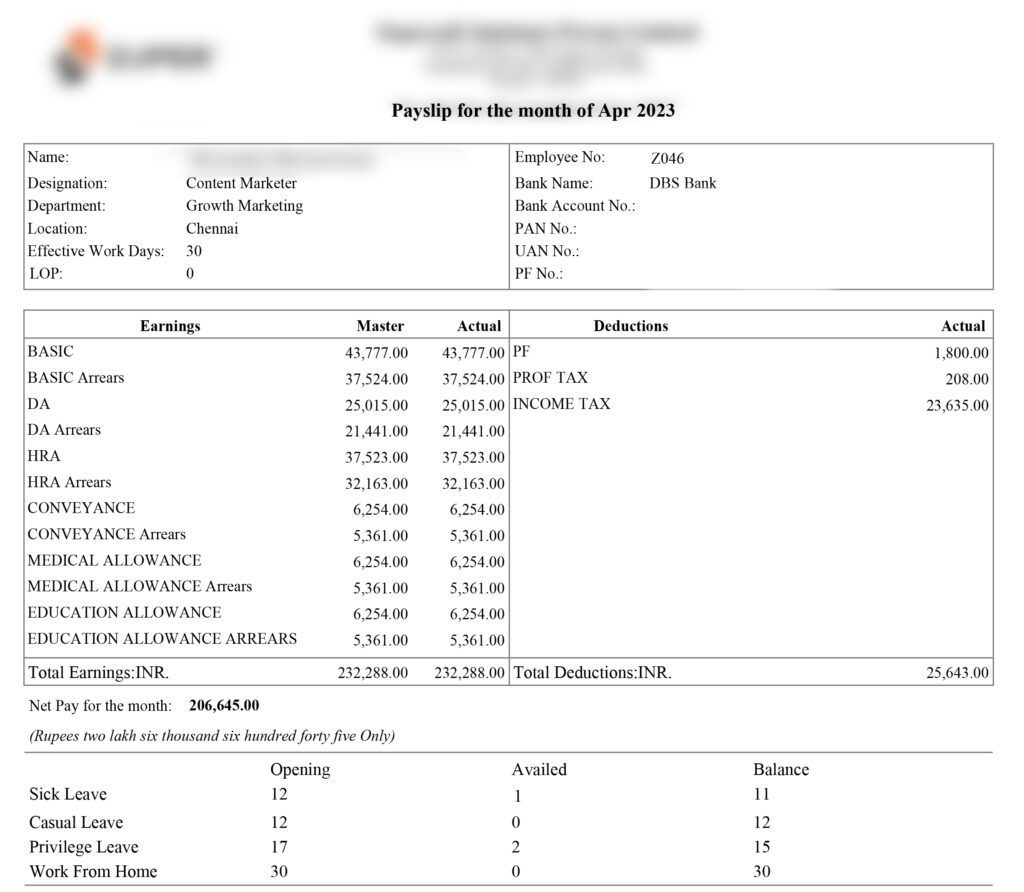
    Sample of a payslip
    Sample of a Payslip

    Inclusions Listed in a Payslip

    The above image is a sample payslip that will help us understand each component. Let’s look at the various components you’ll typically find on your payslip, through this sample.

    Understanding the components of a payslip is essential for employees to manage finances effectively. 

    1. Personal Information

    Your journey through the payslip begins with a brief introduction—a segment containing your personal details. As you can see in the top section of the image, that mentions the details of the employee. It includes your name, employee ID or code, address, and other identifiers. These details ensure that your hard-earned money reaches the right destination.

    2. Earnings

    Earnings constitute the backbone of your payslip. This section shows the diverse sources contributing to your total income for the pay period:

    Basic Salary

    The bedrock of your earnings, your basic salary forms the core of your compensation. It’s typically a fixed amount you receive consistently. In the sample, the basic salary is ₹43,777. It does not include any additional allowances or bonuses.

    Additionally, basic salary forms the basis for calculating various other components of an employee’s salary, such as provident fund contributions and gratuity.

    3. Allowances

    Your payslip may list various allowances, such as House Rent Allowance (HRA), Dearness Allowance (DA), Travel Allowance (TA), or Special Allowances. Furthermore, these add-ons enhance your overall income and can vary based on your employment terms.

    House Rent Allowance (HRA)

    HRA is an allowance provided to employees to help them cover the cost of renting accommodation or paying for their housing expenses. In the sample mentioned, the HRA is ₹ 37,523.

    HRA addresses the housing needs of employees. It is calculated as a percentage of the employee’s basic salary. It is partially or fully exempt from income tax, depending on the city and the actual rent paid by the employee.

    Dearness Allowance (DA)

    DA is an allowance provided to employees to counter the effects of inflation. It aims to ensure that employees can maintain their purchasing power. The DA in the payslip sample is ₹ 25,015.

    DA is typically applicable to government employees and some public sector workers. It is usually periodically revised to keep pace with the cost of living changes.

    Medical Allowance (MA)

    MA is an allowance provided to cover medical expenses incurred by the employee and their family members. As mentioned above in the sample, the MA is ₹6,254. Evidently, MA helps employees meet medical costs, such as doctor’s fees, medicines, and hospitalization expenses. The amount may vary depending on the employer’s policy.

    Conveyance Allowance (CA)

    CA is an allowance provided to cover commuting expenses incurred by the employee when traveling to and from work. As mentioned above in the sample, Conveyance Allowance is also ₹6,254.

    CA helps employees offset the cost of daily transportation to work. It is often a fixed amount or based on the actual distance traveled.

    Special Allowance (SA)

    SA is an allowance that employers provide to employees for specific purposes or as a flexible component that can be used for various purposes.

    SA is more flexible compared to other allowances, and employees can use it for different needs. It is often paid as a part of the salary to account for any miscellaneous expenses.

    4. Bonuses

    Ah, the pleasant surprises! Bonuses represent additional payments, often linked to performance, company policies, or special occasions. They inject an element of unpredictability into your payslip.

    5. Overtime

    If you’ve dedicated extra hours to your work during the pay period, your overtime earnings are mentioned here. It’s a tangible reward for your additional effort.

    6. Incentives

    If your job includes targets or performance-based rewards, these incentives are listed in this section.

    7. Other Benefits

    This category encompasses a wide array of perks and benefits. Such as food coupons, medical allowances, mobile phone reimbursements, or any other supplementary payments that enhance your overall earnings.

    8. In-hand Salary

    In-hand salary is the amount that an employee receives after deductions. It is the amount that remains after subtracting taxes and other deductions from the gross salary.

    In-hand salary is what an employee takes home and can spend or save. It reflects the actual cash that an employee receives in their bank account.

    In the sample mentioned, in-hand salary is mentioned as the “net pay for the month” and amounts to a total of ₹ 2,06,645.

    9. Cost to Company (CTC)

    CTC represents the total compensation an employer is willing to spend on an employee annually, including all components of the salary, benefits, and bonuses.

    CTC is gives employees an understanding of the overall value of their compensation package. It doesn’t include just the basic salary and allowances. It also included other benefits like provident fund contributions, bonuses, and any other perks.

    Understanding the components of a payslip is essential for employees to manage their finances effectively and make informed decisions about their compensation. It also helps employers maintain transparency and ensure that employees receive a fair and competitive salary package.

    10. Deductions: The Necessary Subtractions

    Regrettably, not all your earnings are yours to keep. Deductions form the subtractive side of your payslip, accounting for various financial obligations. Common deductions include:

    Income Tax

    The formidable force of taxation makes an appearance here. It’s the portion of your income that the government claims, and the amount deducted is typically based on your income level and tax-saving investments. It is generally the highest of the deductions. As mentioned in the sample, it amounts to ₹23,635.

    Employee Provident Fund (EPF)

    The EPF deduction is a compulsory contribution to your retirement savings. Both you and your employer make contributions, and the deducted amount accumulates over time, securing your financial future. Under the regulations of EPF, 12 percent of your earnings are required to be contributed towards your provident fund. As mentioned in the sample as PF, it amounts to ₹1800.

    Professional Tax

    In certain states, professional tax is levied on salaried individuals. This state-specific deduction helps fund local governance. The amount as you can see in the sample is ₹208.

    Insurance Premiums

    Payments towards insurance policies, including health insurance, life insurance, or any other coverage that your employer provides, are accounted for here.

    Loan Repayments

    If you have any outstanding loans, such as car loans, home loans, or personal loan, the EMI deductions are mentioned here. This ensures transparent tracking of your debt repayments.

    Other Deduction

    This catch-all category includes various other miscellaneous deductions, such as contributions to social or charitable causes, union fees, or any unique financial obligations specific to your employment

    Why Is It Important to Understand Your Payslip?

    Knowing what’s on your payslip is not just about curiosity; it’s a practical and essential skill for several important reasons:

    1. Financial Awareness: Understanding your payslip gives you a clearer picture of how much you earn and how much the employer is deducting. This helps you make smarter financial choices.
    2. Better Budgeting: When you know your income and deductions, you can further plan your spending more effectively. This means you can budget for your future needs and avoid spending too much.
    3. Smart Tax Planning: Your payslip has info about how much tax you pay. When you understand it, while filing taxes you can find ways to pay less tax legally and save more money.
    4. Savings and Retirement: Part of your salary might go into a retirement fund. Knowing how this works helps you plan for a secure financial future.
    5. Managing Loans: If you’re paying off a loan, your payslip serves as a reminder of how much you deduct each time. This helps you keep track of what you owe and manage repayments well.
    6. Negotiating Salaries: When you understand your payslip, you’re better equipped to discuss your salary when looking for a raise or a new job. You’ll know exactly what you’re worth.
    7. Spotting Mistakes: Sometimes, payslips have errors. When you understand yours, you can quickly spot and fix these mistakes to make sure you’re paid correctly and get the benefits you deserve.

    In Conclusion

    Your payslip, often overlooked in the busy work routine, holds the key to your financial health. 

    It’s not just a piece of paper; it’s a reflection of your efforts and commitment. By examining and understanding the information on your payslip, you can make better financial decisions and take control of your finances. 

    So, when you receive your payslip next time, don’t just glance at it – take the time to understand the numbers, look at the deductions, and empower yourself with financial knowledge.

  • 5 Investment Gurus for Financial Success

    5 Investment Gurus for Financial Success

    Introduction

    In the world of finance and investments, wisdom and guidance from experts can be invaluable. 

    This Teacher’s Day, let’s look at our teachers in the investment field and see what we can learn from them!

    Investment gurus, individuals who have achieved remarkable success in managing and growing their wealth, serve as beacons of financial knowledge.

    These individuals have not only amassed significant fortunes but have also shared their strategies, insights, and philosophies with the world.

    In this blog, we will introduce you to five investment gurus whose wisdom can help you on your path to financial success.

    1. Warren Buffett

    When the topic of investing comes up, who hasn’t heard of Warren Buffett?

    Warren Buffett, nicknamed the Oracle of Omaha, is a famous investor known for his smart money moves. According to Forbes, he’s currently the 5th richest person in the world. He is considered one of the best at what he does.

    Buffett’s strategy is to invest in good companies that have strong foundations, a lasting edge over their competition, and honest leaders.

    He runs a big company called Berkshire Hathaway, and he’s all about holding onto investments for a long time. His letters to shareholders each year are full of great advice for investors.

    Investment Advice

    Invest for the long term in quality businesses.

    Warren Buffett’s track record of successful investments includes companies like Coca-Cola, American Express, and Apple. By holding onto these investments for years, he has allowed the power of compounding to work its magic. This demonstrates the importance of patience and a focus on the underlying fundamentals of the companies you invest in.

    2. Benjamin Graham

    Often referred to as the “father of value investing,” Benjamin Graham’s influence on the investment world is immeasurable.  He laid the foundation for Warren Buffett’s investment philosophy and is best known for his classic book, “The Intelligent Investor.” 

    Graham’s lessons highlight the significance of intrinsic value, safety margin, and logical decision-making. He recommended a systematic and thoughtful investment approach based on solid financial rules.

    Investment Advice

    Always buy stocks at a price below their intrinsic value. Benjamin Graham’s famous metaphor of Mr. Market illustrates the concept of market irrationality. 

    He advised investors to see the stock market like a moody friend whose emotions shouldn’t control their investment choices. Instead, he recommended buying stocks when they are priced lower than their true value. And selling when they are priced higher. This way, investors can aim for steady and reliable profits.

    3. Peter Lynch

    Peter Lynch is celebrated for his successful tenure as the manager of Fidelity Magellan Fund, where he achieved outstanding returns for investors.

    Lynch made it famous to “invest in what you know” and thought regular people should be hands-on with their money. He felt that if you keep an eye on what you see and buy in your daily life, you can find good chances to invest your money wisely.

    Investment Advice

    Invest in businesses that you understand and believe in.

    Peter Lynch believed that anyone could be a successful investor without being a financial expert. He became well-known for investing in companies like Dunkin’ Donuts and The Limited because he noticed their potential in his everyday experiences.

    His approach encourages people to trust their own instincts and what they see in their daily lives when making investment decisions.

    4. Ray Dalio

    Ray Dalio is the founder of Bridgewater Associates, one of the world’s largest hedge funds. His investment approach is deeply rooted in principles of economic cycles and market behavior. Dalio’s work on understanding and navigating market cycles, as outlined in his book “Principles: Life and Work,” has gained significant attention. He emphasizes the importance of diversification and risk management.

    Investment Advice

    Diversify your investments to manage risk effectively.

    Ray Dalio’s “All-Weather Portfolio” is like a mix of different investments, including stocks, bonds, and gold. It’s built to do well in different types of economic situations. When you spread your money across these different kinds of investments, it helps you be safer with your money and make it more steady.

    5. Charlie Munger

    Charlie Munger, Warren Buffett’s long-time business partner and Vice Chairman of Berkshire Hathaway, is another influential investment guru. Munger’s philosophy is often characterized by his emphasis on the importance of multidisciplinary thinking. He encourages investors to expand their knowledge across various fields, enabling them to make more informed and rational decisions.

    Investment Advice

    Cultivate a broad-based knowledge base to improve your investment decision-making.

    Charlie Munger’s idea of a “latticework of mental models” means that when investors gather knowledge from different fields like psychology, economics, and biology, they can make smarter decisions. This approach encourages a well-rounded understanding of the world and its many aspects to help make better choices.

    Conclusion

    In the world of investing, you can get really helpful tips and strategies by listening to some super-smart investors. These five experts – Warren Buffett, Benjamin Graham, Peter Lynch, Ray Dalio, and Charlie Munger – have made a big impact on the money world.

    Even though they do things a bit differently, they all agree on two things: be patient and keep learning. These are the secrets to their success.

    If you take their advice and use it in your own investment plan, you can set yourself up for a better financial future. So, get ready for brighter days ahead!

    Remember that investing always carries risks, so it’s essential to conduct thorough research. If needed, seek professional advice before making any financial decisions. With the guidance of these investment legends, you can navigate the complex world of finance with confidence and competence.

  • How to choose the perfect personal loan?

    How to choose the perfect personal loan?

    Personal loans have become a popular financial tool in India. Whether you need funds for a dream vacation, home renovation, or a medical emergency a personal loan can come to your rescue. A personal loan doesn’t HAVE to feel like a burden.

    Choosing the right personal loan is crucial to ensuring that you don’t end up in a stressful situation.

    In this guide of 9 steps, we will walk you through the process of selecting the perfect personal loan for your needs.

    We’ll cover everything from understanding personal loans to comparing interest rates and finding the best lender. So, let’s dive in!

    1. Understanding Personal Loans

    Before you start your journey to find the perfect personal loan, it’s essential to understand what a personal loan is and how it works.

    A personal loan is an unsecured loan, which means you don’t need to provide collateral like your house or car to get approved. You borrow a specific amount of money from a lender and agree to repay it, usually in fixed monthly installments, over a set period.

    Key points to keep in mind about personal loans:

    Interest Rates

    Personal loans typically have higher interest rates compared to loans on homes or vehicles, because they are unsecured. The interest rate you receive can significantly impact the overall cost of your loan.

    Loan Amount

    The loan amount you can qualify for depends on various factors, including your credit score, income, and the lender’s policies. It’s crucial to assess your financial needs and borrow only what you can comfortably repay.

    Loan Tenure

    Personal loans come with varying tenures, usually ranging from 1 to 5 years. Shorter tenures often result in higher monthly payments but lower overall interest costs.

    EMI (Equated Monthly Installments)

    EMIs are the fixed monthly payments you make towards repaying your personal loan. Make sure you can afford these payments within your monthly budget.

    Credit Score

    Your credit score plays a significant role in determining your eligibility for a personal loan and the interest rate you’ll be offered. Maintaining a good credit score is crucial to secure a favorable loan deal.

    2. Assessing Your Financial Needs

    The first step in choosing the perfect personal loan is understanding why you need it. Assess your financial needs and create a clear plan for how you’ll use the loan proceeds.

    Common reasons for taking a personal loan in India include:

    Debt Consolidation

    If you have multiple high-interest debts, like credit card balances or other loans, a personal loan can help consolidate them into a single, more manageable payment.

    Home Renovation

    Personal loans are often used to spruce up your living space, whether it’s a kitchen remodel, bathroom upgrade, or a fresh coat of paint.

    Medical Emergencies

    Unforeseen medical expenses can strain your finances. A personal loan can provide the necessary funds for medical treatment.

    Education Expenses

    Whether it’s for your child’s education or your own further studies, personal loans can cover tuition fees and related expenses.

    Travel

    Fulfill your wanderlust by financing your dream vacation with a personal loan.

    Wedding Expenses

    Weddings in India can be grand affairs. Personal loans can help cover the costs of ceremonies and celebrations.

    Once you’ve identified your reason for taking a personal loan and have a rough estimate of the required amount, it’s time to move on to the next step.

    3. Checking Your Eligibility

    Lenders in India have specific eligibility criteria that borrowers must meet to qualify for a personal loan. While these criteria can vary from one lender to another, some common factors include:

    Age

    You must be within the lender’s specified age range, usually between 21 and 65 years, to be eligible for a personal loan.

    Income: Lenders typically require a minimum level of income to ensure you can repay the loan. The income requirements vary among lenders.

    Credit Score

    A good credit score significantly improves your chances of approval and can help you secure a lower interest rate. A score above 750 is generally considered good.

    Employment Status

    Most lenders prefer borrowers who are salaried or self-employed individuals with a stable source of income.

    Employment History

    Lenders may ask for your employment history, including your current job tenure.

    Residential Stability

    Some lenders may consider your stability at your current residence.

    It’s crucial to check the eligibility criteria of different lenders (banks) and see where you fit in. Meeting these criteria is the first step toward securing a personal loan.

    4. Comparing Interest Rates

    Interest rates play a significant role in determining the cost of your personal loan. Here’s how you can compare interest rates effectively:

    Research Multiple Lenders

    Don’t settle for the first lender you come across. Explore multiple banks, non-banking financial companies (NBFCs), and online lending platforms to find the best deal.

    Check for Promotions

    Lenders often run promotions and offer special interest rates for a limited period. Keep an eye out for these deals.

    Consider Fixed vs. Floating Rates

    Personal loans can have fixed or floating interest rates. Fixed rates remain constant throughout the loan tenure, making it easier to budget. Floating rates can change with market conditions, potentially affecting your monthly payments.

    Compare APR

    The Annual Percentage Rate (APR) takes into account not only the interest rate but also other charges and fees. It provides a more accurate picture of the total cost of the loan.

    Negotiate

    If you have a good credit score and a strong financial profile, don’t hesitate to negotiate with lenders for a lower interest rate.

    5. Analyzing Fees and Charges

    Apart from interest rates, personal loans often come with various fees and charges. To choose the perfect personal loan, you must understand and consider these fees:

    Processing Fees

    Most lenders charge a processing fee, which is a one-time cost for processing your loan application. This fee typically ranges from 1% to 3% of the loan amount.

    Prepayment Charges

    Check if the lender imposes any penalties for repaying the loan before the end of the tenure. Some loans have prepayment charges, while others allow for full or partial prepayment without penalties.

    Late Payment Fees

    Understand the consequences of missing an EMI payment. Lenders may charge late payment fees, and it could negatively impact your credit score.

    Part-Payment Charges

    Some lenders may charge fees if you make partial payments towards your loan.

    Insurance Premiums

    Some lenders may offer optional loan insurance. Evaluate if it’s necessary based on your circumstances.

    6. Reading the Fine Print

    Before signing on the dotted line, carefully read the loan agreement and the terms and conditions provided by the lender. Pay attention to the following:

    Loan Repayment Schedule

    Understand the EMI schedule, including the date of the first EMI and the frequency of payments.

    Interest Calculation

    Verify how the lender calculates interest. It can be on a reducing balance or flat-rate basis.

    Foreclosure Terms

    If you plan to repay the loan before the tenure ends, check the foreclosure terms to avoid any surprises.

    EMI Bounce Charges

    Know the charges in case your EMI bounces due to insufficient funds in your account.

    Penalties

    Be aware of any additional penalties or charges mentioned in the agreement.

    Loan Disbursement Time

    Understand how long it will take for the loan amount to be disbursed after approval.

    7. Choosing the Right Lender

    Now that you’ve done your research and understand the key aspects of personal loans, it’s time to choose the right lender. Here are some factors to consider:

    Reputation

    Look for a lender with a good reputation for transparency and customer service. Read reviews and ask for recommendations from friends or family.

    Interest Rate

    Compare the interest rates and APRs from different lenders to find the most competitive offer.

    Loan Amount

    Ensure the lender can provide the amount you need to meet your financial requirements.

    Loan Tenure

    Choose a lender that offers loan tenures that align with your repayment capabilities.

    Customer Support

    Consider the accessibility and responsiveness of the lender’s customer support team.

    8. Applying for the Loan

    Once you’ve selected the lender, it’s time to complete the application process. Here’s what you need to do:

    Gather Required Documents

    Lenders typically require proof of identity, address, income, and bank statements. Ensure you have all the necessary documents ready.

    Fill Out the Application Form

    Complete the loan application form accurately, providing all the required information.

    Submit the Application

    Submit your application online or at the lender’s branch, depending on your preference.

    Verification Process

    The lender will verify your documents and assess your eligibility. This may take a few days.

    Loan Approval

    If your application is approved, you will receive a loan offer with the terms and conditions. Review it carefully before accepting.

    Loan Disbursement

    Once you accept the offer, the lender will disburse the loan amount to your bank account.

    9. Managing Your Personal Loan

    After securing the perfect personal loan, it’s essential to manage it wisely:

    Create a Repayment Plan

    Develop a repayment plan that fits your budget and ensures timely EMI payments.

    Avoid Missed Payments

    Missing EMI payments can negatively impact your credit score and result in additional charges. Set up reminders to stay on track.

    Consider Prepayment

    If you have extra funds, consider making partial prepayments to reduce the interest burden and pay off the loan sooner.

    Maintain Good Credit

    Continue to maintain a healthy credit score by managing your finances responsibly.

    Conclusion

    Choosing the perfect personal loan requires careful consideration of your financial needs, eligibility, interest rates, fees, and the reputation of the lender. By following the steps outlined in this guide, you’ll be well-equipped to make an informed decision and secure a personal loan that aligns with your goals and budget. Remember that responsible borrowing and timely repayments are the keys to a successful personal loan experience.

    Moreover, you don’t have to do it all by yourself. At Vittae, our loan managers will help do the research on your part to help you choose the best loan for yourself.

  • Tips to Increase Your Home Loan Eligibility

    Tips to Increase Your Home Loan Eligibility

    Have you ever wanted to buy an iPhone as easily as groceries? Now, compare that iPhone to a huge financial investment like a house, or better yet, a ‘dream home’. Didn’t the amount multiply significantly? 

    After you’ve decided which iPhone model you want, the next step would be whether you can spend a huge amount in a go to purchase it. 

    The concept of Equated Monthly Instalment (EMI) helps you divide a big expense into tiny expenses over a specific period.

    Similarly, there’s a crucial step after you’ve decided on the “model” of your dream home. It is the step that takes you closer to owning your dream home – The Home Loan

    A house is a huge financial investment. To fulfill your dream to buy a home, the loan is, in most cases, an unavoidable step. The EMIs that you pay for the house, are mini-installments to pay back the lump sum home loan amount.

    We want to ensure that you don’t choose a home loan that might look great at first but later becomes heavy on the wallet. Here comes the home loan eligibility criteria that play a key role in determining your home loan EMI. 

    Let’s see how. 

    What is Home Loan Eligibility? 

    Simply put, it is the criteria that the lender considers ensuring you pay back the lump sum amount on time.  

    For example, you’re buying a high-end car and paying a monthly EMI for approximately six months. This amount was arrived at with the help of a car loan EMI calculator.

    But, to get your dream home, you’d have to pay this Home Loan EMI for a maximum tenure of almost thirty years. 

    Even the lowest tenure of a home loan goes on for five years. It’s precisely why calculating your home loan eligibility criteria is crucial. 

    Because the more eligible you are, the lesser the interest you have to pay. Remember, the home loan tenure includes many years even after you’re living in your dream home. The home loan eligibility calculator is technical in approach and considers numerical data. But, the home loan eligibility criteria are more tangible points that can help you get a lesser home loan EMI. 

    Home loan eligibility

    What are these factors that determine your Home Loan Eligibility Criteria

    Your current age

    The younger you are, the more likely you are to clear your loan with the interest on time. Why is that? Well, simple logic. The younger you are, the farther you are away from retirement. 

    This makes you and your partner more eligible to pay off the home loan on time. The same logic stands true for an individual who is closer to retirement and pays a bigger Home EMI plus interest on the home loan. 

    Your financial stability

    Like how every one of you wishes to have the home of your dreams, each borrower who goes to the lender has a different financial situation. 

    These financial institutions are extra careful to ensure that they get the borrower returns this lump sum home loan amount on time. They consider various factors like age, annual income, stability of income, etc. to get a clear understanding. This is one of the numerical factors, like monthly income, that is a key factor in calculating your home loan EMI. 

    Your credit history and scores 

    Do you recollect how back in college, your assignments would get fewer marks if you submitted them after the deadline? 

    Your credit score is literally the “marks” you get for paying back your debt on time. The more time you take to ‘submit’ your debt amount, the less credit score you get. 

    Credit history is how diligently you submitted all your previous debt “assignments”. No borrower wants to take the risk of giving a huge home loan at an affordable home loan EMI rate when you score well only in one exam!

    If you have any existing financial liabilities 

    Liability in simple terms is an existing financial burden. For example, a car loan EMI that you’d have to pay along with your home loan EMI. 

    Clearly, if there’s already a big payment you’re making, the Home Loan EMI is bound to become another huge liability. The lender wants to make sure that you don’t miss out on the home loan payment! Similar to the concept of BNPL, you can’t have too many liabilities that lower your points on the EMI calculator. 

    Your personal profile

    A profile in the finance world is additional personal information about you to have a better understanding of you. For example, you might not have an existing financial liability like a car loan, but you might have an elderly family member who depends on your income. This is another added factor that increases both, the risk to the home loan financier, and invariably the home loan EMI. 

    At Vittae, we learn about you in the very first step that helps our Financial experts to give you a personalized financial plan. Our finance experts give you advice that’s both professional and personalized, on matters like these. 

    Your dream home factor

    What makes a dream home dreamy? Prime location, quality amenities, and everything that you’ve always dreamed would be a part of your own home. 

    All these factors also play a role in determining the cost of the home of your dreams. The bigger this dream is, the costlier it gets.

    But the interest you pay on your home loan doesn’t have to be that costly too. Making a smart choice about buying the right home is important. 

    We also give you expert advice when making these long-term investments.

    How to calculate the Home Loan EMI? 

    The tool used by any financial institution is a Home Loan EMI calculator. It considers all the metrics to calculate how much money you’ll be spending every month on your housing loan. This helps you get a clear picture of how the amount was derived, and plan for the future. 

    The below image will give you a clear understanding of the parameters the home loan calculator considers while calculating your home loan EMI.

    Here are 5 easy tips to increase your home loan eligibility

    • Having a co-applicant helps the process

    When you include your spouse or an earning family member as a co-applicant, your credibility increases. You are more likely to pay off the home loan faster with a dual income and avail greater tax benefits.

    • Ensure you have a good credit score

    The credit score is a strong metric for calculating your home loan EMI. Having a higher credit score boosts your eligibility and helps give you a lower EMI. It’s no rocket science how you can do this. All you have to do is pay back your debts on time, consistently. You can’t trick the home loan eligibility calculator with a bad credit score and hope for a less home loan EMI. 

    • Be diligent about repaying any existing debts

    It is only natural for a household to have existing loans or debts. These debts can be existing loans like car loans or monthly installments like washing machine EMI.  

    This helps you not only manage your expenses but also gives a higher credibility. Repaying debts is also a subset of the BNPL mindset that helps you buy costly necessities like a car at an affordable EMI, like a car loan EMI. Remind yourself about the upcoming home loan EMI and that should help!

    • Pick a longer tenure to help you 

    It’s a common misconception that having a longer tenure will be like a longer burden to pay off the home loan. But it’s simple math that a longer tenure means lower interest for you and less risk for the lender. 

    It’s okay to choose a longer tenure. This gives you the assurance that the extra number of years help you count the home loan EMI as a recurring expense and not a burden. But that doesn’t mean you apply this on other payments like a car loan EMI and drag it forward. Pay off what you can, at the right time. 

    • Update about any additional income sources 

    Having an additional source of income adds a lot more weight to upgrade your home loan eligibility criteria, and gives you an affordable home loan EMI.

    It’s a given that any amount of additional flow of money like rental income increases your payment capacity and invariably gives you a better home loan. 

    These above-mentioned factors revolving around your finance management, are simple tips that will help you immensely when you make a big decision like buying a new home, or better, celebrating a beginning.

    But, given the chance to buy your dream home at a low home EMI, wouldn’t you grab the first deal you get? 

    Well, that’s the ‘buy now pay later’ (BNPL) mindset, that’s playing tricks on you.

    And, we want to ensure that you don’t fall prey to this BNPL mindset and choose the wrong loan. Essentially a wrong loan is not a bad choice, it’s not cost-effective considering the long number of years you have to pay off the home loan. 

    The ‘BNPL’ concept lets you shop, check out, choose a BNPL player, and then pay later. This allows the BNPL financier to pay on behalf of the customer. It’s as if the customer took a mini-loan for the purchase and can return the amount with zero interest, in most cases. This further affects their credit score too. 

    Quick online purchases let you add items to a cart at the click of a button or a tap on the screen. But, buying a house is a long-term investment that should not be made hastily. 

    We can attest that every rupee saved, is a rupee that can be invested, and grown. 

    Understanding these simple metrics helps you, as the borrower, get the most optimum home loan for you. Furthermore, these tips to improve your home loan eligibility criteria will make the drawn-out home loan EMI payments easier on the pocket. 

    Our Financial experts are both aware of the intricacies of the home loan process, and the current market conditions, to help you make the best choice for you. 

    Buying your own home is not a long-term investment but more importantly a memorable milestone. It’s often not a singular decision, but a collective call taken by a family who wants to own their dream home. 

    The home loan application process, with the home EMI calculation, and on top of that, the monthly payments (with interest) can be mentally taxing. We want your dream home to be more about your dream come true, than a home loan that feels like a burden. 

    With Vittae, you can understand, learn and make an informed decision. We enable you to grow financially and also help take tough financial decisions like these. Our experts will ensure that you don’t follow the herd mentality, but take a call that’s personalized to you, truly. You are only one step away from making the right decision for you, and your dream home.

  • Understanding Investment Strategies

    Understanding Investment Strategies

    Embarking on your journey as an investor can be both exciting and overwhelming. On one hand, you’re taking action to grow your wealth, while on the other hand you’re confused with a variety of investment options available. Not to forget, each investment option has its own set of risks and rewards.

    This is why it is important to have a solid understanding of various investment strategies.

    In this blog, we’ll unravel the intricate threads of investment strategies for beginners, focusing on three concrete approaches: Growth, Value, and Hybrid. 

    Get ready to start your investment journey with confidence, armed with smart choices that match your own money goals and how much risk you’re comfortable with.

    By the time you finish reading, you’ll have the know-how to make smart decisions. You’ll know where to invest your money, based on what you want to achieve financially and how much risk you’re okay with taking.

    Growth Strategy: Cultivating Potential Wealth

    Imagine you have a seed. If you plant it and take good care of it, it can grow into a big tree. The growth strategy is like finding companies that are like seeds – they’re small now, but they have a big potential to grow.

    This can make your money increase a lot, but sometimes these companies can be a bit like roller coasters – they go up and down quickly.

    The growth investment strategy is all about picking companies that can grow quickly and become worth more in the future.

    These companies use their earnings to make new things, improve what they have, and grow their business, rather than giving money to the people who own part of the company. This way, they aim to make more money over a long time.

    Key Characteristics

    • High Potential Returns: Growth stocks have the potential to deliver substantial capital appreciation over the long term.
    • Focus on Innovation: Companies following a growth strategy tend to be innovative, often introducing new products or disrupting industries.
    • Volatility: Growth stocks can go up and down in value a lot more than other types of investments. This is because they are riskier, but if things go well, you can make more money.

    Advantages

    • Capital Appreciation: Growth stocks can generate significant wealth if invested in the right companies.
    • Opportunity for Early Investment: Investors have the chance to get in on the ground floor of a potentially successful venture.
    • Compounding Wealth: A growth investment strategy can take advantage of the power of compounding. As your investments grow in value, the gains can be reinvested, leading to exponential growth over time.
    • Adapting to Market Trends: A growth investment strategy encourages staying attuned to market trends and identifying companies with the potential to capitalize on those trends.
    • Long-Term Wealth Creation: Successful growth investments can lead to substantial long-term wealth creation. Early investments in companies that go on to become industry giants can yield significant returns over time, contributing to an investor’s overall financial success.

    Considerations

    • Risk Tolerance: The high volatility of growth stocks requires a higher risk tolerance.
    • Research: In-depth research is essential to identify companies with strong growth potential.

    Example: Infosys Limited (INFY)

    Infosys is one of India’s largest IT services companies. It has a history of innovation and growth in the technology sector. The company invests in research and development to stay competitive and expand its offerings. Over the years, Infosys has witnessed significant growth, making it a prominent growth stock in the Indian market.

    Value Strategy: Uncovering Hidden Gems

    Think of going to a garage sale and finding something really cool that nobody knows is valuable. You buy it for a relatively lower price but your know that it’s worth a lot more.

    The value strategy is like finding these hidden treasures in the stock market. You look for companies that are worth more than what people think. This way, your money can grow over time, and you might even get some extra money regularly.

    People who use this strategy look for stocks that are worth more than what the market thinks. They believe these stocks are being ignored by mistake, and their real value is more than what they cost right now.

    Here’s a closer look at the value strategy:

    Key Characteristics

    • Undervalued Stocks: Value investors target stocks that are trading below their intrinsic value, often due to market overreactions or temporary setbacks.
    • Dividend Income: Many value stocks offer consistent dividend payments, providing a source of income for investors.
    • Patient Approach: Value investing requires patience, as it might take time for the market to recognize the true value of a stock.

    Advantages

    • Potential for Capital Appreciation: As undervalued stocks gain recognition, their prices can rise, leading to capital appreciation.
    • Lower Risk: The focus on intrinsic value can provide a margin of safety and potentially lower the risk of loss.
    • Considerations:
    • Market Timing: Identifying the right time to invest in undervalued stocks can be challenging.
    • Fundamental Analysis: A thorough analysis of a company’s financials is crucial to accurately determine its intrinsic value.
    • Reduced Downside Risk: Since value investors purchase assets at a discount, their risk of losing substantial amounts of capital due to overvaluation is reduced.

    Example: Tata Motors Limited (TATAMOTORS)

    Tata Motors is a major automobile manufacturer in India. It has experienced periods where its stock price was considered undervalued due to challenges in its business or industry. Value investors might consider Tata Motors as an undervalued stock with the potential for growth, especially considering its strong market presence and diverse product offerings.

    Hybrid Strategy: Balancing Risk and Reward

    Imagine you have a magic recipe that mixes the best parts of a cake and an ice cream. Say, the cake is the growth strategy and the ice cream is the value strategy, the hybrid strategy is this recipe that combines the best of both, and gives you a sweet deal!

    You invest in companies that can grow, but you also find those hidden treasures. This can make your money grow and give you some extra money too. But just like a magic recipe, it needs careful attention to make sure everything works well together.

    The hybrid investment strategy, also known as a balanced or blended strategy, aims to combine the features of both growth and value investing. This approach seeks a middle ground by diversifying the investment portfolio with a mix of growth and value stocks. Let’s explore the hybrid strategy in more detail:

    Key Characteristics

    • Diversification: By including both growth and value stocks, the hybrid strategy aims to balance the portfolio’s risk exposure.
    • Capital Appreciation and Dividend Income: This strategy offers the potential for both capital appreciation and dividend income.
    • Flexibility: Investors can adjust the balance between growth and value stocks based on market conditions and their risk tolerance.

    Advantages

    • Adaptability: The portfolio can be adjusted to align with changing market dynamics and the investor’s preferences.
    • Risk Management: By diversifying investments across different asset classes, such as stocks, bonds, and cash equivalents, a hybrid strategy aims to reduce overall risk.
    • Flexibility and Customization: A hybrid strategy can be tailored to an individual’s risk tolerance, financial goals, and investment horizon. This flexibility ensures that the portfolio aligns with the investor’s unique needs.
    • Long-Term Planning: Hybrid strategies are well-suited for long-term financial goals like retirement planning. The combination of growth and conservative assets helps maintain a balance between preserving capital and achieving growth over time.
    • Lower Stress: Because you have a mix of different types of investments, you might feel less worried if one investment isn’t doing well. .

    Considerations

    • Monitoring: Regular portfolio monitoring is necessary to ensure the desired balance is maintained.
    • Research: A strong understanding of both growth and value investing principles is essential for effective implementation.

    Example: HDFC Bank Limited (HDFCBANK)

    HDFC Bank is one of India’s leading private-sector banks. It offers a blend of growth and value characteristics. The bank has consistently shown growth in its customer base and financial performance, making it a growth-oriented stock. Simultaneously, it also offers dividends to shareholders and has a stable track record, aligning with value principles. As a result, HDFC Bank can be a part of a hybrid strategy due to its balance between growth potential and stability.

    Remember, the choice of stocks for any of the investment strategies should be based on thorough research and consideration of your personal financial goals and risk tolerance. It’s always recommended to seek advice from financial professionals before making any investment decisions.

    Conclusion

    As a beginner investor, it’s important to know about different ways aka investment strategies to invest your money.

    The growth strategy is about investing in fast-growing and innovative companies. This could make your money increase a lot, but it might also go up and down a lot, so you need to be okay with taking more risks.

    The value strategy is about finding stocks that are not recognized for how good they are. These stocks could become worth more over time, and you might get some extra money from them regularly. This strategy is safer and more patient, but you might need to wait longer for the value to increase.

    The hybrid strategy mixes both growth and value. This is like a balance between trying to make your money grow a lot and being patient for steady gains. But it needs more attention and understanding of both ways of investing.

    Ultimately, the choice of investment strategy should align with your financial goals, risk tolerance, and time horizon.

    Remember that diversification, research, and a long-term perspective are key to building a successful and resilient portfolio.

    Always consider seeking advice from financial professionals to ensure your investment decisions are well-informed and suited to your individual circumstances.

  • How can Inflation affect your investments?

    How can Inflation affect your investments?

    Imagine if the money you have today couldn’t buy you as much tomorrow! That’s the curious case of inflation – a financial sneak that gradually makes your money less powerful over the years. But here’s the kicker: It doesn’t just play with your wallet – it also impacts your investments. 

    Inflation is an economic phenomenon that affects the purchasing power of money over time. It impacts various aspects of our lives, including our investments. Understanding how inflation influences investments is important for anyone looking to build wealth and secure their financial future. 

    In this blog, we will explore the concept of inflation, understand it, and see how it can affect different types of investments. Whether you’re a seasoned investor or just starting out, this guide will help you navigate the ever-changing landscape of inflation and make informed decisions to protect and grow your wealth.

    Whether you’re a seasoned pro at investing or just starting out, consider this your treasure map to navigate the tricky ways inflation and its impact on your money.


    Understanding Inflation 

    Imagine you drive a car that runs on petrol. At the beginning of the year, you could fill up your car’s tank with 50 liters of petrol for a total cost of ₹3,000. This cost includes the petrol price per liter, taxes, and other expenses.

    Now, as the months pass, you notice that the price of petrol per liter has gone up. This increase happens because of something called “inflation.”

    So, let’s assume that due to inflation, the price of petrol per liter has increased by ₹5. Now, when you go to fill up your car’s tank with the same 50 liters of petrol, it costs you ₹3,250 instead of the initial ₹3,000.

    In this example, inflation is represented by the increase in the price of petrol per liter over time. Whereas, the ₹5 increase in petrol price per liter showcases the effect of inflation on a specific product.

    As the price of petrol goes up, you need to spend more money to buy the same amount of fuel. In fact, we experience this in our daily life.

    Inflation refers to the general increase in prices of goods and services in an economy over time. It is typically measured by calculating the percentage change in a price index, such as the Consumer Price Index (CPI). 

    The Consumer Price Index shows the price development for private expenses and shows the current level of inflation when increasing. In May 2023, the inflation rate in India was at about 4.42 percent compared to the same month of the previous year.

    Why is it important to consider inflation when setting financial goals?

    When it comes to setting financial goals, it’s essential to consider all the factors that can impact your savings and investments. One such factor that often gets overlooked is inflation. 

    Ignoring or underestimating inflation can have significant consequences on your financial plans.

    Maintain the value of your money

    Over time, inflation reduces the purchasing power of money. If you don’t account for inflation in your financial plans, you may end up falling short of your intended targets. 

    For example, let’s say your goal is to save ₹60,000 for a laptop in 2 years, but you fail to consider an average inflation rate of about 3%. This means you might only have the purchasing power of ₹56,000.

    Plan for rising expenses

    As inflation goes up, the cost of living also goes up. Things we really need, like a place to live, education, healthcare, and food, become pricier. That’s why we plan and consider inflation when we make money plans. This way, we can be ready for these higher expenses.

    If we don’t plan for inflation, we might not have enough money for important things in the future. This could make things tough and we might lead to some compromises in life.

    Preserve long-term investments

    Many financial goals include long-term investments, such as saving for a down payment on a house or funding retirement accounts. Failing to consider inflation can result in your investments not keeping pace with rising costs, leading to a stagnant or even diminishing value. 

    Choosing investment options that can generate returns that outpace inflation is crucial or considering adjusting your investment contributions periodically to ensure your long-term financial goals hold their value over time.

    Achieve financial stability

    Inflation can significantly impact your financial stability. By accounting for inflation in your financial plans, you can avoid the risk of falling behind and struggling to catch up. 

    Setting realistic targets that incorporate inflation will help you stay ahead of the rising costs and maintain a more stable financial position.

    Adaptability to economic changes

    The way money can buy things changes as time goes on and the economy changes. If you think about inflation when you plan your money goals, you can adjust things better when the economy changes.

    This means you can change how much you save and invest based on how things are going in the economy. So, your money plans will still work well even if the economy is different.

    The Impact of Inflation on Investments 

    Inflation can have both positive and negative effects on investments. 

    Let’s delve into some of the key ways it can influence different types of investment vehicles:    

    Cash and Fixed Income

    Inflation reduces the purchasing power of cash over time. If the rate of inflation is higher than the interest earned on cash deposits or fixed-income investments, the real value of these investments decreases. 

    To combat this, investors may need to seek higher-yielding investments or consider inflation-protected securities like Treasury Inflation-Protected Securities (TIPS).

    Stocks and Equities

    While inflation may cause uncertainty in the stock market, stocks have historically been able to outpace inflation in the long run. However, during periods of high inflation, certain industries or sectors may be adversely affected. Investors should focus on companies with strong pricing power, robust business models, and the ability to pass on increased costs to consumers.

    Real Estate

    Real estate investments can act as a hedge against inflation since property values and rental income tend to increase with rising prices. Additionally, fixed-rate mortgages can be advantageous during inflationary periods as borrowers pay back their loans with less valuable dollars.

    Commodities

    Certain commodities like gold, silver, and oil have traditionally been seen as inflation hedges. When the value of currency decreases, these commodities tend to retain their value or even increase in price. Investors can consider adding commodities to their portfolios as a means of diversification.


    Strategies to Mitigate the Effects of Inflation

    To Safeguard your investments against inflation, consider implementing the following strategies:

    Diversification

    Diversifying your investment portfolio across different asset classes, such as stocks, bonds, real estate, and commodities, can help mitigate the impact of inflation.

    When you diversify, you spread the risk across a variety of investments. This way some assets that perform well even during inflation, balance out the others that don’t.

    Inflation-Protected Securities

    Bonds issued by governments or corporations linked to inflation, such as TIPS, can protect against rising prices. These securities adjust their principal and interest payments based on changes in inflation, ensuring that your investment keeps pace with rising prices.

    Dividend-Paying Stocks

    Investing in companies that consistently pay dividends can be a smart strategy during inflationary periods. Dividends can provide a steady income stream that may keep pace with or exceed inflation rates.

    Real Estate Investment Trusts (REITs)

    REITs offer an opportunity to invest in real estate without the need for direct ownership. These companies own and manage income-generating properties, making them potentially attractive during inflationary times.

    Regular Review and Re-balancing

    It is important to regularly review and re-balance your investment portfolio to ensure it aligns with your financial goals and risk tolerance. Adjusting your investments based on prevailing economic conditions, including inflation expectations, can help you stay on track.

    In Summary                                 

    Inflation really matters when it comes to handling your money smartly. It can make the value of money you save or invest go down. But if you understand how it works, you can manage your money better.

    You can build a resilient investment portfolio that stands the test of time and inflation by:

    • Staying informed
    • Adapting to changing economic conditions
    • Seeking professional advice when needed.

    When prices go up because of inflation, some investments like cash and certain types of investments lose their value. There are other things you can invest in, like stocks, real estate, and gold, which can do well even when prices rise.

    Diversification, investing in inflation-protected securities, dividend-paying stocks, and REITs, along with regular portfolio reviews, are strategies that can help mitigate the negative effects of inflation on your investments. 

  • Understanding the Power of Compounding

    Understanding the Power of Compounding

    In the world of finance, few concepts are as magical and impactful as the power of compounding. 

    Often described as the “eighth wonder of the world,” compounding has the potential to turn modest investments into significant wealth over time.

    In this blog, we’ll explore what compounding is, how it differs from simple interest, and most importantly, how you can harness its power to make your money grow.

    The Magic of Compounding Explained

    At its core, compounding is the process of earning interest not just on your initial investment (or principal), but also on the accumulated interest that your investment has generated over time.

    Think of compounding like planting a money tree. When you invest money, it’s like planting a small seed. Over time, that seed grows into a tree. It not only produces fruit but also sprouts new branches from the fruit it makes.

    In the first year, the tree grows a few pieces of fruit. The next year, these fruits not only get bigger but also lead to new branches that produce even more fruit. As years go by, the tree’s branches increase, and each one bears more fruit.

    This is how compounding works. Your starting money is the seed. The interest you earn is the fruit, and the accumulated interest is like new branches. The longer you let the tree (or your investment) grow, the more branches (interest on interest) it develops, resulting in a plentiful harvest of wealth over time.

    This is why experts say it’s super important to start investing as early as you can. The more time your money has to grow, the more it can multiply.

    Let’s understand this with an example

    Imagine you put ₹10,000 in a savings account that gives you 5% extra money every year.

    After the first year, you’ll get ₹500 extra, making your total ₹10,500. But in the second year, you won’t only get 5% on the initial ₹10,000; you’ll also get 5% on the new total of ₹10,500.

    So, in the second year, you’ll earn ₹525 extra, making your total ₹11,025.

    You’ll notice that the extra money you earn in the second year is a bit more than what you earned in the first year. This pattern keeps going as long as you keep your money in the account.

    Differentiating Compounding from Simple Interest

    While both compounding and simple interest are ways to calculate interest on an investment, they have significantly different outcomes.

    Simple Interest

    In the case of simple interest, you only earn interest on the initial principal amount. Using the earlier example of ₹10,000 at 5% annual interest, you’d earn ₹500 each year, regardless of how many years have passed.

    In simple interest, the interest remains constant, and you don’t earn interest on the interest you’ve already earned.

    Compounding

    Albert Einstein said, “Compound interest is the eighth wonder of the world. He who understands it, earns it … he who doesn’t … pays it.”

    Compounding, as mentioned earlier, involves earning interest on both the principal and the previously earned interest. Over time, this leads to exponential growth in your investment.

    Using the same example, in the second year, you earned ₹525, which is more than the ₹500 earned in the first year through simple interest. This difference becomes even more pronounced over extended periods.

    Putting Compounding to Work

    Now that we understand the concept of compounding, let’s delve into how to make it work for you.

    Start Early

    The most crucial factor in harnessing the power of compounding is time. The earlier you start investing, the longer your money has to grow. Even small amounts invested consistently can turn into significant sums over time.

    Starting early also gives you the flexibility to weather market fluctuations and take advantage of potential long-term growth.

    Choose the Right Investment Vehicles

    Not all investments offer the same compounding benefits. Investments that generate compound interest, such as savings accounts, fixed deposits, and certain types of bonds, are excellent options for compounding.

    Additionally, consider investing in stocks or mutual funds, which have historically provided higher returns than traditional savings avenues.

    Reinvest Your Earnings

    When you receive interest or dividends from your investments, consider reinvesting them. This allows your earnings to contribute to the compounding process, accelerating your growth.

    Avoid the temptation to withdraw or shift investments frequently. Let your money stay invested to maximize the compounding effect.

    Be Patient and Consistent

    Compounding is a gradual process that requires patience and consistency. It’s not about making quick gains, but about allowing your money to work for you over an extended period. 

    Avoid the temptation to withdraw or shift investments frequently. Let your money stay invested to maximize the compounding effect.

    Increase Your Investments Over Time

    As you earn more money, try to put more into your investments. Even a little extra can make a big difference in the end because of how compounding works.

    This is sometimes called “systematic investing” or “dollar-cost averaging.” It means putting in the same amount of money regularly. When prices are low, you get more shares or units, and when prices are high, you get fewer. This can help you lower the average cost of what you own over time.

    Take Advantage of Tax-Deferred Accounts

    In India, certain investment options like Public Provident Fund (PPF) and Employees’ Provident Fund (EPF) offer tax benefits along with compounding. These accounts allow your money to grow without being taxed until withdrawal. This tax-deferral can significantly boost your savings by allowing more of your money to compound over the years.

    Realizing the Power of Compounding: A Hypothetical Scenario

    To truly appreciate the potential of compounding, let’s consider a hypothetical scenario involving two individuals:

    Aanya and Bhuvan.

    Aanya starts investing ₹5,000 annually at the age of 25 in an investment vehicle that offers an average annual return of 10%. She continues this practice diligently until she turns 60. By the time she retires, her investments, due to the power of compounding, have grown to a staggering ₹34,37,515.

    On the other hand, Bhuvan delays his investment journey and starts investing the same amount, ₹5,000 annually, but only begins at the age of 40. He also chooses an investment with a 10% average annual return and continues investing until he turns 60. Despite investing for the same number of years as Aanya, Bhuvan’s investments amount to only ₹9,32,881.

    This example vividly demonstrates that even though Aanya invested for 15 more years than Bhuvan, her early start gave her investments significantly more time to compound, resulting in a substantially larger final amount.

    In Conclusion

    The power of compounding is a financial superpower that has the potential to transform your financial trajectory. It’s not about how much money you start with, rather it’s about starting early, being consistent, and allowing time to work its magic.

    With the many investment options and tax-advantaged accounts, there are ample opportunities to make compounding work in your favor.

    Whether you’re a young professional just starting your career or someone approaching retirement, understanding and harnessing the power of compounding can set you on a path to financial freedom and security.

    In the end, remember that compounding is not a get-rich-quick scheme. It’s a slow and steady process that rewards patience and discipline.

    So, start today, stay committed, and watch your money grow exponentially over the years, ensuring a brighter and more prosperous financial future.