Category: Investment

  • 5 Investing Mistakes to Avoid

    5 Investing Mistakes to Avoid

    Investing can be a daunting task, especially for beginners who are just starting out. With so many options out there, it’s easy to get overwhelmed and make investing mistakes that can cost you money. 

    But fear not, dear reader! In this blog, we’ll be discussing the five most common investing mistakes that beginners should avoid. 

    By learning from the experiences of others, you can avoid these pitfalls and start your investing journey on the right foot.

    Back to Basics – What is Investing? 

    Investing is essentially putting your money to work to make more money. When you invest, you’re buying something with the hope that it will increase in value over time. 

    This can include stocks, bonds, mutual funds, real estate, and many other things.

    We understand that investing can be confusing for beginners. There are so many options available, and each investment comes with its own risks and potential rewards. 

    We’ve seen that many beginner investors are not familiar with terms like asset allocation, diversification, or risk tolerance. This often leaves them feeling overwhelmed. But, don’t let that stop you from starting your investment journey.

    To make investing simple, it’s important to start with the basics and take things one step at a time.

    Begin by understanding your investment goals and risk tolerance. Risk tolerance is how much of a loss you are willing to handle when making an investment decision. Then, research different investment options that align with those goals.

    It’s also important to consider diversification and asset allocation, which means spreading your investments across different types of assets to reduce risk.

    Another way to simplify investing is to simply take help from Financial Expert. At Vittae, we’ll help you choose investments that align with your goals and risk appetite.

    This can take some of the guesswork out of investing and help you make more informed decisions.

    Remember, Investing doesn’t have to be overly complicated. By starting with the basics, taking things one step at a time, and seeking guidance when needed, you can navigate the world of investing. This was you can avoid making investing mistakes, and make your money work for you.

    So, let’s dive in and explore the world of investing, one mistake at a time.

    5 Investing Mistakes to Avoid

    Warren Buffett said, “After 25 years of buying and supervising a great variety of businesses, Charlie Munger and I have not learned how to solve difficult business problems. What we have learned is to avoid them.”.

    As advised by Warren Buffett, it’s always wise to start a journey by seeing which mistakes you can avoid. Let’s take a look at which investing mistakes you should avoid, on your investment journey.

    Failing to Develop a Plan

    One of the biggest mistakes that beginner investors make is failing to develop a plan. Many people jump into investing without thinking through their goals, risk tolerance, or investment strategies.

    This can lead to impulsive decisions that can be costly in the long run. Before you start investing, take some time to develop a plan.

    Consider your investment goals, your risk tolerance, and your investment time horizon. This will help you make more informed decisions about which investments to choose and how to manage your portfolio.

    For example,

    Rajendra is an investor who wants to save for retirement but doesn’t have a clear investment plan. Without a plan, he invests in a few stocks that he’s heard are performing well.

    This is a common investment mistake, as he didn’t consider the investment’s long-term potential or his risk profile. Without a clear plan, he is more likely to make decisions based on emotions or short-term market trends, rather than a long-term investment strategy.

    He may panic and sell his investments during a market downturn, or chase hot stocks without considering the risks.

    In contrast, let’s say Ramya, is an investor with a clear investment plan.

    She is more likely to make informed decisions that align with her long-term goals. She may have a diversified portfolio (that includes a mix of stocks, bonds, and other investments). Not only that, she can also regularly review and adjust her investments based on market conditions.

    By developing a clear investment plan, investors can avoid the mistake of making impulsive decisions and improve their chances of achieving their long-term investment goals.

    Not Diversifying Your Portfolio

    Another common mistake that beginner investors make is not diversifying their portfolios. This mistake occurs when an investor puts all or most of their money, into a single investment or asset class.

    Diversification is the practice of spreading your investments across different asset classes, industries, and geographies.

    This helps to reduce your overall risk by ensuring that your portfolio is not overly exposed to any one investment or market.

    By diversifying your portfolio, you can increase your chances of achieving your investment goals while minimizing your risk.

    For example,

    Rajendra, a beginner investor has heard about the potential earnings from the technology sector. He decides to invest all his money in a single technology stock. He does this with the belief that the stock will continue to perform well in the future.

    Let’s say the stock or the technology sector as a whole, takes a downturn. How would this affect Rajendra? Well, because he invested a major chunk of his money only in one sector, he has to face the losses.

    If he had diversified his money, into other assets, his loss would have been relatively less. This balances the overall returns from other investments.

    By not diversifying their portfolio, beginner investors are exposing themselves to unnecessary investing mistakes.

    Diversification can help to protect the portfolio against market fluctuations and unexpected events, improving the chances of achieving long-term investment goals.

    Focusing on Short-Term Gains

    Many beginner investors focus solely on short-term gains, rather than taking a long-term view.

    This common investment mistake leads to impulsive decision-making and a failure to consider the long-term prospects of an investment.

    In many cases, investors who prioritize short-term gains end up sacrificing long-term profitability, as they think they’re earning quickly in the short term.

    The stock market can be volatile in the short term, but over the long term, it tends to produce positive returns.

    By focusing on long-term growth rather than short-term gains, you can avoid the temptation to make impulsive decisions based on market fluctuations.

    For example,

    Rajendra purchases a stock solely because it has experienced a sudden surge in value over the past few days.

    He hopes to cash in on the current trend and make a quick profit. The mistake he is making is that he hasn’t carefully researched the company’s fundamentals and long-term prospects.

    This might lead to him losing money when the stock’s value eventually falls back to normal levels.

    It’s important to monitor your investments and make adjustments as needed. It’s also important to remember that investing is a long-term game.

    You need to take a long-term view of your investments and focus on companies with strong fundamentals and growth potential.

    This approach can help you achieve sustainable returns over time, rather than simply chasing short-term gains.

    Trying to Time the Market

    Timing the market is a beginner investment mistake because it involves trying to predict the future movements of the stock market to buy or sell investments at the most advantageous times.

    .This can be a difficult and risky strategy, even for experienced investors. Markets are unpredictable and there are a range of factors that can impact how the market performs.

    For example,

    Rajendra, a beginner investor decides to do stock investing and purchases shares in XYZ company that he believes will perform well.

    However, shortly after buying the shares, he begins to see news reports about a potential economic downturn and market correction.

    Fearing that his investments will lose value, Rajendra decides to sell his shares quickly to avoid losses.

    Unfortunately, what a beginner may not realize is that the market is highly unpredictable, and it can be difficult to accurately predict how it will perform in the short term.

    In this case, he may have sold his shares prematurely and missed out on future gains, if the market ultimately recovered and the company’s shares increased in value.

    By trying to time the market, Rajendra made a mistake that many beginners make.

    Instead of trying to predict the unpredictable, it’s often better to develop a long-term investment strategy based on your financial goals and risk appetite.

    This can help you make more informed investment decisions that are less influenced by short-term market fluctuations.

    Making Emotional Decisions

    Finally, one of the biggest mistakes that beginner investors make is decisions influenced by their emotions.

    The stock market can be unpredictable, and it’s easy to get caught up in the hype and panic of market fluctuations.

    However, making decisions based on fear or greed can lead to poor investment choices and missed opportunities. These emotions can cloud your judgment and lead to making decisions that are not practical.

    For example,

    Rajendra, a beginner investor, hears about a new company that is rumored to be on the verge of a breakthrough.

    He becomes excited about the company’s potential and decides to invest a huge amount of money without doing proper research or analysis.

    This emotional decision is a mistake, that makes him overlook potential risks. He fails to consider the company’s long-term prospects and ultimately has to deal with a loss.

    Similarly, Ramya is another investor who becomes fearful during a market downturn and may panic and sell all investments at a loss. What she should have done is hold on and wait for the market to recover.

    These two examples clearly show how emotional decisions can result in missed opportunities for long-term gains.

    As investors, it is important for you to remain calm and rational when making investment decisions. Make it a habit to base your choices on research rather than emotional reactions.

    By taking a disciplined and analytical approach to investing, you can avoid the pitfalls of emotional decision-making and increase your chances of achieving long-term success.

    How to Avoid These Mistakes?

    Here are some tips to avoid beginner investing mistakes.

    Do your research

    Before investing in a company, make sure you understand its business model, financials, and long-term prospects. This will help you make informed decisions and avoid stock investing in companies that may be risky or have limited growth potential.

    Diversify your portfolio

    Don’t put all your eggs in one basket. Instead, spread your investments across different asset classes, such as stocks, bonds, and real estate. Diversification can help minimize risk and maximize potential returns.

    Invest for the long-term

    Avoid the temptation to focus on short-term gains and instead take a long-term view of your investments. This can help you ride out market fluctuations and take advantage of compounding returns over time.

    Avoid emotional decisions

    Don’t let fear, greed, or excitement drive your investment decisions. Remain calm and rational, and base your choices on research and analysis.

    Start small

    If you’re new to investing, start small and gradually build up your portfolio over time. This can help you gain experience and minimize the risk of significant losses.

    The Bottom Line

    Whenever you start something new, it’s common to make mistakes.

    But, when you start your investment journey, remember to avoid these common investing mistakes.

    Investing is a great way to build wealth and achieve financial freedom, but it’s important to approach it with caution. The first step to this is to avoid common beginner investing mistakes.

    You can reach your financial goal over the long term by educating yourself on investing, ensuring to create a diverse portfolio, and avoiding emotional decision-making. Be it mutual funds, equity, or bonds, remember these pointers when you start investing.

    Staying disciplined in your investment strategy increases your chances of success.

    Stay focused on your goals and don’t let short-term market fluctuations derail your plan. With the right mindset and approach, anyone can become a successful investor.

    Remember, investing is a journey, not a destination, and it takes time, patience, and discipline to succeed.


  • Learning Investor Mindsets ft. The Avengers

    Learning Investor Mindsets ft. The Avengers

    Imagine if the Avengers, Earth’s mightiest heroes, were investors.

    What kind of an investor would each one be? Just like their superhero personas, each Avenger would have their unique investment style and investor mindset.

    In the ever-evolving world of finance, understanding different investor mindsets is crucial. Just as each Avenger possesses unique strengths, weaknesses, and perspectives, investors bring their own attitudes and approaches to the table.

    By comparing the investment styles of our favourite superheroes, we can gain valuable insights into the various mindsets that drive the world of investments.

    In this blog, let’s explore the different investor mindsets by comparing each Avenger to a type of investor.

    Understanding Investor Mindsets with Avengers

    The climax of the 2012 Avengers movie is the popular Battle of New York. All the superheroes work together to close the wormhole and stop the invasion of the Alien Army, Chitauri. In the battle, each Avenger uses his/her unique skills to fight the aliens.

    Let’s take this scenario and compare their skills and qualities to understand which investor mindsets each Avenger would have.

    Iron Man – The Risk-Taker

    Tony Stark, aka Iron Man, is known for his boldness and fearlessness, and his investment style would be no different. Iron Man would make a high-risk, high-reward investor.

    He’s not afraid to take big risks and bet on unproven startups that have the potential to disrupt entire industries. He invests in cutting-edge technologies that others may shy away from and always looks for the next big thing.

    His willingness to take big risks can also cause him to miss out on more conservative, reliable investments that could offer steady returns over time.

    Iron Man demonstrates his risk-taking investor mindset during the Battle of New York. As the Avengers face a massive alien invasion, Iron Man realizes that they need a powerful weapon to turn the tide of the battle.

    He takes a significant risk by diverting power from his suit’s arc reactor (which also powers his life-sustaining device). He unleashes the full potential of his suit’s new prototype weapon, the “Mark VII Unibeam.”

    Despite the potential risks to his own life and well-being, Iron Man takes a calculated gamble and unleashes a massive blast that devastates a significant portion of the invading army.

    Captain America – The Conservative Investor

    Steve Rogers, aka Captain America, is a conservative investor. He values stability and safety above all else. He seeks out investments that are reliable and predictable.

    Furthermore, he’s not interested in taking big risks or chasing after the latest trends. Instead, he looks for companies with solid fundamentals, strong cash flows, and a proven track record of success.

    Captain America is willing to wait patiently for his investments to pay off, and he’s not easily swayed by short-term fluctuations in the market.

    He’s a long-term thinker and believes in slow and steady growth. However, his conservative approach can sometimes cause him to miss out on big opportunities or emerging trends.

    While the Avengers are fighting against the alien invasion, Captain America takes a more cautious and calculated approach to the battle. He prefers to stick to proven strategies rather than taking big risks.

    He also insists on keeping the team’s focus on the mission and maintaining a clear chain of command, even when the situation becomes chaotic.

    This shows Captain America’s conservative approach to investing in the battle, preferring to rely on proven strategies and risk management rather than taking big gambles with uncertain outcomes.

    Thor – The Growth Investor

    Thor is a growth investor, with a focus on long-term potential. He invests in companies with ambitious goals and a strong vision for the future.

    He’s not interested in small, incremental gains but rather in massive growth and expansion. Thor is not afraid to take on risks but does so with a clear plan and a long-term outlook.

    He’s always looking for the next big thing and is willing to invest in unproven startups if he believes in their potential.

    Thor demonstrates his growth investor mindset when he’s battling the alien invasion during the Battle of New York.

    Thor is a god of thunder and possesses immense strength and power, but he doesn’t rely solely on his existing abilities to win the battle.

    Instead, he’s constantly exploring new ways to improve his performance and push his limits. For instance, he experiments with combining his lightning with Iron Man’s technology to create an even more powerful weapon.

    He also willingly puts himself in harm’s way to test the limits of his powers and develop new skills.

    The Hulk – The Defensive Investor

    Bruce Banner, aka The Hulk, is a defensive investor. He’s always on the lookout for potential threats and risks to his investments and takes steps to protect them from harm.

    He invests in companies with strong defenses against competition and market forces, and he diversifies his portfolio to minimize risk.

    The Hulk is not interested in taking big risks or chasing big gains. Instead, he’s focused on preserving and protecting what he has.

    He’s a careful, methodical investor who considers all the angles before making a decision. Hulk demonstrates his defensive investor mindset is during the Battle of New York.

    Unlike some of the other Avengers who take a more aggressive approach to the battle, Hulk initially tries to avoid confrontation and protect himself from harm.

    He’s reluctant to transform into his Hulk form, knowing that it could result in devastating consequences.

    When he’s finally forced to transform, he initially focuses on defending himself and the other Avengers, rather than engaging in all-out attacks.

    This shows Hulk’s defensive investor mindset, where he’s focused on minimizing losses and protecting what’s important.

    Black Widow – The Opportunistic Investor

    Natasha Romanoff, aka Black Widow, is an opportunistic investor. She’s always on the lookout for new opportunities and trends and is not afraid to take quick action to capitalize on them.

    Black Widow is highly adaptable and able to pivot quickly in response to changing market conditions. She invests in a wide range of companies and industries and is always looking for new ways to diversify her portfolio.

    As an investor, she would be the type of person who’s always scanning the market for undervalued assets or emerging trends.

    During the Battle of New York, Black Widow demonstrates her opportunistic investor mindset.

    As the Avengers are fighting against the alien invasion, Black Widow seizes an opportunity to take out a key target, the Chitauri Leviathan.

    She uses her agility and quick thinking to attach an explosive device to the creature’s neck and steer it into a nearby skyscraper. This causes a massive explosion that takes out a significant portion of the invading army.

    This move not only helps turn the tide of the battle, but it also highlights Black Widow’s opportunistic mindset.

    Hawkeye – The Value Investor

    Clint Barton, aka Hawkeye, would make a value investor. He seeks out undervalued companies with solid fundamentals and long-term potential.

    He’s not interested in chasing after the latest trends or hot stocks. But rather in finding hidden gems that others may have overlooked.

    Furthermore, He’s patient and methodical in his approach and is willing to wait for his investments to pay off over time.

    In the movie, when the Avengers discover the location of Ultron’s hidden base, they embark on a mission to infiltrate it and retrieve the powerful synthetic humanoid known as the Vision.

    Hawkeye takes a value-driven approach. He reaches out to Wanda, offering guidance, support, and a chance for her to use her abilities for the greater good.

    He sees the potential for her to become an invaluable asset to the Avengers, bringing her out of her self-doubt and helping her realize her true potential.

    This scenario showcases Hawkeye’s value investor mindset, where he recognizes the hidden worth and potential in individuals and seeks to unlock it.

    He understands that investing in the growth and development of others can yield substantial long-term value for the team and its collective mission.

    In Summary

    Just as the Avengers each bring their unique abilities and personalities to the team, different investor mindsets are necessary for success in the world of investing.

    Iron Man’s risk-taking and Captain America’s conservatism or Black Widow’s opportunism and Thor’s growth mindset, all have a place in the world of investing.

    Ultimately, successful investors know it’s important to have a well-rounded approach to investing.

    By combining different strategies and mindsets, investors can manage risk, capitalize on opportunities, and achieve their long-term investment goals.

    So, whether you’re an Iron Man or a Captain America, remember there’s no one-size-fits-all approach to investing.

    Find the strategy that works best for you. Don’t be afraid to adapt and evolve as the market changes.

    Happy investing!

  • Mutual Funds vs. Stocks: Which is Better for You?

    Mutual Funds vs. Stocks: Which is Better for You?

    Are you looking to start your investment journey? We’ll take a guess. You’re confused about which is the better option for you – mutual funds or stocks? Right?

    You’ve come to the right place. We’re here to educate you about both, so you can take an informed decision. 

    At Vittae, we want to empower everyone with financial growth and wellness.

    Every money story matters. We’re excited that you want to build your money story. 

    Be it mutual funds or stocks, it is the mindset of growth that is key to financial freedom. And you, my friend, are on the right track! 

    Read on to know in detail about mutual funds, stocks, how to invest in them, differences, risks involved about the same. 

    What are Mutual Funds? 

    A mutual fund is like a big basket of money that is collected from many people who want to invest their money. The money is then used to buy different types of investments like stocks, bonds, or other assets, depending on what the fund is trying to achieve.

    The goal is to make money for the investors by buying and selling these investments.

    When you invest in a mutual fund, you buy a small piece of that big basket of money. This means you are investing in various investments, which can help reduce your risk.

    A professional manager is in charge of deciding which investments to buy and sell, based on the fund’s goals.

    The value of your investment in the mutual fund goes up or down based on the performance of the investments in the fund.

    You can buy or sell your shares in the mutual fund at any time, and the price you get is based on the value of the investments in the fund at that time.

    Mutual funds are a way to invest your money in a diversified portfolio of investments, managed by professionals, to earn a return potentially.

    What are stocks? 

    Stocks, also known as shares or equities, represent ownership in a company. When you buy a stock, you are buying a small piece of ownership in that company.

    Stocks are bought and sold on stock exchanges. In India, the Stock Exchange Market is the NSE or BSE (National Stock Exchange or Bombay Stock Exchange).

    When a company sells stocks to the public, it is called an initial public offering (IPO). After that, the stocks can be bought and sold by anyone on the stock exchange.

    The price of a stock can go up or down based on many factors, such as the company’s financial performance, industry trends, and global economic conditions.

    Investing in stocks can be risky, as the value of a stock can be affected by many unpredictable factors. However, over the long term, stocks have historically provided higher returns than other types of investments, such as bonds or savings accounts.

    Investing in stocks requires knowledge, research, and a long-term perspective. It’s important to do your own research or work with a financial advisor to determine which stocks are right for you and your investment goals.

    As the below image shows, there’s been explosive growth in Demat accounts in the last decade. From 2020 to 2021, the number of Demat accounts has almost doubled. The information from SEBI shows how the public is aware of the long-term benefits of investing, to achieve their financial goals.

    Growth of Demat Accounts from FY10-11 to FY20-21
    Growth of Demat Accounts from FY10-11 to FY20-21

    Are Mutual funds and Stocks different? 

    Around this time, it’s all about cricket fever in India because of IPL (Indian Premiere League). Everyone roots for our favourite teams!

    Investing in stocks is like picking individual players for your fantasy sports team. You do your research, pick the players that you think will perform well, and hope that they do.

    If they do, your team succeeds and you make a profit. But if they don’t, your team might lose, and you might end up losing money.

    On the other hand, investing in mutual funds is like drafting an entire sports team for your fantasy league.

    Instead of picking individual players, you choose a team of players with different strengths and weaknesses. When combined, you create a well-rounded and competitive team.

    In the same way, a mutual fund is a collection of different stocks, bonds, and other investments that are managed by a professional fund manager.

    By investing in a mutual fund, you are essentially investing in a diversified portfolio of different assets, which can help expand your risk and potentially increase your chances of success.

    So, investing in stocks can be exciting and potentially lucrative. But, it is also risky and requires a lot of research and expertise.

    Investing in mutual funds, on the other hand, can offer a more diversified and potentially less risky approach to investing, while still providing the potential for growth and profit.

    Key differences between Mutual Funds and Stocks

    Ownership

    When you buy stocks, you own a share in a company. That means you have a direct ownership stake and the potential for capital gains and dividends.

    When you invest in a mutual fund, you own a share in a diversified portfolio of investments managed by a professional fund manager.

    This means you have indirect ownership and the potential for returns based on the performance of the underlying assets.

    Diversification

    Investing in stocks is typically more volatile and risky than investing in mutual funds. Mutual funds offer diversification across multiple stocks, bonds, or other asset classes.

    By holding a diversified portfolio of investments, mutual funds can help to reduce the risk of losses from the poor performance of any investment(s).

    Management

    Investing in individual stocks requires time and expertise to research and analyze companies, industries, and market trends.

    Mutual funds are managed by investment professionals who make decisions on behalf of investors, based on their expertise and analysis of market conditions.

    Fees and expenses

    Buying and selling individual stocks typically involves paying commissions and other fees to brokers. Mutual funds, on the other hand, charge fees for management and other expenses.

    The fees and expenses associated with mutual funds can vary widely. It’s important to research and compare different funds before investing.

    Liquidity

    Stocks are generally more liquid than mutual funds. This means they can be bought and sold quickly and easily on stock exchanges.

    On the other hand, mutual funds are priced once a day and can take several days to settle after a sale. This can limit their liquidity in certain situations.

    The main difference between stocks and mutual funds is that stocks offer direct ownership. They have the potential for higher returns but with greater risk and volatility.

    Mutual funds offer the diversification, professional management, and potentially lower risk and volatility but with slightly lower potential returns.

    Risk Factor in Mutual Funds v/s Stocks

    Investing in mutual funds and stocks carries different types of risks.

    When you invest in a mutual fund, you are essentially investing in a diversified portfolio of stocks or other assets that are managed by a professional fund manager.

    This means, when you invest in a mutual fund, you’re giving your money to a professional manager who invests it in a bunch of different companies.

    This can help reduce your risk because if one company does poorly, it won’t affect your investment too much. But, if the overall stock market does poorly, your mutual fund investment could still lose value.

    When you invest in a stock, you’re buying a piece of ownership in one company. This means that if the company does well, your investment could go up in value. But, if the company does poorly, your investment could lose value. 

    This is riskier than investing in a mutual fund because your investment depends on just one company instead of many.

    Investing in a mutual fund is considered safer than investing in individual stocks, but it may not offer as high of returns. The best choice for you depends on your goals and how much risk you’re comfortable with.

    Returns from Mutual Funds v/s Stocks

    The returns you can expect to get from mutual funds and stocks can vary widely, and it’s difficult to make a direct comparison because they are different types of investments.

    When you invest in a mutual fund, your returns will depend on the performance of the underlying assets held by the fund. 

    Mutual funds can invest in a variety of assets such as stocks, bonds, and real estate, and the returns will depend on how well those assets perform over time. 

    Mutual funds are considered to be a more conservative investment option than stocks, and they tend to offer more modest returns over the long term.

    When you invest in individual stocks, your returns will depend on the performance of the specific companies you have invested in. 

    If the company does well and its stock price goes up, your investment could also increase in value. 

    However, your investment could lose value if the company does poorly and its stock price goes down. Stocks can offer higher returns than mutual funds, but they are also considered to be a riskier investment option.

    Mutual funds are generally considered a more conservative investment option that can offer more modest returns over time, while stocks can offer higher returns but are also riskier. 

    The best choice for you depends on your investment goals and risk tolerance.

    In Conclusion

    We are sure you have financial goals that you want to plan for in the future. When you design your financial plan in line with these goals, remember to pick the investments that align with your goals.

    Now, that you understand the difference between mutual funds and stocks, we hope you make an informed decision.

    At Vittae, we learn about you, our client, and also conduct a risk assessment test to understand how much risk you can afford to take.

    These details help our certified Financial Experts give the perfect advice to achieve your financial goals, sustainably.

    We know it can seem a little overwhelming, but trust us. Take the first step towards investment and kick-start your journey to financial freedom.

  • How to safely invest in stocks: The Yes Bank Example

    How to safely invest in stocks: The Yes Bank Example

    The Yes Bank crisis created panic in March 2020 despite being the biggest private-sector bank. In fact, it was ranked as the number 1 bank in the Business Today-KPMG Best Banks Annual Survey 2008.

    How did a top-performing bank like Yes Bank go into such a big crisis?

    The share price of Yes Bank fell from ₹400 in 2018 to a meager ₹16.60 in March 2020. To date, the bank is drowning in liabilities. As investors, we are all aware of market fluctuations, but when we face a loss like this, chances are, we get scared of making further investments.

    We’re here to tell you otherwise. Yes, investing in stocks is risky, but it is also a great way to build wealth over long periods of time. In this blog, we’ll share how you can invest safely in stocks, using the Yes Bank Crisis as an example.

    If you want to avoid facing huge losses like in the Yes Bank crisis, it is crucial to research about the company before you invest in it.

    Understanding the stock market is essential, but it can often feel overwhelming and confusing. So we’re making it easier for you.

    Buying a stock means buying a small part of the company. Each stock represents your ownership in a company. The Stock Market is the market where these stocks are bought and sold.

    Investing in the stock market can be a rewarding way to grow your wealth and achieve your financial goals. However, investing also involves risks and uncertainties that can lead to losses if you are not careful. It is crucial to research a company before investing in it, especially if you are planning to invest in stocks of private sector banks.

    Investing in stocks of private sector banks can be profit-making, given their potential for growth and profitability.

    Private sector banks in India have been growing at a faster pace than their public sector counterparts, thanks to their focus on technology, innovation, and customer-centricity. However, investing in bank stocks can also be risky, as banks are highly regulated and vulnerable to changes in the economy and interest rates.

    What are Private Sector Banks?

    Private sector banks are banks that are owned and operated by private entities. Private entities include individuals, corporations, or trusts. They are not controlled by the government and are subject to market forces and competition. Private sector banks offer various banking and financial services to customers, such as deposits, loans, credit cards, insurance, mutual funds, etc.

    However, private sector banks also face challenges and risks that can affect their performance and profitability. For example, they may have to deal with bad loans, regulatory issues, governance problems, frauds, scams, competition, etc. These factors can impact their share prices and dividends and erode the value of your investment.

    Researching a company can also help you avoid investing in companies that are facing financial distress or are involved in unethical or illegal activities.

    Let us delve deeper into the Yes Bank Crisis

    Yes Bank was founded in 2004 by Rana Kapoor, Ashok Kapur, and Harkirat Singh. It was one of the fastest-growing private sector banks in India and had over 1,000 branches across the country. Yes Bank offered various banking and financial services to customers, such as deposits, loans, credit cards, insurance, mutual funds, etc.

    However, Yes Bank also engaged in high-risk lending practices and gave loans to companies that were already under financial stress or had poor credit ratings. Some of these companies included DHFL, IL&FS, Reliance Group, Zee Group, Essel Group, etc. These companies defaulted on their repayments and became non-performing assets (NPAs) for Yes Bank.

    As a result of its high Non-Performing Assets (NPAs) and low capital adequacy ratio (CAR), Yes Bank faced a liquidity crunch. This led to a loss of confidence among its depositors and investors.

    Its share price plummeted from over ₹ 400 in 2018 to less than ₹ 16 in 2020. Its ratings were downgraded by various rating agencies and it was put under moratorium by the Reserve Bank of India (RBI) in March 2020.

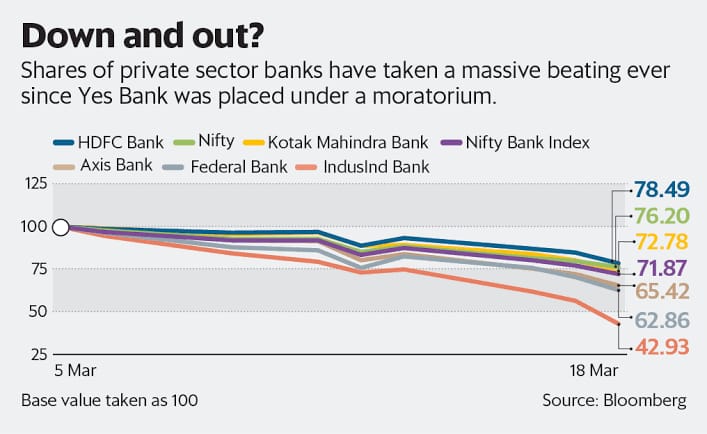
    Comparison of Yes Bank with competitor banks in 2020.
    Comparison of Yes Bank with competitor banks in 2020.

    The RBI imposed a limit of ₹50,000 on withdrawals by depositors and superseded the board of directors of Yes Bank for 30 days. It also announced a reconstruction scheme for Yes Bank involving an infusion of ₹10,000 crores by a consortium of eight lenders led by the State Bank of India (SBI).

    The reconstruction scheme was approved by the government and the RBI lifted the moratorium on Yes Bank on March 18, 2020. However, Yes Bank still faces challenges in restoring its credibility and profitability in the market.

    Takeaways from Yes Bank Crisis

    The case study of Yes Bank shows how important it is to research a company before investing in it. But how do you research a company? What are the sources of information, and what are the parameters to look at?

    What are the benefits of research before investing?

    Researching a company before investing in it can help you make more informed decisions about where to put your money. Here are some of the benefits of doing your homework:

    You have clarity about the company’s financial health

    When you read a company’s financial statements, you get the bigger picture of its revenue, net income, and other key financial metrics. This information helps you determine whether a company is profitable and financially stable.

    Below are the key financials of Yes Bank documented from 2020 to 2022. Ideally, every investor should have done detailed research prior to opting Yes Bank. This step can be done even when there are clear signs in the market revealing the company’s liabilities. It will help cover for your losses.

    Key Financials of Yes Bank from 2020-2022
    Key Financials of Yes Bank from 2020-2022

    You are aware of the company’s competitive advantages

    When you learn about what sets a company apart from its competitors, it gives you a “competitive advantage” over other investors as well. You get a clearer understanding of how your company is better than its competitors to help it succeed in the long haul.

    You understand the company’s management

    When you research about a company’s management, it helps you determine whether they are capable and trustworthy. A good management team can help a company succeed, while a bad team can lead to failure.

    Types of Research

    When researching a company, there are two key areas to focus on:

    Quantitative Research: This involves looking at the company’s business model, market position, and growth prospects. Learning about the company’s financials helps you understand the risks and potential rewards associated with the investment.

    The below image shows data about Yes Bank’s bad loans for the years 2019 and 2020. It explains clearly how the bad loans doubled from 2019 to 2020. It also highlights how crucial it is to research the financials of the company.

    Under-reported Bad Loans of Yes Bank from 2019-2020
    Under-Reported Bad Loans of Yes Bank from 2019-2020

    Qualitative Research: This involves looking at the company’s management team, competitive advantages, and overall business model. This information can give you a better understanding of the company’s long-term prospects.

    For example, let’s see what qualitative research on Yes Bank (prior to the crisis) would look like.

    Below are two points from the analysis:

    Strong marketing strategies: Yes Bank is seen to be strong on the marketing front, which means they are actively spending to aim for better reach in the public.

    This can be observed from its Ad campaigns in mainstream newspapers, television, and print advertisements as its promotional activities. It is also active on social media platforms like Facebook, Instagram, Twitter, and YouTube to attract more clients.

    Use of Digital in Rural Areas: The use of digital media for banking and financial purposes is not widespread in most rural regions. This means the bank has a possibility of losing out on a majority of the rural population.

    How to Research?

    There are several strategies you can use when researching a company:

    Reference Websites or Trusted Sources

    Look for reputable sources of information, such as financial news websites, investor blogs, or trusted investment advisors. These sources can provide you with valuable insights into a company’s financial health and prospects.

    For example, two trusted sources for market and business news are Reuters & Bloomberg.

    Narrow Your Focus

    Focus on key financial metrics, such as revenue, net income, earnings per share, price-earnings ratio, and return on equity. This will give you a good idea of the company’s financial health and help you determine whether it’s a good investment.

    VITTAE TIP: You can also google this vital information about any company. Every company by law has to be transparent about their bank statements. As a potential investor, you must look at the company’s finances and read up about its past financial statements as well.

    The below image is a screenshot of the Google Search Result Page after you type “Yes Bank share price” and look in the ‘Financials’ section. You can see how there is clear information about the Income Statement for every month in 2022. This particular bar-graph shows the revenue and net-income of Yes Bank.

    Yes Bank Income Statement in 2021-2022
    Yes Bank Income Statement in 2021-2022

    Tips & strategies when researching companies:

    Look at Industry Peers: Look at how a company compares to its industry peers. This can give you a good idea of whether it’s outperforming or underperforming relative to its competitors.

    Look at Historical Performance: Look at how a company has performed over the past several years. This can give you a good idea of whether it’s a stable and reliable investment

    Look at Analyst Reports: Look at reports from investment analysts to get an idea of what they think about the company’s prospects. Keep in mind that analysts can be biased, so it’s important to do your own research as well.

    In Conclusion

    Investing in the stock market can be overwhelming and confusing, especially for beginners. That’s why it’s essential to have a trusted guide like Vittae, dedicated to helping individuals like you reach their financial goals.

    Investors can customize financial plans that meet their specific needs and wants, ensuring that they stay on track to achieve their long-term goals. Our financial experts take the time to understand our client’s unique situations and provide personalized recommendations to help them make informed decisions.

    We believe in empowering investors by educating them about what’s important and what’s not, making the investment process. You can confidently navigate the complexities of the stock market and take control of your financial future. 

    Whether you are a beginner or an experienced investor, we can help you achieve financial growth by providing personalized financial planning and wealth management. You can navigate the complexities of the stock market with confidence and achieve your financial goals.

  • Beginners Guide to start an SIP

    Beginners Guide to start an SIP

    Have you ever checked off a to-do list, and noticed how there’s always that one item still yet to be checked? In the finance world, it’s often to “start investing”. 

    Every year, you aim for a bigger hike and better savings, but a step often overlooked is to start investing. Focused solely on increasing your savings, you miss out on investment opportunities to grow your savings faster.

    Did you know a basic Systematic Investment Plan (SIP) can start with as little as ₹ 500? SIP is an investment option that enables you to invest small amounts regularly. It’s a simple step, that’ll help you finally tick off “start investing” on your finance checklist. 

    Let’s understand what SIPs are, and how they can benefit you. We’ll also bust some common misconceptions about it and give 5 simple tips to start SIP. 

    What is a SIP? 

    Even the tallest wall is built brick by brick. SIP investments also work on the same fundamentals. A SIP allows you to invest a fixed amount in a mutual fund.

    The words mutual funds, compounding, fund schemes, debt funds, and investment plans often confuse an investment beginner. It’s also common that the popular disclaimer “Mutual Fund investments are subject to market risks” makes you question your SIP decision.

    So let’s break it down into even simpler terms. SIP stands for Systematic Investment Plan.

    While ‘systematic’ means being consistent about your investment, ‘plan’ keeps the consistency in check, for a fixed time.

    The letter S in SIP, according to us could also stand for “simple”. Cause, starting a SIP is exactly that. 

    It’s the investment you make in a “systematic” manner to reap maximum returns. 

    It’s totally up to you, the investor, to decide how regularly you want to invest. Either once in 7 days or once in 365 days. It’s these factors that show why SIP investments are not risk-free but risk-friendly.

    Every financial expert will tell you that any investment plan is not without risk, but they will strongly agree that an informed decision is a rupee well invested. Over a period of investing with discipline, you will be able to create wealth, from a sustainable mode of investment.

    A popularly known fact is that the rate of interest on SIP investments is usually higher than the rate of interest that you would be getting on a savings account in your bank.

    While the minimum balance amount for a savings account in a private bank is above ₹10,000, you can start investing in SIP for a minimum amount of ₹500. A SIP doesn’t require a lump sum amount but only a systematic approach. It’s highly likely you’ll benefit more from a small amount of systematic investment than saving a lump sum amount in a bank.

    It’s alright to feel confused at the beginning. For someone who is starting off with SIP investments, all the numbers and terms can seem like unfamiliar territory. Even Warren Buffett, an investment mogul, got reaps from his investments after he turned 50 years old. 

    That doesn’t mean you have to wait till you’re 50, It means you ought to be patient to reap phenomenal results. 

    Here are the simple steps on how to start a SIP in India:

    Keep the necessary documents ready 

    Make sure you have government-approved ID proof and address proof (Aadhaar card & PAN Card) in hand. Much like any formal/legal application, this too needs identity verification. You are also required to submit a Cancelled Cheque, which has your name printed on it.

    Keep all the necessary documents ready to save time. It’s important to save both, your rupees and your time.

    Get your KYC done

    Check with the updated norms of ‘Know Your Customer’ (KYC) and ensure you comply with them. Once you have all the above-mentioned documents, KYC is an easy step. The Know Your Customer process recognizes and verifies you as a customer. In this, your bank account is verified, while you have to also add a nominee. A nominee makes fund transfer easier in your absence. Be patient in this step.

    Register for a SIP 

    You need to register with an investment platform through a Financial Expert who is certified and follows

    the SEBI guidelines. This marks the beginning of your investment journey.

    Choose the right investment plan

    This is an important step that’ll depend on your saving capacity, which determines the returns you seek. As a beginner, it’s advised to rely on someone experienced. 

    Choose a SIP amount & date

    Once you have the SIP plan/scheme, choose the right amount that’s suitable for you. At Vittae, we believe that financial stability and freedom are unique to each individual. Opt for an amount that you’re comfortable with.

    Next, select a date that works for you. You can choose multiple dates within a month too.

    Submit the SIP form 

    Once all the above steps are finalized, submit the SIP form online/offline. This enables the investment platform to invest a certain amount regularly, on your behalf. This is the last step for you to begin your Systematic Investment Plan and start your SIP journey.

    The mathematical magic of any investment is that the amount you invest might be less, but the returns you get grow exponentially

    The best feature of SIP is that the majority of them don’t charge a penalty. All you have to do is sign into your account and opt out of the Systematic Investment Plan. Financial services like Vittae ensure that you’re on the right track, and continue to stay on that path. 

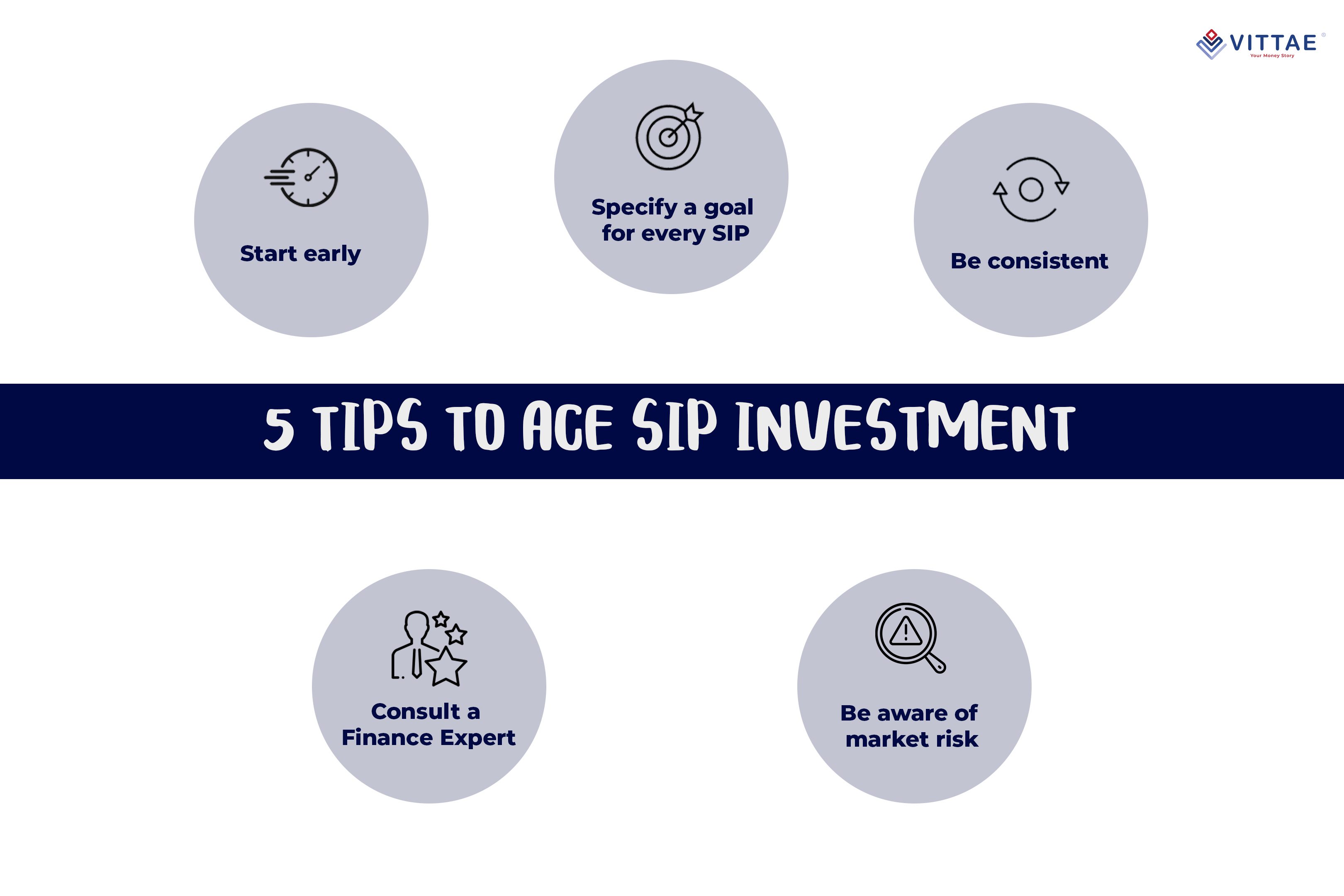
    Five simple tips to start an SIP

    Tips before starting an SIP

    The most crucial steps come not while investing through SIP but being consistent about it every month after it. 

    Wondering why we’re constantly reminding you to be consistent with your SIP investments?

    We wish you the best and want you to invest in regular intervals. This way, every month you will be by default converting your ‘money earned’ to ‘money saved’, even before it becomes ‘money spent’.

    This consistency brings your financial discipline and helps you get better returns in the future.

    Another wonderful advantage of investing in SIP plans is that you do not have to worry about the market. With SIP, you can avoid the stress that comes with “timing the market”.

    For example, when the stock market is low, you’ll be allotted say 30 units for ₹10,000. Similarly, when the stock market is high, you’ll get 20 units for the same amount.

    The SIP benefit is that on average, your net returns will be well-balanced. A bonus is that this allows you to diversify your portfolio, by starting multiple SIPs.

    5 Common Myths about SIPs

    SIPs are meant only for Investment Beginners

    As mentioned above, SIPs can be made even for a minimum amount of ₹500. It is a common misconception that SIPs are for beginners who want to start in a “small” and systematic way. The fact is, the amount of your monthly investment depends entirely on your saving capacity. So, irrespective if you start with a small or big amount, ensure to plan your investment wisely.

    SIP amount & tenure cannot be altered

    You, the customer have full control over how much money you want to invest, and for what time. If you are a full-time professional or a freelancer, your cash flow will be very different in both scenarios. Decide when and how much to invest in a SIP. Every rupee earned and saved is valuable, and you decide where it goes.

    SIP is a sure shot way to fast returns

    It’s a common mistake for investors to expect “guaranteed returns” on SIP as it’s the safest bet in mutual funds. The fact is, nobody can beat the market and the risks that come with it. However, if you stay invested for the long term, you do get the benefit of capital appreciation that in most cases, gives you net positive returns.

    SIP should be chosen in a bullish market

    When the market shows an upward trend, it’s known to be “bullish” in nature. Investment beginners don’t make any new investments assuming that they’ll be spending too much for too little.

    As explained, in SIP, consistent investments over a longer tenure result in top performance. It is likely that when you plan your SIP, you don’t factor in the nature of the market. Ensure to still be ‘systematic’ in your investment plan.

    SIP is a financial product

    SIP is an investment facility. It enables the investor i.e. you, to make regular investments. The amount you opt for will be deducted from your bank account and invested in the mutual fund scheme/plan chosen by you. The compounding effect will be calculated on your amount alone.

    In Summary

    If you are looking to start your money story and aiming to achieve financial freedom, now is the time to begin.

    Even with the market risks involved when you invest in SIPs regularly, we are positive your net returns will make you smile. Investment plans are not roller-coaster rides that are for the thrill of the moment, but like a sitcom with multiple seasons that you’ll enjoy over time.

    With Vittae Financial Experts, you’ll get personalized financial guidance that’ll lead you to grow financially. SIP is a first step, that’ll help you to look from a long-term perspective. For your savings to turn into wealth, you need to be both patient and wise. From understanding your own risk appetite to investing in your first SIP we wish you financial growth and wellness.

    In Warren Buffett’s words, “Someone’s sitting in the shade today because someone planted a tree a long time ago”.  A sapling takes time to grow into a tree. Similarly, your investments will also grow, provided you start early and are patient. There’s no better time than now, to start planning for your financial freedom.

  • 5 Factors to consider while choosing Mutual Funds

    5 Factors to consider while choosing Mutual Funds

    ‘Mutual funds are subject to market risks’- a line you now know by heart. It is essential that you do enough research to choose which fund house you want to invest in. After all, you know what’s best for you. There are a list of factors that you must keep in mind before investing in a Mutual Fund house. However, it can get a little overwhelming with all the finance jargon, numbers and whatnot. Vittae has curated an easy-to-reach package on the factors to consider while choosing Mutual Funds!

    Here’s a list of factors that you can watch out for:

    Asset under Management (<10,000 crore)

    Asset under management is the total market value of investments (Stocks, Fixed Deposits, Real Estates, etc.) owned or managed by an AMC on behalf of its investors. It is generally considered as a key indicator in measuring the success of financial institutions. It is not necessary that a higher AUM will guarantee higher returns for an investor but an Asset Management Company with an AUM < ₹10,000 Crore is advisable.

    Expense ratio

    Expense ratio is an annual fee charged by an Asset Management Company for the services that they offer. The components of an Expense ratio include Management fees, Fund manager fees, entry fee for joining a mutual fund house, exit fee while withdrawing from a mutual fund. 

    The Expense ratio will be higher if you choose to invest in a Regular Fund. In a Regular Fund, the AMC deploys a broker to carry out the buying and selling of the portfolio asset. An extra brokerage fee will be charged with a Regular Fund that shoots up the Expense ratio. On the other hand, Direct Funds do not carry this extra weight. All transactions happen by themselves. Unless you require a financial expert to bridge any gaps and help you choose funds, it’s best to go for Direct Funds.

    Past performance

    One year’s top-performing mutual funds aren’t necessarily going to be the next year’s top performers. Past performances could be a little deceptive as they don’t reflect the performance of the fund in the future. You can keep a check on the performance by scaling it against the benchmark. There is a benchmark for every category of mutual fund. A healthy mutual fund is one that consistently beats the benchmark. For example, the performance of Axis Small Cap Fund in a 5-year window has been 20.72% and the benchmark for the small cap category at 9.08%. The excess money it generates after shooting past the benchmark is called the ‘alpha’. Higher the alpha, the higher returns you get.

    Fund manager philosophy

    An investment philosophy is a set of beliefs and principles that sets the ball rolling from a fund manager’s point of view. It is what guides a fund manager’s decision-making process. Read the fine print in the Scheme Information Document (SID) before you set foot in an AMC.

    Risk tolerance

    Risk tolerance is the degree of risk an investor is willing to brave. Investors with a long-term investment horizon generally tend to be aggressive risk seekers. While investors who seek short-term goals tend to be conservative and opt for safer roads to assure their money is safe. Keep in mind, high returns warrant higher risks. One must be aware of their risk appetite and financial goals before choosing an Asset Management Company. 

    Investing in Mutual Funds could really bring out who you are as an individual. Things may look like they’re going downhill in the first couple of months after you first invest. You may feel like jumping fund houses or even selling your mutual fund units at a loss in the fear of losing money. Hold up. The night is always the darkest before dawn. Contrary to what you think, jumping fund houses will actually shrink your investment return. You would only end up buying high and selling low. Patience and discipline are like the two wings of a plane that generate the thrust to push the airplane forward through the air.

    Do not judge the performance of a fund house after a few months. Focus on your long-term goal. You don’t want to abandon a potentially successful investment because of short-term volatility. Sit back and let it grow.

    Glossary

    Scheme Information Document – A document that sets forth concisely all information about the Scheme that a prospective investor ought to know before investing. It lets the investors ascertain about any further changes before investing.

    Asset Management Company – An asset management company is a firm which pools funds from the investors and invests it into different investment options such as equities, debt, real estate, gold etc. 

  • Basics of Mutual Funds | How to start investing in Mutual Funds?

    Basics of Mutual Funds | How to start investing in Mutual Funds?

    What is a Mutual Fund?

    A Mutual fund is an investment house where investors come together to pool their funds. The fund manager then invests the pooled-in funds in equities, bonds, real estate, gold, and other asset classes to generate higher returns. The gains/losses incurred from such investments are mutually divided among the investors in the ratio of their investments. This is also why it is called ‘Mutual’. Let me explain the basics of mutual fund with an example.

    For instance, you and your friend invest INR 2000 and INR 1000 in a mutual fund. And the gains obtained from the total investment after a month is INR 1500. This is split in the ratio of their investments– 2:1. Which means, you will end up with INR 3000 and your friend with INR 1500 after a month. This idea, when replicated at a larger scale with thousands of investors coming together, is termed a mutual fund.

    Why Mutual Funds?

    • Managed by Experts

    The whole job of fund managers is to safeguard the wealth of investors. Your portfolio is managed by these experts who conduct extensive research and due diligence on buying & selling of stocks. These seasoned finance experts who are skilled in managing investments, decide where and when to invest in equities, debt, gold, and other asset classes. 

    • Higher Returns

    As the adage goes “Don’t put all your eggs in one basket”, mutual funds diversify their investments into different financial instruments. This strategy of diversification has played a vital role in driving the popularity of mutual funds. The fund manager spreads your investment across a cross-section of stocks from companies of different industries. Hence, when one industry doesn’t perform well, the gains from other sectors can offset the losses from the adversely performing sector.

    • SEBI-Regulated

    Mutual funds are regulated by Securities and Exchange Board of India (SEBI), whose main objective is to protect the interests of investors, promote their development and regulate the securities market. It is also SEBI that approves an Asset Management Company to manage funds by investing across industries.

    • Affordability

    You can start investing in mutual funds with as low as INR 100.

    • Liquidity

    Liquidity implies the ease of converting an investment into cash. Liquidity is higher in Mutual Funds. This means, you can sell your investments and pull out the money anytime.

    Categories of Mutual Funds

    Mutual funds are categorized based on the asset class they invest in. Here are the categories:

    Equity Mutual funds

    Equity mutual funds invest a major chunk of their funds in stocks. It is best suited for investors seeking long-term growth as it could be volatile in the short-term. High risk, higher returns. Further, Equity Mutual Funds are categorized into different categories based on the market capitalization of the stocks they invest in. 

    *invests across stocks of different sectors and segments of the market.

    Debt Mutual funds

    Debt mutual funds invest their assets in corporate or government securities like T-bills, Corporate bonds, commercial papers, government securities, and other market securities. This is a lower-risk asset when compared to Equity. Low risk, low returns. They are classified into different categories based on the duration of their investment period. 

    Hybrid Mutual Funds

    Hybrid Funds offer you the best of both worlds. A mix of Equity & Debt. High returns from Equity when the markets perform well and regular income from Debt to cushion the tailwinds when markets go south. The fund manager also invests in Gold & international equities, depending on the investment objective. Since your portfolio becomes diversified, the risk of losing money decreases.

    How to Invest in Mutual Funds?

    • SIP

    Systematic Investment Plan (SIP) is a mode of investment that offers you the option to invest a fixed sum at regular intervals. Instilling discipline in investors, it allows investors to make regular & automated investments periodically. 

    • Lumpsum

    A lump sum mode of investment is when investors make a bulk one-time investment. Unlike SIPs, this is invested in one-go!

    If you’re someone with little to no time to research & identify the right stocks then mutual funds are a good option. You can consult a financial advisor to choose the right mutual fund for you.

  • How to pick the right Mutual Fund for you in 2022? 

    How to pick the right Mutual Fund for you in 2022? 

    Mutual funds have been proven to be a very successful way to begin one’s investment journey. As an investor, it’s the best investment avenue to begin your journey without having to know much about equity markets, indexes or even how the economy is performing.

    But as a new working individual I personally struggled with picking the right fund. And not surprisingly I, like many of you, would google “Best mutual funds for highest returns”. But is that really the right way to go about a personalized suggestive option?

    Of course not!

    But don’t worry, you don’t have to go through the same struggle I did.

    How to select right mutual funds?

    Investments are not a ‘One size fits all’ type of assets. They are supposed to be personalized based on your expectations, needs and comfort levels. Hence, these are some of the points that you should keep in mind while selecting a suitable fund for yourself:

    Right Mutual fund in 2022

    1. Your Personal Objective – Be mindful of what you are trying to achieve with your investment. Whether it’s a foreseeable major expense like your wedding, a future trip abroad, an emergency fund, your child’s education, your retirement, or even something for your family, make sure you have a clear reason for this investment.

    This objective will help you decide 2 things

    a) A timeline – What your investment’s duration should be.

    b) How risky/ risk-free should you be in order to choose the fund.

    2. Risk Appetite- Risk is a very interesting point here. People between the ages of 22 to 28 are generally ‘risk seekers’. To state the obvious, these are people who in general have lesser debt, lower obligations and have the bandwidth to take on additional risk.

    There after funds that contribute to over 85 to 90% of the funds AUM* to just equity. This makes the fund riskier but it is able to generate higher returns too. (Remember, an investor always looks for additional compensation when he takes more risk. Hence, a high risk to high reward ratio is seen amongst different funds)

    Now, for people over the age of 29, Risk becomes a critical factor. People in this age bracket are generally more cautious about their finances because of responsibilities, debt and other things.For them a fund that has a good balance of both Equity and Debt is preferrable. 20 – 35% of AUM may be dedicated to Debt funds making the fund safer & more stable.

    3. A Suitable Fund – Now that you have a goal in mind with the required time line and risk appetite, look for funds that help you reach the required returns percentage. 

    How do you do that? Well, an easy way is to compare the returns percentage that the fund has made over the required tenure (for eg say 3 years) to the returns made by the Indian Indexes such as Nifty & Sensex. If your fund beats or equates that return percentage, you are good to go. 

    For Example – My 3-year goal is to buy a car for  X amount of rupees. My money has to grow at a continuous interest rate of 15%. I would look for a fund that has been consistently performing well and one that gives me a return of at least 20% CAGR*.

    Types of Funds:

    • Equity Schemes – These are funds that are high risk and have a high return potential. These are ideal for investors in their prime earning stage, looking to build a portfolio with superior returns in the long term.
    • Money Market Funds – These are funds that invest in short term debt instruments, giving a sustainable and stable return. These types of funds are suitable for investors with low risk who are looking to park their surplus over a short term.
    • Fixed Income or Debt Funds – These funds would have majority of their investment in debt instruments such as government securities (G-sec), bonds and debentures. Ideal for low-risk investors who are looking for a steady income.
    • Balanced and Hybrid Funds – Funds that have a good mix of both Equity and debt. The allocation of the AUM would keep changing based on how the sectors are performing in the current market sentiment. Since it’s a combination, the returns would be moderate to high depending on the allocation.

    So do your research to identify the right mutual funds that match with your expectations, needs and comfort levels. 

    If you find this whole process overwhelming, you can always hire an Advisor who can help you with this!

    Glossary

    AUM – Asset Under Management means the total value of the fund being invested by the fund house.

    CAGR – Compounded annual growth rate is the annualized average rate of revenue growth between two given years, assuming growth takes place at an exponentially compounded rate.

    NAV – The performance of a particular scheme of a mutual fund is denoted by NAV (Net asset value). NAV is the market value of securities held by the scheme.

  • Why is SGB the best option to invest in Gold?

    Why is SGB the best option to invest in Gold?

    Alongside China, India is by far the world’s largest importer and consumer of gold. Gold is one of the most preferred investments in India. With over 95% of Gold being imported, the yellow metal turns adverse to India’s forex reserve. To address this problem, Government of India launched Sovereign Gold Bonds (SGBs) in 2015 under the ambit of the Gold Monetisation Scheme.

    The objective of the scheme was to cut down the demand for physical gold and shift a part of the domestic savings (used for the purchase of gold) into financial savings. 

    SGBs are government backed securities, issued by the Reserve Bank of India (RBI) on behalf of the Indian government. Investors have to pay the issue price and the bonds will be redeemed upon maturity.

    How to buy Gold Bonds? 

    SGBs can be ordered through the Net-banking option of banks, from designated Post Offices, Stock Holding Corporation of India Ltd. (SHCIL) or even through authorized stock exchanges. Investors can also download the application from RBI’s website or through bank sites.

    Sovereign Gold Bond
    Sovereign Gold Bond

    Who can invest through SGBs?

    “Residents” in India as defined under Foreign Exchange Management Act, 1999 are eligible to invest in SGBs. Eligible investors include individuals, HUFs, trusts, universities and charitable institutions. Joint holding is allowed in SGBs. For minors, the application has to be made by his/her guardian(s).

    Can NRIs invest in SGBs?

    Only residents of India are eligible to invest in SGBs. Individual investors with subsequent change in residential status from resident to non-resident may continue to hold SGBs until early redemption/maturity.

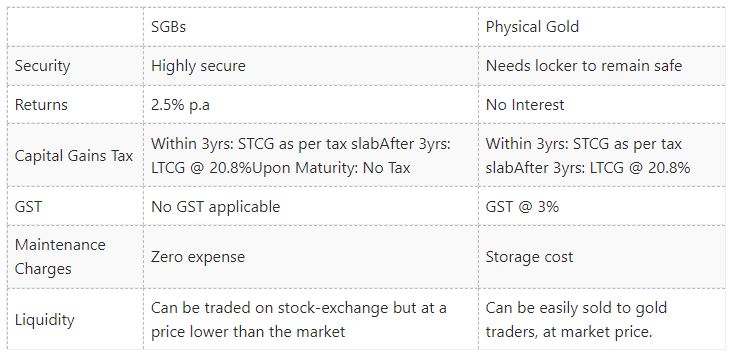
    SGBs vs Physical gold


    SGB vs Gold
    • SGBs offer a superior alternative to holding gold in physical form since the risks & costs of storage are eliminated. SGBs are free from issues such as making charges and purity in the case of gold held in the form of jewelry. 
    • The flip side of SGBs is their fixed lock-in period. SGBs are issued for a fixed term of eight years with an option to redeem them from the fifth year onwards at the RBI buyback window.
    • Also, if gold bonds are sold prematurely on the stock exchange before three years, then they will attract short-term capital gains tax (STCG) as per the investor’s slab rate. But if they are sold after three years, then long-term capital gains tax (LTCG) of 20 per cent will be applicable, and the investor will also get indexation benefits. And, if one were to hold the bonds until maturity, or until the RBI buyback window, then capital gains tax will not be applied. 

    Price of Sovereign gold bond

    The Reserve Bank of India (RBI) fixes the issue price per gram for each tranche by calculating the simple average of the closing prices of 999 purity gold as disclosed by Indian Bullion and Jewellers Association (IBJA) on the last three working days before the week marked for the subscription.

    Our Take

    Buying gold jewelry isn’t an investment. But if the idea is to remain invested in Gold, then SGB is the best option in the market. Along with capital gains, investors are paid interest rate. NO GST during purchase and NO Capital gains tax on sale. And also, India need not shell out dollars from its reserve. It’s a win-win situation.

  • Is It The Right Time To Start Gold Investment?

    Is It The Right Time To Start Gold Investment?

    Gold Investment is considered to be an all weather investment. More than an investment, Gold is treated as an insurance for all the other investments. It is a hedge against inflation.

    During an economic downturn while asset classes such as stocks, mutual funds and real estate may tumble, Gold would still sustain and outperform them. This is the reason why portfolio managers always insist on having a fair share of your investments in gold.

    Gold_Investment

    Today, we see the stock markets across the globe have become more volatile due to geo-political tensions with Russia- Ukraine conflict and stringent covid-lockdown in China. Fears of economic recession and increase in Fed rates has created the perfect situation for gold to skyrocket again.

    Is this the right time to invest in gold? Ideally, yes. Stock markets are down, cryptos have crashed and real estate is yet to recover. Gold at its present value looks attractive. Experts believe people will shift their focus to gold if stock don’t recover soon.

    Gold’s performance in the last 20 years

    The annualized return from march 2000 to march 2020, Nasdaq 100 had a return of 2.5 percent, S&P 500 gave a return of 4 percent whereas gold gave a return of almost 9 percent. 

    In 2020, gold delivered an annual average return of 24.6 percent. Over the last 40 years gold provided an average annual return of 9.6 percent and negative returns only at 8 instances. 

    Stock Vs Gold performance during the economic crisis

    During the 2008 global financial crisis, while the stock market fell as much as 60 percent, gold remained unaffected and in fact it grew by 6 percent. The same would be visible with multiple other crisis situations like the East-Asian crisis. 

    This clearly indicates that gold is a safe bet when it comes to economic downturns. 

    How to start gold investment? 

    There are multiple options to invest in Gold like buying physical gold, Gold ETFs or Sovereign Gold Bonds (SGBs). 

    • Physical Gold can be purchased in the form of coins or bars. Buying jewelry isn’t an investment.
    • A gold ETF is a type of ETF that can be purchased or sold on a stock exchange like any regular stock. The option eliminates storage costs & security risks of holding physical gold but comes with an expense ratio and Capital gains tax.
    • SGBs are substitutes for holding physical gold. SGBs are less risky as they are guaranteed by the government. But there is more to add, these bonds offer 2.5% interest and NIL Capital Gains tax if they are redeemed by completing the term(8years).

    Options like SGBs and Gold ETFs are termed as Paper-Gold which obviates the need to buy physical gold and store them while assuring the same return.

    If the World Bank & IMF are to be believed, the global economy is slowing down significantly due to covid and geo-political tensions. Global trade has shrunk. And stocks, mutual funds, cryptos, real estate will see a major correction. Smart investors looking for better investment options would definitely find gold as their best bet. So it’s time for you to become smart by starting to invest in gold.