Category: General

  • The Remarkable Journey of Apple Inc.

    The Remarkable Journey of Apple Inc.

    In the heart of Silicon Valley, amidst the hustle and bustle of tech giants and startups alike, there’s a company that stands tall. It casts its long shadow over the world of technology and innovation. 

    This is the incredible journey of Apple Inc., a company that started in a garage and went on to revolutionize the world.

    The Humble Beginnings (1976-1985)

    Long ago in 1976, two young and creative guys named Steve Jobs and Steve Wozniak started a company called Apple. They began their journey in Steve Jobs’ parents’ garage, dreaming of making computers that regular people could use.

    Their very first creation was called the Apple I, which was a super important step in the world of computers. It was made by Wozniak and was like a tiny computer on a single board. They sold it in a local computer shop after investing $1,300 to get started.

    Then, in 1980, Apple became a big deal when it went public, which means they started selling shares of the company to people. They raised a huge amount of money, $100 million, which was a record back then. It made Apple one of the fastest-growing companies in the United States. They got there thanks to their Apple II series of computers, which were known for their cool graphics and easy-to-use interface.


    The Macintosh Revolution (1984-1990)

    In the 1980s, Apple introduced more products, but the Macintosh computer stood out as a game-changer in the personal computer world. In 1984, Apple ran a groundbreaking ad during the Super Bowl, presenting the Macintosh as a computer “for everyone.” What made the Macintosh special was its easy-to-use graphical interface and a mouse for navigation, which made it simple and approachable.

    Despite its promising start, the Macintosh didn’t immediately become as popular as expected. It didn’t sell well, and there were conflicts within the company that led to Steve Jobs leaving in 1985. However, even after he left, Steve Jobs’ vision continued to shape Apple’s direction.

    The Dark Ages (1991-1996)

    The early ’90s were a tough time for Apple Inc. The company faced stiff competition from Microsoft’s Windows operating system, and its product lineup was fragmented. The Macintosh line, once a symbol of innovation, seemed to be losing its shine.

    In 1996, Apple found itself on the brink of disaster. The company was bleeding money, and its market share had dwindled. It was in this dire situation that Apple made a critical decision – it brought Steve Jobs back into the fold.

    The Resurrection (1997-2001)

    When Steve Jobs came back to Apple, things started getting much better. He made the product lineup simpler and encouraged innovation. In 1998, they released the iMac, which looked cool and brought USB ports to regular people’s computers.

    But the big moment came in 2001 with the iPod. It was a small device that could play music, and it completely changed how we listen to music. It also set the stage for Apple Inc. to become huge in consumer electronics. When they connected the iPod to iTunes, it became super easy to use and hard to resist.

    The Era of the iPhone (2007-Present)

    June 29, 2007, marked a historic day when Apple unveiled the iPhone. This sleek, touchscreen device combined a phone, an iPod, and an internet communicator into one. It was an instant hit, and lines formed outside Apple stores as people eagerly waited for their chance to own one.

    The iPhone’s popularity turned Apple Inc. into the big tech company it is now. It also brought us the App Store, which was a game-changer for both app creators and users. As time went on, each new version of the iPhone got faster, stronger, and more creative.

    Besides the iPhone, Apple released other revolutionary gadgets, like the iPad in 2010 and the Apple Watch in 2015. These products made sure that Apple stayed at the top of the tech industry.

    The Legacy (2020-Present)

    The company continued to innovate, focusing on areas like augmented reality, services (Apple TV+, Apple Music, Apple Arcade), and sustainability. Apple’s commitment to reducing its environmental footprint was evident in its efforts to make its entire supply chain carbon-neutral.

    The COVID-19 pandemic posed challenges, but Apple adapted swiftly, emphasizing remote work and enhancing its online retail experience. The release of the M1 chip, Apple’s first ARM-based processor for Macs, showcased the company’s ongoing commitment to designing its own hardware.

    What Lies Ahead (2023 and Beyond)

    In the fast-paced world of technology, it’s challenging to predict Apple’s future. However, we’ve considered a few key trends and possibilities:

    Continued Innovation

    Apple’s dedication to innovation is unlikely to wane. Expect more groundbreaking products and technologies in the coming years, possibly in the fields of augmented reality, electric vehicles, and healthcare.

    Sustainability

    Apple’s push for sustainability is likely to intensify. The company aims to be entirely carbon-neutral by 2030, and this commitment will drive changes in its products and supply chain.

    Services Growth

    Apple’s services segment, including Apple Music, Apple TV+, and Apple Arcade, is also expected to grow. The company will likely expand its service offerings, potentially entering new markets.

    Privacy and Security

    As privacy concerns continue to mount, Apple’s focus on user data protection expected to remain a priority. This could lead to further developments in privacy features and regulations.

    Market Challenges 

    Apple faces ongoing scrutiny from regulators regarding its market dominance and App Store policies. How the company navigates these challenges will shape its future.

    In conclusion, the journey of Apple Inc. is a captivating tale of innovation, resilience, and vision. 

    From its humble beginnings in a garage to its current status as one of the world’s most valuable companies, Apple has consistently pushed the boundaries of what technology can achieve. 

    As we look ahead, one thing is certain: Apple’s journey is far from over. The next chapters promise to be just as exciting and transformative. Apple has repeatedly proven that it can shape the future, and we eagerly anticipate what it will bring to the world next.


     

  • Multi-Cap Funds v/s Flexi-Cap Funds

    Multi-Cap Funds v/s Flexi-Cap Funds

    Investing in mutual funds offers individuals an array of options to grow their wealth. 
    When it comes to choosing mutual funds, multi-cap and flexi-cap funds are two popular options for investors looking to build diversified portfolios with different degrees of flexibility. In this blog post, we’ll explore the essential distinctions between Multi-Cap Funds and Flexi-Cap funds.

    Market volatility can significantly impact the performance of multi-cap and flexi-cap funds, making it essential for investors to carefully assess their risk tolerance and investment objectives.

    This will empower you to make a well-informed decision when deciding where to invest your valuable funds.

    Let’s dive into the details to make this comparison clearer for you.

    Multi-Cap Funds


    Multi cap funds, short for “multi-capacity,” are mutual funds that spread their investments across various market capitalization segments. This typically includes large-cap funds, mid-cap stocks and small-cap stocks.

    SEBI introduced explicit directives on September 11, 2020, outlining the prescribed asset allocation for Multi-cap Mutual Funds.

    These funds are mandated to maintain a minimum of 75% of their assets in equity and equity-related instruments at all times. The portfolio must be diversified, with a minimum allocation of 25% to large-cap stocks, 25% to mid-cap stocks, and an additional 25% to small-cap stocks.

    The primary goal of multi-cap funds is to offer investors a comprehensive and diversified portfolio that can adjust effectively to evolving market conditions. Let’s delve into some key characteristics of multi-cap funds for a clearer understanding:

    Diverse Investment Universe

    Multi cap funds are like all-access passes for investing. They can put your money in different-sized companies, different types of businesses, and various industries. This wide range of choices lets the people who manage the fund take advantage of opportunities, big to small, in the stock market.

    Risk-Return Profile

    Multi cap funds offer a balanced risk-return profile. By investing in a mix of large-cap, mid-cap, and small cap stocks, these funds aim to provide a blend of stability and growth potential. They can perform well in different market cycles.

    Active Management

    Most multi-cap funds are actively managed, meaning experienced portfolio managers make investment decisions based on their analysis of market conditions and individual stocks. This active management approach aims to outperform the benchmark index.

    Diversification

    Multi-cap funds inherently offer diversification benefits because they invest in a wide range of stocks. This diversification helps spread risk across various asset classes and industries, reducing the impact of poor performance in a single sector or stock.

    Investor Profile

    Multi-cap funds are suitable for a broad range of investors, from conservative to aggressive. They can be a core holding in a well-balanced portfolio or serve as a standalone investment, depending on an investor’s risk tolerance and financial goals.

    Tax Efficiency

    Multi-cap funds may be tax-efficient for long-term investors because they often have a lower portfolio turnover compared to some other actively managed funds. This can lead to reduced capital gains taxes.

    Flexi-Cap Funds

    Flexi-cap Funds, on the other hand, are a relatively newer category of mutual funds that offer investors even greater flexibility when it comes to portfolio construction.

    These funds allocate investments across different market capitalizations, allowing fund managers the flexibility to adjust their portfolio compositions

    These funds have gained popularity in recent years due to their adaptive approach to investing. Here are some key characteristics of Flexi-cap funds:

    Absolute Flexibility

    Flexi-cap funds have the freedom to invest in stocks of all sizes, ranging from large, well-established companies to smaller, promising ones. They don’t have strict rules about how much they should invest in each category, so fund managers can decide how to balance the portfolio as they think best.

    Market-Centric Approach

    Flexicap funds focus on identifying opportunities in the market rather than adhering to predefined allocation ratios. This means that fund managers can increase exposure to sectors or market segments that they believe will perform well. This is regardless of the market capitalization of the sectors they choose.

    Active Management

    Like multi-cap funds, flexi-cap funds are typically actively managed. Fund managers have the discretion to make investment decisions based on their outlook for individual stocks, sectors, and the overall market.

    Risk-Return Profile

    Flexi-cap funds can make more money for you, but they can also be riskier because there are no strict rules about where to invest. This means your investments might go up and down a lot more, so you should be ready for that.

    Investor Profile

    Flexicap funds are better suited for investors who have a higher risk tolerance and are comfortable with greater portfolio flexibility. These funds are not typically recommended as core holdings but can complement a diversified portfolio.

    Performance-Based Strategy

    The performance of flexicap funds can be highly dependent on the fund manager’s skill in identifying opportunities and managing risk. Investors should carefully research the track record and expertise of the fund manager before investing.

    Key Differences Between Multi-cap and Flexi-cap Funds

    Investment Universe

    Multi-cap funds invest in a predetermined mix of large-cap, mid-cap, and small-cap stocks, while flexi-cap funds have no specific allocation requirements, allowing for more extensive flexibility in-stock selection.

    Allocation Rules

    Multi-cap funds follow a set allocation strategy, which may change over time based on market conditions. Flexi-cap funds, however, have no predefined allocation rules and can adapt more dynamically.

    Risk-Return Profile

    Multi-cap funds offer a balanced risk-return profile, whereas flexicap funds tend to be riskier due to their greater flexibility and the potential for higher returns. You can take a call as to which funds are suitable for you based on your risk appetite.

    Investor Profile

    Multi-cap funds are suitable for a broad range of investors, including those seeking a well-rounded, diversified portfolio. Flexi-cap funds are better suited for investors with higher risk tolerance and a preference for more active portfolio management.

    Performance Dependence

    The performance of multicap funds is often influenced by broader market movements and sector allocations, whereas the performance of flexicap funds is highly dependent on the fund manager’s stock selection and timing decisions.

    Choosing Between Multicap and Flexicap Funds

    Selecting between multicap and flexicap funds ultimately comes down to your individual investment objectives, risk tolerance, and investment horizon. Here are some considerations to help you make an informed decision:

    Risk Tolerance

    If you are risk-averse and prefer a more stable investment, multicap funds may be a better choice. However, if you are comfortable with higher volatility in pursuit of potentially higher returns, flexicap funds could be appealing.

    Investment Horizon

    Your investment horizon plays a crucial role. Multicap funds are often recommended for long-term investors looking for steady growth. Whereas, flexicap funds may be more suitable for those with shorter investment horizons who can actively manage their portfolios.

    Portfolio Diversification

    If you already have a diversified portfolio but let’s say you want to add a more dynamic element. Then, flexicap funds can complement your existing holdings. On the other hand, multicap funds can serve as a core holding in a diversified portfolio.

    Fund Manager Expertise

    Research the fund manager’s track record and investment approach. A skilled fund manager can significantly impact the performance of both multicap and flexicap funds.

    Risk Management

    Consider your ability to actively manage your investments. If you have the time and expertise to monitor your portfolio and adjust your asset allocation. Then, you may be more inclined to invest in flexicap funds. However, if you prefer a hands-off approach, multicap funds can provide stability.

    Conclusion

    Both multicap and flexicap funds have their advantages and cater to different investor preferences. 

    Multicap funds offer a more structured and balanced approach to investing, making them suitable for a wide range of investors. 

    Flexicap funds, on the other hand, provide greater flexibility and the potential for higher returns. But, they come with higher risk and require more active management.

    Your choice between multicap and flexicap funds should align with your financial goals, risk tolerance, and investment horizon. 

    It’s essential to carefully assess your individual circumstances and conduct thorough research. This includes evaluating the track record of fund managers, before making your investment decision. 

    Diversifying your investments across different asset classes and fund categories. This can also be a wise strategy to manage risk and achieve your financial objective

  • 3 must-have financial experts in life

    3 must-have financial experts in life

    Introduction

    Navigating the world of finance and accounting can feel like a confusing journey. Yet, there’s a shortcut to success: having the right experts by your side. Think of it as turbocharging your progress toward your financial goals and securing your financial well-being.

    In this blog, we’re here to shed light on the roles of three essential professionals who should be part of your financial squad: the Financial Advisor, the Accountant, and the Chartered Accountant (CA).

    Each of these financial experts has a unique role to play in helping you make sense of the complex terrain of money management and personal finance. Join us as we delve deeper into why you need them and how they can be your guiding stars on your financial voyage.

    Why do you need a Financial Advisor?

    A Financial Advisor is like a navigator for your financial voyage. Their primary role is to help you set clear financial goals and create a meticulously tailored plan to achieve them. Here’s why you need a Financial Advisor:

    How can they help you?

    Goal Setting

    A Financial Advisor assists you in identifying and crystallizing your short-term and long-term financial objectives, whether it’s buying a home, saving for retirement, or funding your child’s education. They help you prioritize and establish a road map to reach these milestones.

    Investment Guidance

    Investing can be overwhelming due to various options and risks. Financial advisors guide you on where to put your money, considering your risk tolerance and financial goals.

    Risk Management

    Financial Advisors evaluate and help you deal with financial uncertainties by figuring out how comfortable you are with taking risks. They develop plans to safeguard your money from unexpected events, so your finances stay safe.

    Retirement Planning

    They make custom retirement plans that match your idea of a comfortable and secure retirement. They consider your current money situation and future needs to create a complete strategy.

    Tax Efficiency

    Financial Advisors assist you in finding ways to pay less in taxes legally and efficiently, all while making sure you follow the tax rules.

    Why do you need an Accountant?

    An accountant serves as a meticulous record-keeper for your financial matters. They’re experts in organizing your financial paperwork, making sure you follow tax rules, and keeping your financial information accurate. Here’s why you should have one:

    How can they help you?

    Financial Record Keeping

    Accountants maintain detailed financial records, tracking income, expenses, and transactions. This meticulous record-keeping is crucial for accurate financial reporting and ensuring transparency.

    Tax Compliance

    Tax regulations are constantly evolving, making it challenging for individuals and businesses to stay up-to-date. Accountants prepare and file your tax returns, ensuring compliance with ever-changing tax laws and helping you maximize deductions and credits.

    Financial Analysis

    Beyond record-keeping, Accountants provide insights into your financial performance by analyzing your financial statements. They identify trends, opportunities, and areas that may require adjustments, empowering you to make informed decisions.

    Budgeting and Forecasting

    Accountants help you create and manage budgets, ensuring your financial resources are allocated optimally. They also assist with financial forecasting, providing a roadmap for future financial decisions.

    Business Support

    For people who own businesses, accountants are really important. They help plan finances, keep all the money records, and make sure the business can stay financially healthy. They can also give advice on how to spend less, make more money, and follow the rules.

    Why do you need a Chartered Accountant (CA)?

    Chartered Accountants are like a Marine Surveyor on your financial voyage, with high expertise and technical skills to guide you.

    Often referred to as CAs, Chartered Accountants are highly skilled experts in accounting and finance. They bring a wealth of knowledge to the table, specializing in auditing, and financial analysis, and offering strategic financial advice. Here’s how a CA can make a difference for you:

    How can they help you?

    Auditing

    CAs meticulously examine financial statements to ensure they’re accurate, transparent and comply with all the rules. These audits are vital for gaining the trust of investors and regulators.

    Strategic Financial Advice

    CAs provide strategic financial guidance to individuals and businesses, helping them make informed decisions that align with their goals. Their deep understanding of financial markets and regulations is invaluable in complex decision-making.

    Tax Planning

    CAs offer valuable advice to individuals and businesses, helping them make smart financial decisions that match their goals. Their deep knowledge of financial markets and rules is incredibly helpful when facing complex decisions during tax planning.

    Risk Assessment

    CAs are great at figuring out financial risks and suggesting ways to lower them. This protects your financial stability, and their strategies are like a safety net for your wealth.

    Complex Financial Transactions

    CAs can tackle tricky financial transactions, like mergers, international taxes, and investment portfolios. They make sure these transactions happen smoothly, efficiently, and in a way that’s best for your money.

    In Conclusion

    In the world of your personal and business money matters, having a group of experts isn’t just helpful, it’s something you really need.

    • Financial Advisors help you plan your financial path.
    • Accountants keep your money records in tip-top shape.
    • Chartered Accountants tackle the tough financial stuff.

    Working with these pros isn’t just smart; it’s necessary. They help you reach your money goals, lower risks, and secure your financial future.

    Don’t wait—get these essential experts on your side. They’re your best buddies on your money journey.

  • Understanding Your Payslip

    Understanding Your Payslip

    Introduction

    Opening your payslip can be quite a puzzling experience. We all eagerly search for that bottom-line figure – our take-home pay. But more often than not, it goes a little like this:

    “Great, payday! Wait, that’s not what I expected. How much are they taking for taxes? And what’s that other deduction? Can’t be right… ?”

    Does this sound familiar to you? 

    In this blog, we’ll help you understand your payslip, to help you make better financial decisions. We hope this comprehensive guide empower you with information to decode your payslip. 

    What is a Payslip?

    Let’s start by defining a payslip. At its core, a payslip is a document that your employer issues, typically on a monthly basis, detailing your earnings and deductions for a specific pay period. 

    This tangible record of your salary serves as a financial compass, helping you navigate the intricacies of your income, taxes, and other financial aspects related to your employment.

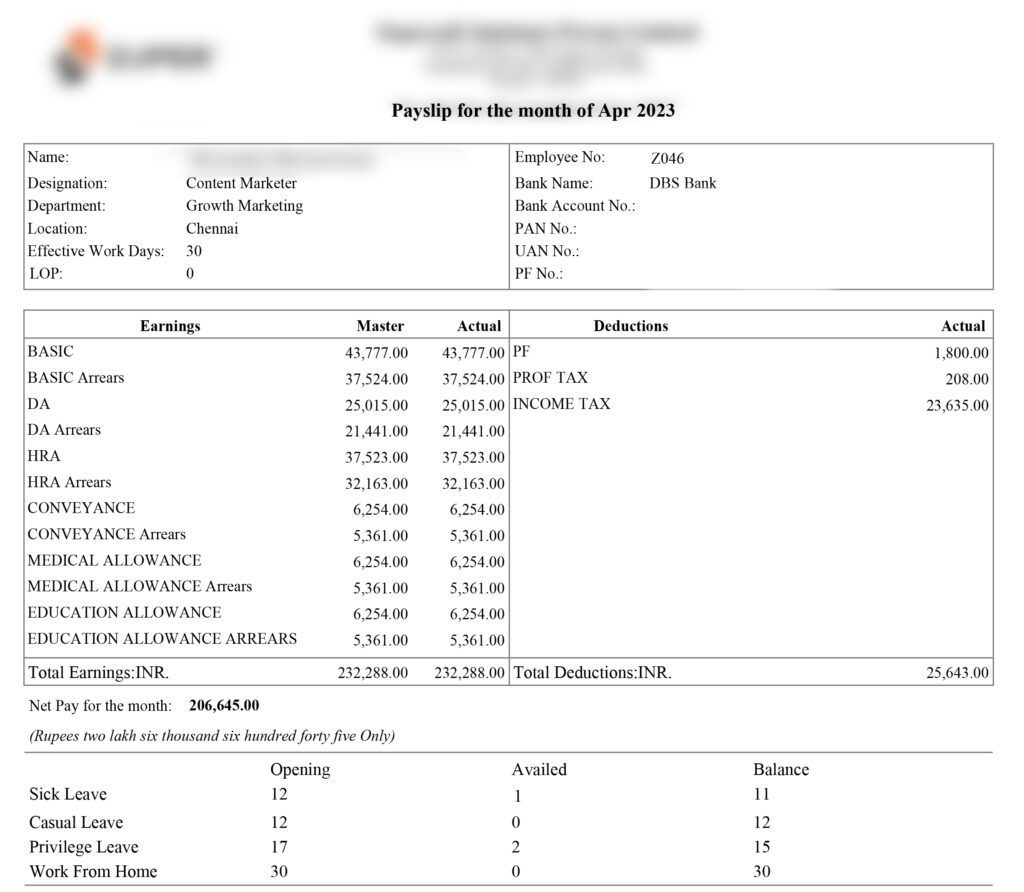
    Sample of a payslip
    Sample of a Payslip

    Inclusions Listed in a Payslip

    The above image is a sample payslip that will help us understand each component. Let’s look at the various components you’ll typically find on your payslip, through this sample.

    Understanding the components of a payslip is essential for employees to manage finances effectively. 

    1. Personal Information

    Your journey through the payslip begins with a brief introduction—a segment containing your personal details. As you can see in the top section of the image, that mentions the details of the employee. It includes your name, employee ID or code, address, and other identifiers. These details ensure that your hard-earned money reaches the right destination.

    2. Earnings

    Earnings constitute the backbone of your payslip. This section shows the diverse sources contributing to your total income for the pay period:

    Basic Salary

    The bedrock of your earnings, your basic salary forms the core of your compensation. It’s typically a fixed amount you receive consistently. In the sample, the basic salary is ₹43,777. It does not include any additional allowances or bonuses.

    Additionally, basic salary forms the basis for calculating various other components of an employee’s salary, such as provident fund contributions and gratuity.

    3. Allowances

    Your payslip may list various allowances, such as House Rent Allowance (HRA), Dearness Allowance (DA), Travel Allowance (TA), or Special Allowances. Furthermore, these add-ons enhance your overall income and can vary based on your employment terms.

    House Rent Allowance (HRA)

    HRA is an allowance provided to employees to help them cover the cost of renting accommodation or paying for their housing expenses. In the sample mentioned, the HRA is ₹ 37,523.

    HRA addresses the housing needs of employees. It is calculated as a percentage of the employee’s basic salary. It is partially or fully exempt from income tax, depending on the city and the actual rent paid by the employee.

    Dearness Allowance (DA)

    DA is an allowance provided to employees to counter the effects of inflation. It aims to ensure that employees can maintain their purchasing power. The DA in the payslip sample is ₹ 25,015.

    DA is typically applicable to government employees and some public sector workers. It is usually periodically revised to keep pace with the cost of living changes.

    Medical Allowance (MA)

    MA is an allowance provided to cover medical expenses incurred by the employee and their family members. As mentioned above in the sample, the MA is ₹6,254. Evidently, MA helps employees meet medical costs, such as doctor’s fees, medicines, and hospitalization expenses. The amount may vary depending on the employer’s policy.

    Conveyance Allowance (CA)

    CA is an allowance provided to cover commuting expenses incurred by the employee when traveling to and from work. As mentioned above in the sample, Conveyance Allowance is also ₹6,254.

    CA helps employees offset the cost of daily transportation to work. It is often a fixed amount or based on the actual distance traveled.

    Special Allowance (SA)

    SA is an allowance that employers provide to employees for specific purposes or as a flexible component that can be used for various purposes.

    SA is more flexible compared to other allowances, and employees can use it for different needs. It is often paid as a part of the salary to account for any miscellaneous expenses.

    4. Bonuses

    Ah, the pleasant surprises! Bonuses represent additional payments, often linked to performance, company policies, or special occasions. They inject an element of unpredictability into your payslip.

    5. Overtime

    If you’ve dedicated extra hours to your work during the pay period, your overtime earnings are mentioned here. It’s a tangible reward for your additional effort.

    6. Incentives

    If your job includes targets or performance-based rewards, these incentives are listed in this section.

    7. Other Benefits

    This category encompasses a wide array of perks and benefits. Such as food coupons, medical allowances, mobile phone reimbursements, or any other supplementary payments that enhance your overall earnings.

    8. In-hand Salary

    In-hand salary is the amount that an employee receives after deductions. It is the amount that remains after subtracting taxes and other deductions from the gross salary.

    In-hand salary is what an employee takes home and can spend or save. It reflects the actual cash that an employee receives in their bank account.

    In the sample mentioned, in-hand salary is mentioned as the “net pay for the month” and amounts to a total of ₹ 2,06,645.

    9. Cost to Company (CTC)

    CTC represents the total compensation an employer is willing to spend on an employee annually, including all components of the salary, benefits, and bonuses.

    CTC is gives employees an understanding of the overall value of their compensation package. It doesn’t include just the basic salary and allowances. It also included other benefits like provident fund contributions, bonuses, and any other perks.

    Understanding the components of a payslip is essential for employees to manage their finances effectively and make informed decisions about their compensation. It also helps employers maintain transparency and ensure that employees receive a fair and competitive salary package.

    10. Deductions: The Necessary Subtractions

    Regrettably, not all your earnings are yours to keep. Deductions form the subtractive side of your payslip, accounting for various financial obligations. Common deductions include:

    Income Tax

    The formidable force of taxation makes an appearance here. It’s the portion of your income that the government claims, and the amount deducted is typically based on your income level and tax-saving investments. It is generally the highest of the deductions. As mentioned in the sample, it amounts to ₹23,635.

    Employee Provident Fund (EPF)

    The EPF deduction is a compulsory contribution to your retirement savings. Both you and your employer make contributions, and the deducted amount accumulates over time, securing your financial future. Under the regulations of EPF, 12 percent of your earnings are required to be contributed towards your provident fund. As mentioned in the sample as PF, it amounts to ₹1800.

    Professional Tax

    In certain states, professional tax is levied on salaried individuals. This state-specific deduction helps fund local governance. The amount as you can see in the sample is ₹208.

    Insurance Premiums

    Payments towards insurance policies, including health insurance, life insurance, or any other coverage that your employer provides, are accounted for here.

    Loan Repayments

    If you have any outstanding loans, such as car loans, home loans, or personal loan, the EMI deductions are mentioned here. This ensures transparent tracking of your debt repayments.

    Other Deduction

    This catch-all category includes various other miscellaneous deductions, such as contributions to social or charitable causes, union fees, or any unique financial obligations specific to your employment

    Why Is It Important to Understand Your Payslip?

    Knowing what’s on your payslip is not just about curiosity; it’s a practical and essential skill for several important reasons:

    1. Financial Awareness: Understanding your payslip gives you a clearer picture of how much you earn and how much the employer is deducting. This helps you make smarter financial choices.
    2. Better Budgeting: When you know your income and deductions, you can further plan your spending more effectively. This means you can budget for your future needs and avoid spending too much.
    3. Smart Tax Planning: Your payslip has info about how much tax you pay. When you understand it, while filing taxes you can find ways to pay less tax legally and save more money.
    4. Savings and Retirement: Part of your salary might go into a retirement fund. Knowing how this works helps you plan for a secure financial future.
    5. Managing Loans: If you’re paying off a loan, your payslip serves as a reminder of how much you deduct each time. This helps you keep track of what you owe and manage repayments well.
    6. Negotiating Salaries: When you understand your payslip, you’re better equipped to discuss your salary when looking for a raise or a new job. You’ll know exactly what you’re worth.
    7. Spotting Mistakes: Sometimes, payslips have errors. When you understand yours, you can quickly spot and fix these mistakes to make sure you’re paid correctly and get the benefits you deserve.

    In Conclusion

    Your payslip, often overlooked in the busy work routine, holds the key to your financial health. 

    It’s not just a piece of paper; it’s a reflection of your efforts and commitment. By examining and understanding the information on your payslip, you can make better financial decisions and take control of your finances. 

    So, when you receive your payslip next time, don’t just glance at it – take the time to understand the numbers, look at the deductions, and empower yourself with financial knowledge.

  • How to choose the perfect personal loan?

    How to choose the perfect personal loan?

    Personal loans have become a popular financial tool in India. Whether you need funds for a dream vacation, home renovation, or a medical emergency a personal loan can come to your rescue. A personal loan doesn’t HAVE to feel like a burden.

    Choosing the right personal loan is crucial to ensuring that you don’t end up in a stressful situation.

    In this guide of 9 steps, we will walk you through the process of selecting the perfect personal loan for your needs.

    We’ll cover everything from understanding personal loans to comparing interest rates and finding the best lender. So, let’s dive in!

    1. Understanding Personal Loans

    Before you start your journey to find the perfect personal loan, it’s essential to understand what a personal loan is and how it works.

    A personal loan is an unsecured loan, which means you don’t need to provide collateral like your house or car to get approved. You borrow a specific amount of money from a lender and agree to repay it, usually in fixed monthly installments, over a set period.

    Key points to keep in mind about personal loans:

    Interest Rates

    Personal loans typically have higher interest rates compared to loans on homes or vehicles, because they are unsecured. The interest rate you receive can significantly impact the overall cost of your loan.

    Loan Amount

    The loan amount you can qualify for depends on various factors, including your credit score, income, and the lender’s policies. It’s crucial to assess your financial needs and borrow only what you can comfortably repay.

    Loan Tenure

    Personal loans come with varying tenures, usually ranging from 1 to 5 years. Shorter tenures often result in higher monthly payments but lower overall interest costs.

    EMI (Equated Monthly Installments)

    EMIs are the fixed monthly payments you make towards repaying your personal loan. Make sure you can afford these payments within your monthly budget.

    Credit Score

    Your credit score plays a significant role in determining your eligibility for a personal loan and the interest rate you’ll be offered. Maintaining a good credit score is crucial to secure a favorable loan deal.

    2. Assessing Your Financial Needs

    The first step in choosing the perfect personal loan is understanding why you need it. Assess your financial needs and create a clear plan for how you’ll use the loan proceeds.

    Common reasons for taking a personal loan in India include:

    Debt Consolidation

    If you have multiple high-interest debts, like credit card balances or other loans, a personal loan can help consolidate them into a single, more manageable payment.

    Home Renovation

    Personal loans are often used to spruce up your living space, whether it’s a kitchen remodel, bathroom upgrade, or a fresh coat of paint.

    Medical Emergencies

    Unforeseen medical expenses can strain your finances. A personal loan can provide the necessary funds for medical treatment.

    Education Expenses

    Whether it’s for your child’s education or your own further studies, personal loans can cover tuition fees and related expenses.

    Travel

    Fulfill your wanderlust by financing your dream vacation with a personal loan.

    Wedding Expenses

    Weddings in India can be grand affairs. Personal loans can help cover the costs of ceremonies and celebrations.

    Once you’ve identified your reason for taking a personal loan and have a rough estimate of the required amount, it’s time to move on to the next step.

    3. Checking Your Eligibility

    Lenders in India have specific eligibility criteria that borrowers must meet to qualify for a personal loan. While these criteria can vary from one lender to another, some common factors include:

    Age

    You must be within the lender’s specified age range, usually between 21 and 65 years, to be eligible for a personal loan.

    Income: Lenders typically require a minimum level of income to ensure you can repay the loan. The income requirements vary among lenders.

    Credit Score

    A good credit score significantly improves your chances of approval and can help you secure a lower interest rate. A score above 750 is generally considered good.

    Employment Status

    Most lenders prefer borrowers who are salaried or self-employed individuals with a stable source of income.

    Employment History

    Lenders may ask for your employment history, including your current job tenure.

    Residential Stability

    Some lenders may consider your stability at your current residence.

    It’s crucial to check the eligibility criteria of different lenders (banks) and see where you fit in. Meeting these criteria is the first step toward securing a personal loan.

    4. Comparing Interest Rates

    Interest rates play a significant role in determining the cost of your personal loan. Here’s how you can compare interest rates effectively:

    Research Multiple Lenders

    Don’t settle for the first lender you come across. Explore multiple banks, non-banking financial companies (NBFCs), and online lending platforms to find the best deal.

    Check for Promotions

    Lenders often run promotions and offer special interest rates for a limited period. Keep an eye out for these deals.

    Consider Fixed vs. Floating Rates

    Personal loans can have fixed or floating interest rates. Fixed rates remain constant throughout the loan tenure, making it easier to budget. Floating rates can change with market conditions, potentially affecting your monthly payments.

    Compare APR

    The Annual Percentage Rate (APR) takes into account not only the interest rate but also other charges and fees. It provides a more accurate picture of the total cost of the loan.

    Negotiate

    If you have a good credit score and a strong financial profile, don’t hesitate to negotiate with lenders for a lower interest rate.

    5. Analyzing Fees and Charges

    Apart from interest rates, personal loans often come with various fees and charges. To choose the perfect personal loan, you must understand and consider these fees:

    Processing Fees

    Most lenders charge a processing fee, which is a one-time cost for processing your loan application. This fee typically ranges from 1% to 3% of the loan amount.

    Prepayment Charges

    Check if the lender imposes any penalties for repaying the loan before the end of the tenure. Some loans have prepayment charges, while others allow for full or partial prepayment without penalties.

    Late Payment Fees

    Understand the consequences of missing an EMI payment. Lenders may charge late payment fees, and it could negatively impact your credit score.

    Part-Payment Charges

    Some lenders may charge fees if you make partial payments towards your loan.

    Insurance Premiums

    Some lenders may offer optional loan insurance. Evaluate if it’s necessary based on your circumstances.

    6. Reading the Fine Print

    Before signing on the dotted line, carefully read the loan agreement and the terms and conditions provided by the lender. Pay attention to the following:

    Loan Repayment Schedule

    Understand the EMI schedule, including the date of the first EMI and the frequency of payments.

    Interest Calculation

    Verify how the lender calculates interest. It can be on a reducing balance or flat-rate basis.

    Foreclosure Terms

    If you plan to repay the loan before the tenure ends, check the foreclosure terms to avoid any surprises.

    EMI Bounce Charges

    Know the charges in case your EMI bounces due to insufficient funds in your account.

    Penalties

    Be aware of any additional penalties or charges mentioned in the agreement.

    Loan Disbursement Time

    Understand how long it will take for the loan amount to be disbursed after approval.

    7. Choosing the Right Lender

    Now that you’ve done your research and understand the key aspects of personal loans, it’s time to choose the right lender. Here are some factors to consider:

    Reputation

    Look for a lender with a good reputation for transparency and customer service. Read reviews and ask for recommendations from friends or family.

    Interest Rate

    Compare the interest rates and APRs from different lenders to find the most competitive offer.

    Loan Amount

    Ensure the lender can provide the amount you need to meet your financial requirements.

    Loan Tenure

    Choose a lender that offers loan tenures that align with your repayment capabilities.

    Customer Support

    Consider the accessibility and responsiveness of the lender’s customer support team.

    8. Applying for the Loan

    Once you’ve selected the lender, it’s time to complete the application process. Here’s what you need to do:

    Gather Required Documents

    Lenders typically require proof of identity, address, income, and bank statements. Ensure you have all the necessary documents ready.

    Fill Out the Application Form

    Complete the loan application form accurately, providing all the required information.

    Submit the Application

    Submit your application online or at the lender’s branch, depending on your preference.

    Verification Process

    The lender will verify your documents and assess your eligibility. This may take a few days.

    Loan Approval

    If your application is approved, you will receive a loan offer with the terms and conditions. Review it carefully before accepting.

    Loan Disbursement

    Once you accept the offer, the lender will disburse the loan amount to your bank account.

    9. Managing Your Personal Loan

    After securing the perfect personal loan, it’s essential to manage it wisely:

    Create a Repayment Plan

    Develop a repayment plan that fits your budget and ensures timely EMI payments.

    Avoid Missed Payments

    Missing EMI payments can negatively impact your credit score and result in additional charges. Set up reminders to stay on track.

    Consider Prepayment

    If you have extra funds, consider making partial prepayments to reduce the interest burden and pay off the loan sooner.

    Maintain Good Credit

    Continue to maintain a healthy credit score by managing your finances responsibly.

    Conclusion

    Choosing the perfect personal loan requires careful consideration of your financial needs, eligibility, interest rates, fees, and the reputation of the lender. By following the steps outlined in this guide, you’ll be well-equipped to make an informed decision and secure a personal loan that aligns with your goals and budget. Remember that responsible borrowing and timely repayments are the keys to a successful personal loan experience.

    Moreover, you don’t have to do it all by yourself. At Vittae, our loan managers will help do the research on your part to help you choose the best loan for yourself.

  • Banking Systems – Indian v/s American

    Banking Systems – Indian v/s American

    Introduction

    In today’s connected world, banks play a massive role in how money works in different countries. Think of them as the engines that drive a country’s money and economy. But these banks aren’t the same everywhere – take India and the United States, for example. Even though both want to help people and the economy by handling money, they do it in quite different ways.

    The banking sector plays a vital role in the economic development and stability of any country. With globalization and technological advancements, the banking systems of different nations have evolved differently. Each banking system reflects its own unique economic, cultural, and regulatory landscapes.

    In this blog, we will delve into and compare Indian and American banking systems, shedding light on their similarities, differences, strengths, and challenges.

    Historical Development

    The paths of Indian and American banking systems have developed differently.

    In India, modern banks started during British rule. At first, there were the Bank of Bengal (1806), Bank of Bombay (1840), and Bank of Madras (1843). They were known together as the Presidency Banks.

    In the United States, banking has a long history. Institutions like the Bank of North America (1781) and the First Bank of the United States (1791) played a big role in shaping the country’s money system.

    Regulatory Framework

    Both India and the United States have established regulatory bodies to oversee their banking systems. 

    Let’s understand the differences in the roles of the Reserve Bank of India (RBI) and the Federal Reserve System (the Fed). 

    Reserve Bank of India (RBI)

    The RBI is India’s central bank and plays a crucial role in regulating and supervising the country’s banking sector. Here’s how it operates:

    • Monetary Policy: The Reserve Bank of India (RBI) plays a crucial role in shaping and executing monetary policy. This involves regulating the flow of money, managing interest rates, and ensuring access to credit within the economy. The RBI undertakes these measures to effectively handle inflation, foster economic growth, and uphold overall stability.
    • Currency Issuance: The RBI is responsible for issuing and managing the Indian currency (rupee). It makes sure there’s enough money in the form of notes and coins for people to use
    • Banking Regulation: The RBI makes rules for banks and financial companies in India. It gives permission for new banks to start, watches how they work, and fixes things if they’re not doing well financially, to keep them strong and stable.
    • Financial Stability: The RBI monitors the financial system to identify and address risks that could destabilize the economy. It works to prevent banking crises and maintain confidence in the financial sector.

    Federal Reserve System (Fed)

    The Federal Reserve, often referred to as the Fed, is the central banking system of the United States. Its functions are similar to those of the RBI:

    • Monetary Policy: The Fed plays a critical role in shaping the U.S. economy by influencing monetary policy. It sets interest rates and uses various tools to control the money supply, aiming to keep inflation in check and promote sustainable economic growth.
    • Currency Issuance: Just like the RBI, the Fed is responsible for issuing and regulating the U.S. currency. It ensures that there’s enough money in circulation to facilitate economic transactions.
    • Bank Supervision and Regulation: The Fed keeps an eye on banks to make sure they are secure and stable. It checks them regularly, makes sure they follow the rules, and fixes things if there’s a problem to stop any financial troubles.
    • Financial Stability: Similar to the RBI, the Fed also monitors the overall stability of the U.S. financial system. It identifies systemic risks, works to prevent financial crises, and responds swiftly if problems arise.

    Both the RBI and the Fed have the same goal: to keep things steady and help their economies grow in a healthy way. But they’re different because their economies are of different sizes and at different stages of development.

    To reach their goal, they have different ways and plans. They use various tools and strategies to achieve these goals, considering factors such as inflation, unemployment, economic growth, and financial sector health.

    Popular Differences b/w banking in India & America

    Online Banking and Apps

    • India: In India, the Unified Payments Interface (UPI) has revolutionized digital payments. UPI apps like Google Pay, PhonePe, and Paytm allow users to instantly transfer money, pay bills, and even make purchases at local shops using QR codes.
    • America: While online banking is prevalent in the US, the use of mobile apps for payments and transfers isn’t as integrated as UPI apps in India. Digital wallets like Apple Pay and Google Pay exist, but their usage might not be as widespread for everyday transactions. They have to use third-party apps like Venmo to make bank transactions. 

    Cheque Usage

    • India: Cheques are not commonly used in India for everyday transactions. The focus has shifted more towards digital payments and mobile wallets.
    • America: Cheques are still quite prevalent in the US, especially for bill payments, rent, and other transactions. Many people and businesses use checks as a reliable payment method.

    Credit and Debit Cards

    • India: Credit cards and debit cards have become widely accepted in India, with a surge in card usage for online shopping, dining, and other transactions.
    • America: Credit and debit cards have been a standard payment method in the US for many years, and their usage is deeply ingrained in daily life.

    Branch Visits

    • India: In India, visiting a physical bank branch is still relatively common, especially for tasks like opening accounts or complex transactions.
    • America: Many banking activities in the US can be done online or through ATMs, reducing the need for frequent visits to physical branches.

    Account Types and Charges

    • India: Many Indian banks offer basic savings accounts with minimal charges to cater to a larger population. There are also specialized accounts for various demographics, like student accounts and senior citizen accounts.
    • America: Account types and fees in the US can vary widely between banks. While some banks offer fee-free accounts, others might have stricter fee structures or minimum balance requirements.

    Overdraft Protection

    • India: Overdraft protection is less common in India, and overdrawing an account can lead to penalties.
    • America: Many US banks offer overdraft protection, allowing transactions that exceed the available balance, often with associated fees.

    Interest Rates

    • India: Interest rates on savings accounts tend to be higher in India compared to the US.
    • America: Interest rates on savings accounts in the US are generally lower, but there are options for higher-yield savings accounts.

    These differences highlight different banking landscapes and financial behaviors between India and America.

    It’s also important to note that the banking sector is constantly evolving, and these differences might change over time.  

    Banking Structure

    The banking structures in India and the United States are fundamentally different. The American banking system is dominated by a mix of national banks, state-chartered banks, and credit unions. 

    Additionally, the U.S. has a significant presence of international banks due to its status as a global financial hub. 

    In India, the banking sector is categorized into scheduled commercial banks, cooperative banks, and regional rural banks. Public sector banks historically played a central role, but recent years have witnessed an influx of private sector banks, leading to increased competition and innovation.

    Services and Accessibility

    Both banking systems now work online and through phone apps, making things easier. But, there’s a difference in how easy it is to use these services in each country.

    • Banking Everywhere in the U.S.: In the U.S., you can find banks and ATMs all over, even in small towns. It’s easy for people in cities and rural places to get banking help.
    • Banking Challenges in India: In India, it’s a bit harder. Not everyone can easily access banking services, especially in faraway rural areas. The government is trying to change this with plans like Jan Dhan Yojana, which want to help more people have access to banking services.

    Technological Advancements

    The American banking system is known for quickly embracing new technologies. Things like mobile banking, online payments, and digital wallets are now a big part of how money moves in the U.S. They’re also using fancy things like artificial intelligence, data analysis, and blockchain technology.

    India is catching up with technology, but it’s not all easy. Some things like good internet and reliable systems are a challenge. However, they did something amazing called the Unified Payments Interface (UPI). This changed how people use tech to pay in India and made it much better.

    Loan and Credit Culture

    In the U.S., loans and credit work differently. They have a system that gives people and businesses credit scores. This helps eligible folks get loans easily. But in 2008, with people not being able to pay their home loans, there was a mortgage crisis.

    But in India, things are a bit different. We’ve always been careful about giving out loans. We usually need collateral to make sure people pay back the loan. Now, small money lending groups in India are helping out a lot. They’re giving credit to people who don’t usually get it from regular banks.

    Risk Management and Regulation

    The global financial crisis in 2008 led to important rule changes in many countries. In the U.S., they made the Dodd-Frank Wall Street Reform and Consumer Protection Act. This was done to make the financial system stronger and to protect people.

    In India, the Reserve Bank introduced something called Basel III norms. This made banks have more money saved and manage risks better. While both countries tried to make their rules stronger, they’re still figuring out how to handle risks that could affect big banks that are connected to many things.

    Customer Protection and Financial Literacy

    Customer protection and financial literacy are important aspects of any banking system. In the United States, regulatory bodies enforce consumer protection laws, and financial literacy initiatives are widespread. 

    India has also taken steps to enhance customer protection, with RBI implementing guidelines to address issues like unauthorized transactions and electronic fraud. Financial literacy programs like Pradhan Mantri Jan Dhan Yojana have aimed to improve financial awareness among

    In Conclusion

    The banking systems in India and America have taken shape under the influence of their distinctive historical, economic, and regulatory backgrounds. These differences offer us glimpses into the potential trajectories of banking evolution.

    In the area of technological advancement, the American banking system has set global benchmarks. Meanwhile, India’s banking system is engaged in a dynamic journey, striving to overcome hurdles related to both financial inclusion and the integration of technology.

    Despite their unique paths, both systems are united by shared aspirations of ensuring stability, fostering growth, and safeguarding customer interests.

    As they continue to progress, it’s highly likely that they will draw inspiration from each other’s successes, all while collaboratively addressing the challenges they individually face.

  • What are ETFs and How Do They Work?

    What are ETFs and How Do They Work?

    In the evolving landscape of investment opportunities, Exchange-Traded Funds (ETFs) have gained significant popularity among beginner and experienced investors. 

    ETFs offer a versatile and accessible way to diversify one’s portfolio while also providing exposure to various asset classes. 

    In this blog, we will delve into the world of ETFs, exploring what they are, how they work, their tax implications, and their benefits and potential risks.

    What are ETFs?

    ETFs are a special way to invest money that combines the goodness of mutual funds and equity. 

    They’re like a mix of mutual funds (spread your money out) and stocks easy to buy and sell).

    Imagine an ETF as a group of investments, like different types of money-making tools, such as owning a part of a company (stock) or lending money to a company (bond). When you put your money into an ETF, you’re actually investing in a bunch of these tools at the same time. 

    ETFs usually charge you less money for this compared to other similar ways of investing. Also, it’s easy to turn your ETF investments back into money whenever you want because they’re traded on the market.

    However, not all ETFs are perfect for everyone. You need to think about some important stuff before choosing one, like:

    1. How much they charge you to manage your money
    2. How easy it is to buy or sell them
    3. How well they fit with your other investments
    4. How good the investments they include are
      So, consider these things before jumping in!

    Unlike traditional mutual funds, which are typically priced at the end of each trading day, ETFs are traded throughout the day at market prices. 

    This real-time trading feature offers investors greater flexibility in executing buy and sell orders, allowing them to react promptly to market movements.

    Types of ETFs

    ETFs come in various types, catering to different investment preferences and strategies. Here are some common types of Exchange-Traded Funds:

    Equity ETFs

    These are like baskets of stocks. They let you own a small piece of many different companies. For example, if you buy an equity ETF, you’re getting a little bit of various Indian companies all at once. This helps spread out the risk.

    Gold ETFs

    These are a way to invest in gold without needing to buy physical gold. When you buy a gold ETF, you’re actually investing in the price of gold. It’s a convenient way to benefit from gold’s value changes.

    Sector ETFs

    Imagine the economy is like a big puzzle, and different sectors are like different pieces of that puzzle. Sector ETFs let you focus on specific parts of the economy, like technology, banking, or energy. You’re investing in companies that belong to a particular sector.

    Index ETFs

    Think of this as a copycat investment. Index ETFs track a particular index, which is like a list of the best-performing companies or assets. When you buy an index ETF, you’re copying the performance of that index.

    Debt ETFs

    These are like investing in loans. Debt ETFs invest in bonds, which are like IOUs issued by the government or companies. When you buy a debt ETF, you’re lending money, and they pay you back with interest over time.

    International ETFs

    Just like you can travel abroad, your money can travel too! International ETFs let you invest in companies from other countries. So, you can be a part-owner of foreign businesses.

    Commodity ETFs

    These are like investing in things we use every day, like oil, metals, or agricultural products. When you buy a commodity ETF, you’re investing in the prices of these everyday goods.

    Leveraged and Inverse ETFs

    These are a bit tricky. Leverage means making your investment more powerful, like using a magnifying glass. Inverse means doing the opposite, like looking in a mirror. Leveraged ETFs try to double or triple the gains or losses of an index. Inverse ETFs aim to make money when the index goes down. These can be riskier, so be careful.

    Multi-Asset ETFs

    Just like a buffet offers different types of food, multi-asset ETFs give you a mix of different investments in one package. It’s like getting stocks, bonds, and maybe other things all in one place.

    Remember, each type of ETF has its own pros and cons, and they suit different goals and situations. It’s like choosing different flavors of ice cream – some might be more suitable for you depending on what you like and what you’re looking to achieve with your investments. Always take time to understand what you’re investing in before you dive in!

    How Do ETFs Work?

    ETFs operate based on a unique structure that allows them to offer the benefits of both stocks and mutual funds. Let’s break down the mechanics of how ETFs work.

    Creation and Redemption

    To create or redeem ETF shares, you need an authorized participant, who is typically a large financial institution. 

    When you wish to create an ETF, the authorized participant will put together a bunch of securities that the ETF will be based on (to match a certain index). 

    The authorized participant then exchanges these securities with the ETF provider for a block of ETF shares. 

    If you want to redeem the ETF shares, they’ll exchange the shares back with the securities

    Arbitrage

    The creation and redemption mechanism of ETFs helps keep their market prices in line with their Net Asset Value (NAV), which represents the value of the underlying assets. 

    If the ETF’s market price deviates from its NAV, arbitrage opportunities arise. Institutional investors, including authorized participants, can exploit these opportunities by buying undervalued ETF shares or selling overvalued ones until the prices align.

    Market Trading

    Once created, ETF shares trade on stock exchanges just like individual stocks. Investors can buy and sell ETF shares throughout the trading day at prevailing market prices. This flexibility allows investors to react to market movements promptly.

    Transparency

    ETFs provide transparency in terms of their holdings. Most ETFs disclose their holdings daily, enabling investors to know exactly what assets they are invested in. This transparency is beneficial for investors seeking to understand the composition of their portfolios.

    As with any investment vehicle, ETFs come with their own set of advantages and disadvantages. Let’s explore these:

    Benefits of ETFs

    • Diversification: ETFs offer instant diversification by providing exposure to a wide range of securities within a single investment.
    • Liquidity: ETFs are traded on stock exchanges throughout the trading day, offering high liquidity and the ability to enter or exit positions quickly.
    • Lower Costs: ETFs generally have lower expense ratios compared to traditional mutual funds, which can lead to lower overall costs for investors.
    • Transparency: ETFs disclose their holdings daily, allowing investors to know exactly what assets they own.
    • Tax Efficiency: The unique structure of ETFs contributes to their tax efficiency, potentially reducing the tax burden for investors.
    • Flexibility: Investors can use ETFs for various investment strategies, such as long-term investing, trading, or hedging.

    Potential Risks of ETFs

    • Trading Costs: Though ETFs have lower expense ratios, investors may incur trading costs. Costs such as brokerage commissions when buying and selling ETF shares are common trading costs.
    • Tracking Error: Due to factors like expenses and market volatility, an ETF’s performance may slightly deviate from the performance of its underlying index.
    • Complexity: Some ETFs, particularly leveraged and inverse ETFs, can be complex and carry higher risks. Investors need to thoroughly understand these products before investing in them.
    • Market Fluctuations: Like all investments, ETF prices are subject to market fluctuations, which can lead to potential losses for investors.
    • Limited Control: While ETFs provide exposure to a diversified portfolio, investors have limited control over the selection of individual securities within the ETF.
    • Tax Implications: While ETFs offer tax advantages, investors should still be aware of the potential tax consequences, especially if they are in higher tax brackets.

    In Conclusion

    Exchange-Traded Funds (ETFs) have transformed the investment landscape by offering an accessible and efficient way for investors to gain exposure to various asset classes and market segments.

    These investment vehicles combine the benefits of stocks and mutual funds, providing diversification, flexibility, and potential tax advantages. 

    ETFs provide options for both beginners entering the market and experienced investors adjusting their portfolios. They offer a range of options to match your investment goals and risk tolerance.

    As with any investment, it’s essential to conduct thorough research before you invest in ETFs. Remember to understand the specific ETF’s objectives and holdings, and consider consulting with a financial expert like Vittae before making investment decisions.

    By doing so, you can harness the power of ETFs to enhance your investment strategy and work toward your financial goals.

  • How to manage debt effectively

    How to manage debt effectively

    In today’s fast-paced world, managing debt has become an essential skill for financial stability and freedom. 

    Whether it’s student loans, credit card debt, or personal loans, many people find themselves juggling multiple forms of debt simultaneously. 

    However, the key to a healthy financial future lies in managing these debts effectively. 

    In this comprehensive guide, we will explore strategies, tips, and actionable steps to help you take control of your debts and pave the way to a brighter financial future.

    So, let’s dive in and learn how to master the art of handling debt like a pro!

    Understanding Debt

    Before we start diving into the smart ways to handle your debts, it’s really important to get a clear picture of what debt actually is and the different types you might come across.

    Secured Debt

    This type of debt is like a promise you make with something valuable you own. It’s like when you buy a house or a car, and you take a loan to help pay for it. 

    If you’re not able to keep up with your payments, the lender has the right to take away the house. This makes the lender feel safer about lending you the money.

    For example, let’s say you take a loan to buy a car. The car itself becomes the ‘collateral’. If you can’t pay back the loan, the lender could take the car back.

    Unsecured Debt

    This kind of debt isn’t connected to anything valuable you own. It’s more based on how trustworthy you are with money. 

    When you get a credit card or a personal loan, there’s no specific thing the lender can take away from you if you can’t pay. They’re lending you money based on your history of handling money responsibly (credit score).

    Imagine you get a credit card. Since it’s unsecured debt, the credit card company can’t just take something from you if you don’t pay your bill. They might report your late payments to credit agencies, which can affect your credit score.

    Good Debt vs. Bad Debt

    Not all debts are created equal! Some can actually be pretty helpful, while others are not so great.

    Good debt is like a wise investment in your future. 

    For example, taking out a loan to buy a house can be good debt because the value of the house might increase over time. 

    Similarly, borrowing money for education (like student loans) can help you get a better job in the long run.

    On the other hand, bad debt is when you borrow money for things that lose value quickly or aren’t necessary. 

    High-interest credit card debt is a classic example. If you use a credit card to buy something that’s not essential, and you can’t pay off the balance quickly. This means you could end up owing a lot more than you initially spent due to high-interest rates.

    Having a handle on these concepts will set the stage for you to become a debt management pro!

    Building a Solid Foundation

    1. Create a Detailed Overview

    Start by creating a comprehensive list of all your debts, including the interest rates, minimum payments, and due dates. This overview will give you a clear picture of your financial obligations.

    2. Assess Your Financial Situation

    Calculate your monthly income and expenses. Understanding your cash flow will help you determine how much you can allocate toward debt repayment.

    3. Set Realistic Goals

    Define clear goals for debt repayment. Whether it’s paying off a specific debt within a certain time frame or reducing overall debt by a certain percentage, having goals will keep you motivated.

    Prioritizing Debt Repayment

    The following are three tested and trusted methods to pay off debts. 

    The Debt Snowball Method:

    Imagine you have different debts, like credit card balances or loans. With the Debt Snowball method, you start by focusing on the smallest debt you owe. 

    You make sure to pay the minimum required amount on all your debts, but you put extra money towards that smallest debt. 

    This helps you pay it off faster. Once you’re done with that smallest debt, you take the money you were using to pay it off and add it to the minimum payment you’re already making on the next smallest debt. 

    This creates a “snowball” effect, where the amount you’re putting towards your debts gets bigger and bigger as you pay off each one. 

    This method can make you feel good because you’re seeing results relatively quickly, even if the debts you’re paying off have lower interest rates.

    The Debt Avalanche Method

    Picture your debts again, but this time you’re looking at the interest rates they have. With the Debt Avalanche method, you start by targeting the debt with the highest interest rate. 

    You still make the minimum payments on your other debts, but you put any extra money towards the high-interest debt. 

    Once that high-interest debt is cleared, you move on to the next highest-interest debt. 

    This approach saves you more money in the long run because you’re getting rid of the debts that cost you the most in interest. It might take a bit longer to pay off the first debt, but you’ll end up paying less overall.

    Hybrid Approach

    Hybrid Approach combines the best of both worlds. You begin with the Debt Snowball method. 

    This helps you see progress sooner and builds your confidence as you knock out smaller debts. 

    Once you’ve cleared a few of the smaller debts and you’re feeling motivated, you switch over to the Debt Avalanche method. 

    This way, you’re attacking the high-interest debts after you’ve gained some momentum. It’s like starting with a sprint and then settling into a steady pace for the long haul. 

    This approach helps you balance the emotional boost of quick wins with the financial benefit of saving on interest.

    Remember, whichever method you choose, the key is to stick to your plan and keep making consistent payments. Over time, your debts will shrink, and you’ll be on your way to achieving financial freedom!

    Negotiating with Creditors

    1. Contact Your Lenders

    If you’re facing financial hardship, don’t hesitate to reach out to your creditors. They might be willing to negotiate lower interest rates, extended payment terms, or even a settlement if your situation is dire.

    Reach out to creditors as soon as financial troubles arise to show your commitment to resolving the issue responsibly. Be transparent about the reasons for your difficulties, such as a job loss or medical expenses, to help creditors understand your challenges.

    2. Debt Consolidation

    Consider consolidating your debts into a single loan with a lower interest rate. This can simplify payments and potentially reduce your overall interest burden.

    Take stock of all debts, including credit cards, loans, and medical bills, to understand your total liability. Consolidation can secure a lower overall interest rate, reducing the cost of repayment.

    Make one monthly payment instead of juggling multiple due dates, minimizing the chance of missed payments.

    Budgeting for Debt Repayment

    Create a Detailed Budget

    Designing a comprehensive budget involves analyzing your income and expenses to allocate a specific portion towards debt repayment. 

    Prioritize essentials like housing, utilities, groceries, and transportation. Identify extra spending areas where you can cut back, such as dining out or entertainment. 

    By tracking your expenses diligently, you’ll gain better control over your finances and accelerate your debt repayment progress.

    Emergency Fund

    Establishing an emergency fund is a cornerstone of financial stability. Aim to save three to six months’ worth of living expenses. 

    This fund acts as a safety net during unexpected events like medical emergencies or job loss, preventing you from resorting to more debt. 

    Start small and gradually build up your emergency fund over time, ensuring you’re prepared for any financial curveballs.

    Increasing Your Income

    Side Hustles

    Explore diverse opportunities for earning extra income. Freelancing, consulting, or participating in the gig economy can supplement your main income stream. 

    Leverage your skills and interests to identify side gigs that align with your schedule and abilities.

    The additional earnings can make a significant difference in accelerating your debt payoff journey.

    Skill Development

    Investing in skill development can lead to higher earning potential. 

    Identify areas where you can enhance your expertise, whether through online courses, workshops, or certifications. 

    Developing valuable skills not only opens doors for higher-paying roles but also strengthens your financial resilience in the long run.

    Avoiding Debt Traps

    Credit Card Discipline

    While credit cards offer convenience, they can lead to debt traps if not managed wisely. Commit to paying your balance in full each month to avoid accumulating high-interest charges. Be mindful of your credit utilization ratio and only use credit for planned, manageable expenses. Remember to pay off your credit card debt on time.

    Living Within Your Means

    Practicing frugality is essential to avoid overspending. Distinguish between needs and wants; prioritize essential expenses and reduce discretionary spending.

    Consider adopting strategies like the 50/30/20 rule, allocating 50% to essentials, 30% to wants, and 20% to debt repayment and savings.

    Long-Term Financial Wellness

    Saving for the Future

    While debt repayment is crucial, don’t neglect saving for long-term goals. Allocate a portion of your budget to retirement accounts and other investment vehicles. 

    Compounding interest over time can significantly grow your savings, ensuring a comfortable future alongside debt freedom.

    Seek Professional Advice

    If you’re overwhelmed by debt, seeking professional guidance is a wise step. A financial advisor can provide personalized strategies tailored to your circumstances. 

    They can help you navigate complex financial situations, create a feasible debt repayment plan, and align your goals for both immediate relief and long-term financial stability.

    Celebrating Your Progress

    Don’t forget to celebrate your achievements along the way. Each debt paid off and each milestone reached is a step closer to financial freedom. Acknowledging your progress will keep you motivated and committed to your goals.

    In Conclusion

    Managing debt effectively requires dedication, discipline, and a clear plan of action. 

    By understanding your financial situation, setting goals, and implementing strategies like the debt snowball or avalanche methods, you can regain control over your finances. 

    Remember, managing debt is not just about paying off what you owe; it’s about creating a solid foundation for a more secure and prosperous future. 

    So, start today, and take the first step towards achieving your financial goals.

  • 8 steps to take to achieve Financial Freedom

    8 steps to take to achieve Financial Freedom

    Financial freedom is not a mere fantasy; it’s a concrete goal that requires careful planning, disciplined execution, and a steadfast commitment to your financial well-being.

    The ability to live life on your terms, without the constraints of money worries, is a goal shared by many. While the journey might seem daunting, achieving financial freedom is possible through a series of strategic steps.

    In this comprehensive guide, we will delve deep into each step, offering you a road-map to pave your way to financial independence.

    Step 1: Set Clear and Attainable Financial Goals

    Think of setting financial goals as planning a road trip. Just like you wouldn’t start driving without a destination in mind, you shouldn’t manage your money without clear goals.

    These goals are like stars on a map, showing you where you want to go. They help you focus your efforts and decide how to use your money wisely.

    Example: If your goal is to buy a home within five years and retire by 60, break it down. Set short-term goals like saving a specific amount each month for a down payment and long-term goals like contributing consistently to retirement accounts.

    Step 2: Create a Comprehensive Budget

    Think of a budget as your financial game plan. It’s not just a boring list of expenses; it’s a powerful tool that helps you take control of your money. Creating and sticking to a budget is like having a road map that guides your spending decisions, so you can stay on track to achieve your goals without stress.

    Example: Analyze your monthly expenses and identify areas where you can cut back.

    If you find that you’re spending too much on entertainment, allocate a fixed budget for it. Redirect the extra funds towards savings or debt reduction.

    Step 3: Establish an Emergency Fund

    Life can throw unexpected curveballs, like a sudden car breakdown or a medical emergency. This is where having an emergency fund becomes your financial superhero. An emergency fund acts like a safety cushion, protecting you from these unexpected expenses that could otherwise knock you off your financial track.

    Example: Imagine facing a sudden medical expense or car repair. Without an emergency fund, you might resort to high-interest credit cards.

    But with a well-funded emergency fund, you can handle such situations without affecting your financial stability.

    Step 4: Strategically Manage Your Debts

    Debt can act like a weight holding you back on your journey to financial freedom. That’s why it’s crucial to manage your debts smartly. This involves not only understanding the types of debts you have but also creating a plan to pay them off strategically. By tackling your debts in a structured way, you can make steady progress towards your goal of financial independence.

    Example: Imagine you have credit card debt, a student loan, and a car loan. One approach is the snowball method, where you start by paying off the smallest debt first.

    As you eliminate each debt, you gain a sense of accomplishment and motivation to tackle the next one. Alternatively, you can use the avalanche method, which involves prioritizing the debt with the highest interest rate.

    This reduces the overall interest you’ll pay over time. By using either method, you’re actively taking control of your debt and making tangible progress toward your financial freedom.

    Step 5: Diversify Your Income Streams

    Financial freedom doesn’t solely depend on saving money; it’s about increasing your income too. Exploring various ways to earn money can accelerate your journey to financial independence. This step is about opening doors to new opportunities that go beyond your regular paycheck.

    Example: Suppose you have a knack for crafting. You could turn this into a side hustle by selling your creations online. Similarly, if you’re passionate about photography, you could offer your services for events or stock photos.

    Additionally, consider investing in dividend-paying stocks. They provide a source of passive income, giving your finances an extra boost.

    Step 6: Invest Wisely for Long-Term Growth

    Investing is like planting seeds that grow into trees of wealth over time. Allocating a portion of your savings towards investments can significantly impact your financial journey. It’s not about getting rich quickly; it’s about allowing your money to work for you over the long haul.

    Example: Let’s say you’re interested in investing in stocks. Instead of picking individual stocks, consider investing in index funds or exchange-traded funds (ETFs).

    These options offer instant diversification across a range of companies, reducing the risk of putting all your eggs in one basket. Over time, the compounding effect can turn your initial investment into a substantial nest egg.

    Step 7: Continuous Learning and Self-Improvement

    The financial world is constantly evolving, so staying informed is crucial. Investing in your financial education is one of the most valuable steps you can take. The more you understand about managing money, investments, and economic trends, the better equipped you’ll be to make informed decisions that align with your financial goals.

    Example: Make it a habit to read financial books, follow reputable personal finance blogs, and attend seminars or webinars on relevant topics.

    You might even consider enrolling in an online course that teaches advanced financial strategies. This ongoing education will empower you to navigate the complexities of personal finance with confidence.

    Step 8: Regularly Review and Adjust Your Plan

    Financial plans are not set in stone; they need to be flexible to accommodate changes in your life. Regularly reviewing your financial situation and adjusting your plan accordingly ensures that you’re always on the right track.

    Example: As your life evolves, your financial goals might change. Perhaps you get a promotion, experience a major life event, or face unexpected challenges.

    By revisiting your goals, budget, and investments annually, you can make sure they’re aligned with your current circumstances. Adjusting your plan allows you to stay adaptable and continue making progress towards financial freedom, no matter what life throws your way.

    In Summary

    Think of achieving financial freedom as a steady journey, not a race. Every move you make builds the foundation for a more secure and independent life. As we wrap up, let’s review the key steps that will guide you towards this important goal.

    • Setting clear money goals is like making a map for your journey. It helps you know where you’re going and how to manage your resources effectively.
    • Creating and sticking to a budget might sound boring, but it’s like having a superpower. It helps you spend on what matters, so you’re in control of your money and stress-free.
    • Having money for emergencies is a smart move. It’s like having an umbrella for a rainy day. This fund protects you from unexpected expenses, so your financial plans stay on track.
    • Handling debts wisely means taking charge of your money story. Understanding what you owe, paying off what matters most, and avoiding high-interest traps give you control of your financial future.
    • Getting money from different places can speed up your journey to financial freedom. Whether it’s a side job, freelance work, or investments, having more than one way to earn can make a big difference.
    • Investing is like planting seeds that grow into money trees. Where you put your money matters. Choosing things like stocks or mutual funds can help your money grow faster over time.
    • Learning about money keeps you in the know. Being informed helps you make smart choices with your money, no matter how complicated things seem.
    • Being flexible and checking your plans regularly is a must. Just like a road trip, life’s journey has twists and turns. Adjusting your plans helps you stay on course no matter what comes your way.

    As you put these steps into action, remember that patience and commitment are key. 

    Challenges might pop up, but they’re chances to learn and get better. With each step, you’re breaking down the barriers that money worries can bring. 

    Your dream of more choices and a life free from money stress is getting closer. Keep following these steps, and you’ll build a strong foundation for a life that’s secure, satisfying, and truly free.

  • Evolution of Barbie: A Doll to a Mega-Movie Franchise

    Evolution of Barbie: A Doll to a Mega-Movie Franchise

    What started as a simple plastic figurine has evolved into a global phenomenon. A phenomenon that encompasses not only dolls of various shapes and backgrounds but also a vast array of merchandise, books, TV shows, and now, even mega-movie franchises. 

    Barbie, the iconic doll that has captured the hearts and imaginations of millions around the world, has come a long way since her inception in 1959. 

    This evolution is a testament to Barbie’s enduring cultural relevance and adaptability. 

    In this blog post, we will delve into the fascinating journey of Barbie’s evolution from a doll to a mega-movie franchise.

    The Birth of Barbie: A Cultural Icon Emerges


    Barbie was created on March 9, 1959, by Ruth Handler, one of the founders of Mattel Inc. She introduced the first Barbie doll at a big toy event in New York.

    Barbie looked similar to a German doll called Bild Lilli and became super popular because she was stylish and cool. But she was more than just a toy – she was different from the usual baby dolls. She showed a grown-up and independent image.

    As time went on, Barbie’s appearance changed a lot to match what people thought was beautiful. In the 1960s, she became slimmer and more athletic-looking to match the idea of being young and healthy.

    As years passed, Barbie started to show different jobs, cultures, and even historical characters. This made her relatable to more and more people from different backgrounds.

    Barbie’s Cultural Impact: Beyond the Doll

    As Barbie’s popularity grew, so did her influence on popular culture. In the 1980s, Barbie took on new roles as a rock star, an astronaut, and even a presidential candidate, challenging gender stereotypes and encouraging young girls to dream big.

    The Barbie doll was no longer just a toy; it became a symbol of empowerment and limitless possibilities for young girls.

    Barbie’s cultural impact extended beyond physical toys. The character became the center of books, animated films, and TV shows that aimed to teach important life lessons while entertaining children. “Barbie and the Rockers,” “Barbie: Life in the Dreamhouse,” are just a few examples of the multimedia empire that Mattel built around the beloved doll.

    The Economic Impact of Barbie Dolls

    Sales Figures

    Since her debut in 1959, Barbie has become one of the best-selling toys of all time. With over a billion dolls sold worldwide, Barbie has consistently generated substantial revenue for its parent company, Mattel Inc. As of September 2021, the annual sales were averaging around $1 billion globally.

    The secret behind Barbie’s financial prowess lies in her remarkable ability to stay relevant and captivating through different eras, effortlessly adapting to evolving tastes and preferences. This adaptability has been key to maintaining her exceptional sales performance over the decades.

    Product Line Diversification

    Barbie’s economic impact extends beyond the doll itself. The brand has expanded its product line to include accessories, clothing, playsets, and even video games, contributing significantly to its revenue stream.

    By venturing into these avenues, Barbie has allowed her fans to extend their connection with the brand beyond conventional play. This thoughtful expansion empowers enthusiasts to creatively dress up and accessorize them creating a deeper bond with Barbie universe.

    Licensing and Partnerships

    Barbie’s influence goes beyond the toy aisle. Through strategic licensing and partnerships, Barbie has collaborated with numerous companies to create a wide range of products, from apparel to home goods, further boosting her economic footprint.

    By partnering with well-established brands, Barbie’s economic prowess is further increased. By creating a connection between her iconic image and respected brand names the economic impact of Barbie is boosted.

    The Evolution of Barbie in the Digital Age

    In the 2000s, new things came up that Barbie needed to be a part of. As technology got better, Barbie also showed up on websites, apps, and video games. This was a fun way for kids to play with Barbie using computers and phones.

    These digital games were not just for fun – they also taught kids new things and helped them be more creative and smarter.

    At the same time, Barbie wanted to change how she looked and how people thought about her. People said Barbie’s looks were not realistic, so the company that makes her, Mattel, started making dolls that looked different. They had different body shapes, skin colors, and hair types.

    In 2016, Barbie did something important. They started a line of dolls called “Fashionista.” These dolls showed that Barbie wanted to include all kinds of beauty, not just one. This was a big change that showed Barbie was keeping up with how the world was changing.

    Barbie’s Leap to the Silver Screen: A New Frontier

    While Barbie had already conquered various forms of media, the leap to the silver screen was a monumental step. In 2020, Warner Bros. Pictures and Mattel announced a live-action Barbie film, starring Margot Robbie as both the lead actress and a producer. This announcement marked a new era for Barbie, transforming her from a plastic doll to a full-fledged movie star.

    The decision to cast Margot Robbie, a renowned actress, in the main role showcased Barbie’s aspiration to be more than just a children’s character.

    The film aimed to explore themes of identity and empowerment while appealing to a broader audience, including those who had grown up with Barbie. The movie was not just about capitalizing on nostalgia; it was an attempt to reinvent Barbie for a modern audience.

    In July 2023, the movie also actively competed with Christopher Nolan’s Oppenheimer and stood victorious at the box office. 

    How much money did Barbie Make? 

    Barbie has achieved an astonishing milestone by earning over $1 billion from ticket sales worldwide. This incredible success makes it the most successful movie ever directed by a woman. 

    The movie, which combines fantasy and comedy, has raked in an impressive $459 million from theaters in the United States and Canada. But its triumph doesn’t stop there, as it has also captured a staggering $572.1 million from international theaters. 

    This adds up to a jaw-dropping total of $1.0315 billion, as reported by Warner Bros. Pictures.

    When we look at recent box office history, only 53 movies have managed to cross the billion-dollar mark, and that’s not even considering inflation. 

    What’s truly remarkable is that Barbie now holds the record as the highest-grossing film ever directed by a woman. 

    It has outshone the previous record holder, Wonder Woman, which had a global total of $821.8 million. This is not just a triumph for Barbie, but a groundbreaking achievement for female directors in the world of cinema.

    In Conclusion 

    Barbie’s journey from a simple doll to a multimedia sensation, including her successful foray into cinema, showcases the economic brilliance of the brand’s evolution. 

    The combination of doll sales, diverse product offerings, and a thriving cinematic presence has solidified it’s status as not just a toy, but a cultural phenomenon with a lasting economic impact. 

    As Barbie continues to evolve and adapt, her economic journey remains an inspiring testament to the power of innovation and adaptation in the ever-changing world of entertainment and consumer goods.